第17章音
Additional Problems追加問題
Exercises 129–138練習問題 129–138
Exercise 129問題 129
A 0.80-m-long tube is opened at both ends. The air temperature is The air in the tube is oscillated using a speaker attached to a signal generator. What are the wavelengths and frequencies of first two modes of sound waves that resonate in the tube?
英語のヒント
長さ0.80 mの管の両端を開く。気温はである。信号発生器につないだスピーカーで管内の空気を振動させる。管内で共鳴する音波の最初の二つのモードの、波長と振動数はいくらか。
Solution解き方
;
Exercise 130問題 130
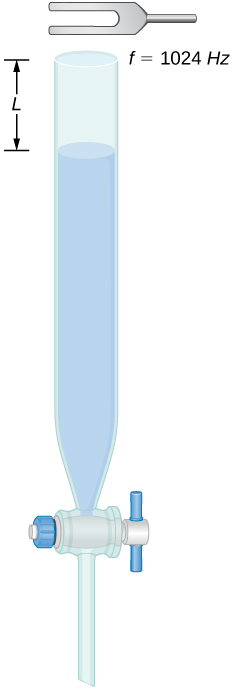
A tube filled with water has a valve at the bottom to allow the water to flow out of the tube. As the water is emptied from the tube, the length L of the air column changes. A 1024-Hz tuning fork is placed at the opening of the tube. Water is removed from the tube until the mode of a sound wave resonates. What is the length of the air column if the temperature of the air in the room is
英語のヒント
水で満たした管の底に、水を流し出すための弁がある。管から水を抜くと、気柱の長さLが変わる。開口部へ1024 Hzの音叉を置き、のモードの音波が共鳴するまで水を抜く。室内の気温がのとき、気柱の長さはいくらか。
Exercise 131問題 131
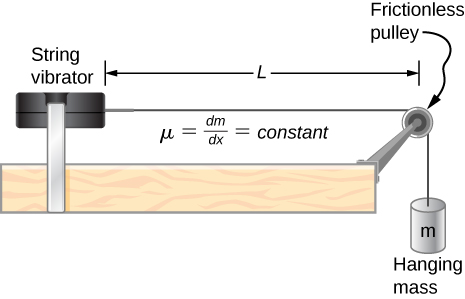
Consider the following figure. The length of the string between the string vibrator and the pulley is The linear density of the string is The string vibrator can oscillate at any frequency. The hanging mass is 2.00 kg. (a)What are the wavelength and frequency of mode? (b) The string oscillates the air around the string. What is the wavelength of the sound if the speed of the sound is ?
英語のヒント
次の図を考える。弦振動器と滑車の間の糸の長さは、線密度はである。振動器は任意の振動数で振動でき、つるした質量は2.00 kgである。(a) のモードの波長と振動数はいくらか。(b) 糸は周囲の空気を振動させる。音速のとき、音の波長はいくらか。
Solution解き方
a. ; b.
a. b.
Exercise 132問題 132
Early Doppler shift experiments were conducted using a band playing music on a train. A trumpet player on a moving railroad flatcar plays a 320-Hz note. The sound waves heard by a stationary observer on a train platform hears a frequency of 350 Hz. What is the flatcar’s speed in mph? The temperature of the air is .
英語のヒント
初期のドップラーシフトの実験では、列車上で演奏する楽団を使った。走行する鉄道の無蓋車でトランペット奏者が320 Hzを演奏すると、駅のホームに静止した観測者には350 Hzが聞こえる。無蓋車の速さは何mphか。気温はとする。
Exercise 133問題 133
Two cars move toward one another, both sounding their horns . Car A is moving at 65 mph and Car B is at 75 mph. What is the beat frequency heard by each driver? The air temperature is .
英語のヒント
2台の車が互いへ向かって進み、どちらも警笛を鳴らす。車Aは65 mph、車Bは75 mphで走る。それぞれの運転者に聞こえるうなりの振動数はいくらか。気温はである。
Solution解き方
Exercise 134問題 134
Student A runs after Student B. Student A carries a tuning fork ringing at 1024 Hz, and student B carries a tuning fork ringing at 1000 Hz. Student A is running at a speed of and Student B is running at What is the beat frequency heard by each student? The speed of sound is
英語のヒント
学生Aが学生Bを追って走る。Aは1024 Hz、Bは1000 Hzで鳴る音叉を持つ。Aの速さは、Bの速さはである。それぞれに聞こえるうなりの振動数はいくらか。音速はである。
Exercise 135問題 135
Suppose that the sound level from a source is 75 dB and then drops to 52 dB, with a frequency of 600 Hz. Determine the (a) initial and (b) final sound intensities and the (c) initial and (d) final sound wave amplitudes. The air temperature is and the air density is
英語のヒント
振動数600 Hzの音源の音のレベルが、75 dBから52 dBへ下がる。(a) 初めと(b) 終わりの音の強度、(c) 初めと(d) 終わりの音波の振幅を求めよ。気温は、空気密度はである。
Solution解き方
; a. ; b. ; c. ; d.
。a. b. c. d.
Exercise 136問題 136
The Doppler shift for a Doppler radar is found by , where is the frequency of the radar, f is the frequency observed by the radar, c is the speed of light, and v is the speed of the target. What is the beat frequency observed at the radar, assuming the speed of the target is much slower than the speed of light?
英語のヒント
ドップラーレーダーのドップラーシフトはで求める。ここではレーダーの振動数、fはレーダーが観測する振動数、cは光速、vは標的の速さである。標的が光速よりはるかに遅いとすると、レーダーが観測するうなりの振動数はいくらか。
Exercise 137問題 137
A stationary observer hears a frequency of 1000.00 Hz as a source approaches and a frequency of 850.00 Hz as a source departs. The source moves at a constant velocity of 75 mph. What is the temperature of the air?
英語のヒント
静止した観測者には、音源が近づくと1000.00 Hz、遠ざかると850.00 Hzが聞こえる。音源は一定の速度75 mphで動く。気温はいくらか。
Solution解き方
Exercise 138問題 138
A flute plays a note with a frequency of 600 Hz. The flute can be modeled as a pipe open at both ends, where the flute player changes the length with his finger positions. What is the length of the tube if this is the fundamental frequency?
英語のヒント
フルートが600 Hzの音を出す。フルートは両端が開いた管として表せ、奏者が指の位置によってその長さを変える。この音が基本振動数なら、管の長さはいくらか。
Challenge Problems発展問題
Exercises 139–147練習問題 139–147
Exercise 139問題 139
Two sound speakers are separated by a distance d, each sounding a frequency f. An observer stands at one speaker and walks in a straight line a distance x, perpendicular to the the two speakers, until he comes to the first maximum intensity of sound. The speed of sound is v. How far is he from the speaker? Assume the distance, d, between the slits is larger than the wavelength of the sound.
英語のヒント
二つのスピーカーが距離dだけ離れ、それぞれ振動数fの音を出す。観測者は一方のスピーカーの位置から、二つのスピーカーを結ぶ線に垂直な方向へ、初めて音の強度が極大になるまで距離xをまっすぐ歩く。音速はvである。観測者はスピーカーからどれだけ離れているか。スリット間の距離dは音の波長より大きいとする。
Solution解き方
Exercise 140問題 140
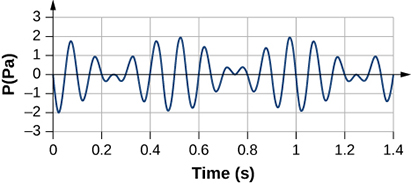
Consider the beats shown below. This is a graph of the gauge pressure versus time for the position The wave moves with a speed of (a) How many beats are there per second? (b) How many times does the wave oscillate per second? (c) Write a wave function for the gauge pressure as a function of time.
英語のヒント
下に示すうなりを考える。位置でのゲージ圧と時間のグラフである。波は速さで進む。(a) 1秒間にうなりは何回あるか。(b) 波は1秒間に何回振動するか。(c) ゲージ圧を時間の関数として表す波動関数を書け。
Exercise 141問題 141
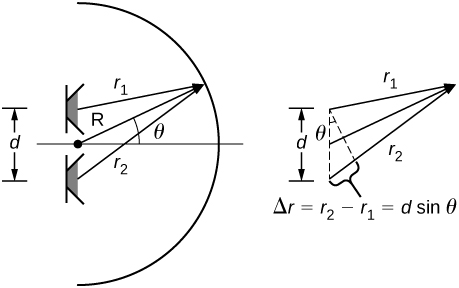
Two speakers producing the same frequency of sound are a distance of d apart. Consider an arc along a circle of radius R, centered at the midpoint of the speakers, as shown below. (a) At what angles will there be maxima? (b) At what angle will there be minima?
英語のヒント
同じ振動数の音を出す二つのスピーカーが、距離dだけ離れている。下図のように、両者の中点を中心とする半径Rの円の弧を考える。(a) どの角度で極大になるか。(b) どの角度で極小になるか。


Solution解き方
a. For maxima
b. For minima,
b. For minima,
英語のヒント
a. 極大の場合は。b. 極小の場合は。
Exercise 142問題 142
A string has a length of 1.5 m, a linear mass density , and a tension of 120 N. If the air temperature is what should the length of a pipe open at both ends for it to have the same frequency for the mode?
英語のヒント
糸の長さは1.5 m、線密度は、張力は120 Nである。気温のとき、両端が開いた管をのモードで同じ振動数にするには、管の長さをいくらにすればよいか。
Exercise 143問題 143
A string is fixed at both ends and is under a tension of 155 N. It oscillates in the mode and produces sound. A tuning fork is ringing nearby, producing a beat frequency of 23.76 Hz. (a) What is the frequency of the sound from the string? (b) What is the frequency of the tuning fork if the tuning fork frequency is lower? (c) What should be the tension of the string for the beat frequency to be zero?
英語のヒント
糸の両端を固定し、張力155 Nをかける。糸はのモードで振動して音を出す。近くで音叉を鳴らすと、23.76 Hzのうなりが生じる。(a) 糸が出す音の振動数はいくらか。(b) 音叉の振動数が低い場合、その値はいくらか。(c) うなりの振動数をゼロにするには、糸の張力をいくらにすればよいか。
Solution解き方
a. ; b. ; c.
a. b. c.
Exercise 144問題 144
A string has a linear mass density , a length L, and a tension of , and oscillates in a mode n at a frequency f. Find the ratio of for a small change in tension.
英語のヒント
線密度、長さL、張力の糸が、モードn、振動数fで振動する。張力を少し変えたときの比を求めよ。
Exercise 145問題 145
A string has a linear mass density a length a tension of and oscillates in a mode . (a) What is the frequency of the oscillations? (b) Use the result in the preceding problem to find the change in the frequency when the tension is increased by .
英語のヒント
線密度、長さ、張力の糸が、モードで振動する。(a) 振動数はいくらか。(b) 前の問題の結果を使い、張力を増したときの振動数の変化を求めよ。
Solution解き方
a. ; b.
a. b.
Exercise 146問題 146
A speaker powered by a signal generator is used to study resonance in a tube. The signal generator can be adjusted from a frequency of 1000 Hz to 1800 Hz. First, a 0.75-m-long tube, open at both ends, is studied. The temperature in the room is (a) Which normal modes of the pipe can be studied? What are the frequencies and wavelengths? Next a cap is place on one end of the 0.75-meter-long pipe. (b) Which normal modes of the pipe can be studied? What are the frequencies and wavelengths?
英語のヒント
信号発生器で駆動するスピーカーを使い、管の共鳴を調べる。発生器の振動数は1000〜1800 Hzに調節できる。まず、両端が開いた長さ0.75 mの管を調べる。室温はである。(a) どの固有モードを調べられるか。それぞれの振動数と波長はいくらか。次に、この0.75 mの管の一端にふたをする。(b) どの固有モードを調べられるか。それぞれの振動数と波長はいくらか。
Exercise 147問題 147
A string on the violin has a length of 23.00 cm and a mass of 0.900 grams. The tension in the string 850.00 N. The temperature in the room is The string is plucked and oscillates in the mode. (a) What is the speed of the wave on the string? (b) What is the wavelength of the sounding wave produced? (c) What is the frequency of the oscillating string? (d) What is the frequency of the sound produced? (e) What is the wavelength of the sound produced?
英語のヒント
バイオリンの弦の長さは23.00 cm、質量は0.900 g、張力は850.00 Nである。室温はである。弦をはじくとのモードで振動する。(a) 弦を伝わる波の速さはいくらか。(b) 生じる波の波長はいくらか。(c) 弦の振動数はいくらか。(d) 出る音の振動数はいくらか。(e) 出る音の波長はいくらか。
Solution解き方
a. ; b. ; c. ;
d. ; e.
d. ; e.
a. b. c. d. e.
bow wake
船首波
v-shaped disturbance created when the wave source moves faster than the wave propagation speed
英語のヒント
波源が波の伝播速度を超えて動くときにできる、V字形の乱れ
shock wave
衝撃波
wave front that is produced when a sound source moves faster than the speed of sound
英語のヒント
音源が音速を超えて動くときにできる波面
sonic boom
ソニックブーム
loud noise that occurs as a shock wave as it sweeps along the ground
英語のヒント
衝撃波が地上を通過するときに生じる大きな音