第17章音
17.5 Sources of Musical Sound17.5 楽音の発生源
Learning Objectives学習目標
Learning Objectives学習目標
By the end of this section, you will be able to:
英語のヒント
この節を終えると、次のことができるようになる。
- Describe the resonant frequencies in instruments that can be modeled as a tube with symmetrical boundary conditions
英語のヒント
対称な境界条件をもつ管としてモデル化できる楽器の共鳴振動数を説明する。 - Describe the resonant frequencies in instruments that can be modeled as a tube with anti-symmetrical boundary conditions
英語のヒント
反対称な境界条件をもつ管としてモデル化できる楽器の共鳴振動数を説明する。
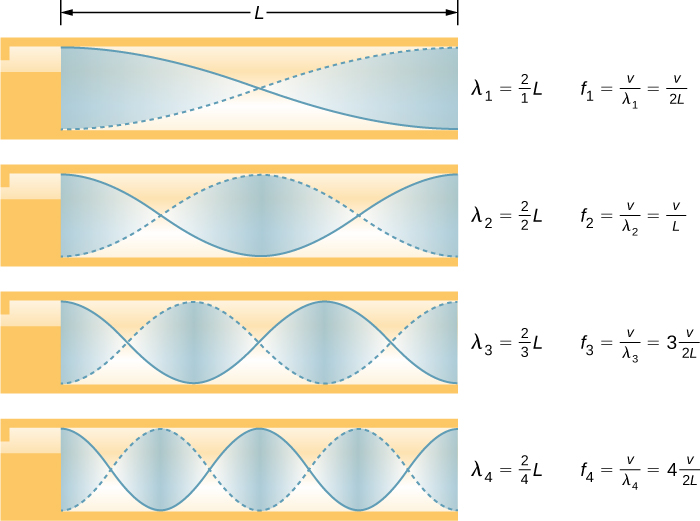
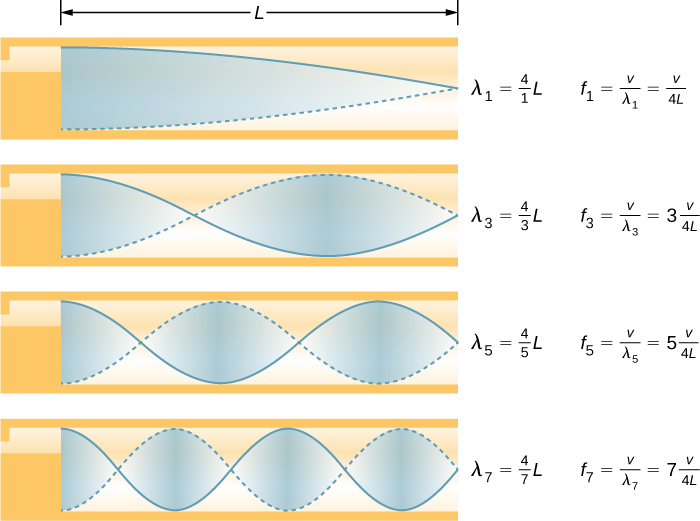
Some musical instruments, such as woodwinds, brass, and pipe organs, can be modeled as tubes with symmetrical boundary conditions, that is, either open at both ends or closed at both ends (Figure 17.24). Other instruments can be modeled as tubes with anti-symmetrical boundary conditions, such as a tube with one end open and the other end closed (Figure 17.25).
英語のヒント
OpenStax / Rice University, University Physics Volume 1, CC BY 4.0. Source-book artwork retained. · CC BY 4.0 · Source出典

Figure 17.24図 17.24
Some musical instruments can be modeled as a pipe open at both ends.
英語のヒント
一部の楽器は、両端が開いた管としてモデル化できる。
OpenStax / Rice University, University Physics Volume 1, CC BY 4.0. Source-book artwork retained. · CC BY 4.0 · Source出典

Figure 17.25図 17.25
Some musical instruments can be modeled as a pipe closed at one end.
英語のヒント
一部の楽器は、一端が閉じた管としてモデル化できる。
Resonant frequencies are produced by longitudinal waves that travel down the tubes and interfere with the reflected waves traveling in the opposite direction. A pipe organ is manufactured with various tubes of fixed lengths to produce different frequencies. The waves are the result of compressed air allowed to expand in the tubes. Even in open tubes, some reflection occurs due to the constraints of the sides of the tubes and the atmospheric pressure outside the open tube.
英語のヒント
管内を進む縦波が、逆向きに進む反射波と干渉することで、共鳴振動数が生じる。パイプオルガンには、異なる振動数を出すために、長さの異なる固定長の管が取り付けられている。管内で圧縮空気を膨張させると波が生じる。開いた管でも、管の側面による制約と開口部の外の大気圧によって、波の一部は反射する。
The antinodes do not occur at the opening of the tube, but rather depend on the radius of the tube. The waves do not fully expand until they are outside the open end of a tube, and for a thin-walled tube, an end correction should be added. This end correction is approximately 0.6 times the radius of the tube and should be added to the length of the tube.
英語のヒント
腹は管の開口部そのものには現れず、その位置は管の半径に依存する。波は管の開口端の外へ出て初めて十分に広がるため、管の壁が薄い場合には開口端補正を加える必要がある。この補正はおよそ管の半径の0.6倍であり、管の長さに加える。
Players of instruments such as the flute or oboe vary the length of the tube by opening and closing finger holes. On a trombone, you change the tube length by using a sliding tube. Bugles have a fixed length and can produce only a limited range of frequencies.
英語のヒント
フルートやオーボエなどの奏者は、指穴を開閉して管の長さを変える。トロンボーンでは、管を滑らせてその長さを変える。ビューグルは管長が固定されており、限られた範囲の振動数しか出せない。
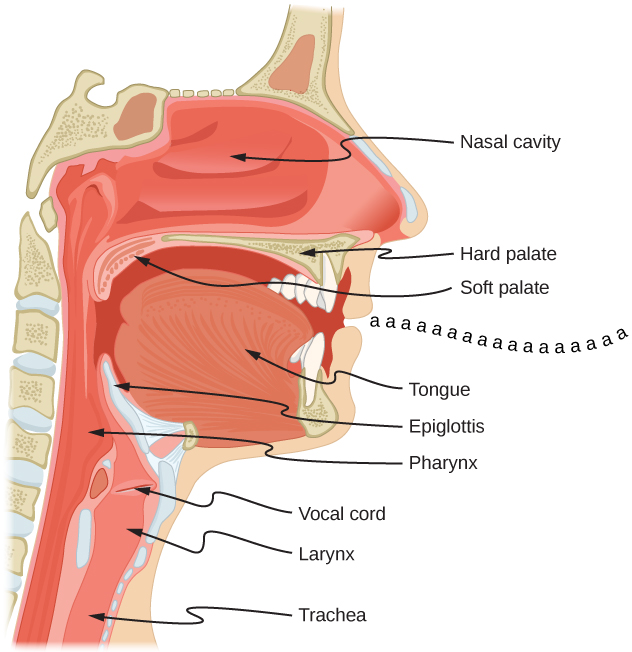
The fundamental and overtones can be present simultaneously in a variety of combinations. For example, middle C on a trumpet sounds distinctively different from middle C on a clarinet, although both instruments are modified versions of a tube closed at one end. The fundamental frequency is the same (and usually the most intense), but the overtones and their mix of intensities are different and subject to shading by the musician. This mix is what gives various musical instruments (and human voices) their distinctive characteristics, whether they have air columns, strings, sounding boxes, or drumheads. In fact, much of our speech is determined by shaping the cavity formed by the throat and mouth, and positioning the tongue to adjust the fundamental and combination of overtones. For example, simple resonant cavities can be made to resonate with the sound of the vowels (Figure 17.26). In boys at puberty, the larynx grows and the shape of the resonant cavity changes, giving rise to the difference in predominant frequencies in speech between men and women.
英語のヒント
基本音と倍音は、さまざまな組合せで同時に存在できる。たとえばトランペットとクラリネットは、どちらも一端を閉じた管を変形した楽器だが、中央のCを出しても明らかに違って聞こえる。基本振動数は同じで、通常その成分が最も強いが、倍音と各成分の強さの配分は異なり、奏者によって微妙な変化を付けられる。この組合せが、気柱、弦、共鳴箱、太鼓の膜のどれを使うかにかかわらず、楽器や人の声にそれぞれの特徴を与える。実際、話し声の多くは、喉と口が作る空洞の形を変え、舌の位置を動かして基本音と倍音の組合せを調節することで決まる。たとえば単純な共鳴空洞で、母音の音に共鳴させることができる(図17.26)。思春期の男子では喉頭が成長し、共鳴する空洞の形が変わる。その結果、話し声で優勢な周波数に男女の違いが生じる。
OpenStax / Rice University, University Physics Volume 1, CC BY 4.0. Source-book artwork retained. · CC BY 4.0 · Source出典

Figure 17.26図 17.26
The throat and mouth form an air column closed at one end that resonates in response to vibrations in the voice box. The spectrum of overtones and their intensities vary with mouth shaping and tongue position to form different sounds. The voice box can be replaced with a mechanical vibrator, and understandable speech is still possible. Variations in basic shapes make different voices recognizable.
英語のヒント
喉と口は、一端を閉じた気柱を作り、喉頭の振動に応じて共鳴する。口の形と舌の位置によって倍音のスペクトルと強さが変わり、異なる音が生まれる。喉頭を機械的振動器に置き換えても、理解できる話し声を作れる。基本的な形の違いにより、さまざまな声を聞き分けられる。
Example 17.6例題 17.6
Finding the Length of a Tube with a 128-Hz Fundamental基本振動数128 Hzの管の長さを求める
(a) What length should a tube closed at one end have on a day when the air temperature is
英語のヒント
(a) 空気の温度が次の値である日に、一端を閉じた管の長さをどれだけにすればよいか。
if its fundamental frequency is to be 128 Hz (C below middle C)?
英語のヒント
。基本振動数を128 Hz(中央のCより低いC)にするものとする。
(b) What is the frequency of its fourth overtone?
英語のヒント
(b) その第4倍音の振動数はいくらか。
Strategy方針
The length L can be found from the relationship , but we first need to find the speed of sound v.
英語のヒント
長さLは関係式から求められるが、まず音速vを求める必要がある。
Solution解答
- Identify knowns: The fundamental frequency is 128 Hz, and the air temperature is .
Use to find the fundamental frequency (),英語のヒント
既知量を確認する。基本振動数は128 Hz、気温はである。を使って、基本振動数()を求める。Solve this equation for length,英語のヒント
この式を長さについて解く。Find the speed of sound using ,英語のヒント
を使って音速を求める。Enter the values of the speed of sound and frequency into the expression for L.英語のヒント
音速と振動数の値をLの式に代入する。 - Identify knowns: The first overtone has , the second overtone has , the third overtone has , and the fourth overtone has .
Enter the value for the fourth overtone into英語のヒント
既知量を確認する。第1倍音は、第2倍音は、第3倍音は、第4倍音はである。第4倍音の値をに代入する。
Significance考察
Many wind instruments are modified tubes that have finger holes, valves, and other devices for changing the length of the resonating air column and hence, the frequency of the note played. Horns producing very low frequencies require tubes so long that they are coiled into loops. An example is the tuba. Whether an overtone occurs in a simple tube or a musical instrument depends on how it is stimulated to vibrate and the details of its shape. The trombone, for example, does not produce its fundamental frequency and only makes overtones.
英語のヒント
多くの管楽器は、共鳴する気柱の長さ、したがって鳴る音の振動数を変えるための指穴、バルブなどを備えた、形を変えた管である。非常に低い振動数を出すホルン類には、輪に巻かなければならないほど長い管が必要になる。チューバがその例である。単純な管や楽器でどの倍音が生じるかは、どのように振動を励起するかと、形状の細部に依存する。たとえばトロンボーンでは、基本振動数の音は出ず、倍音だけが生じる。
If you have two tubes with the same fundamental frequency, but one is open at both ends and the other is closed at one end, they would sound different when played because they have different overtones. Middle C, for example, would sound richer played on an open tube, because it has even multiples of the fundamental as well as odd. A closed tube has only odd multiples.
英語のヒント
基本振動数が同じ二つの管で、一方が両端開放、他方が一端閉鎖なら、倍音が異なるため、鳴らした音は違って聞こえる。たとえば開管の中央のCは、基本振動数の奇数倍に加えて偶数倍の成分も含むため、より豊かな音になる。閉管には奇数倍の成分しかない。