第6章多項式
Simplify Expressions with Integer Exponents整数の指数を含む式を簡単にする
All of the exponent properties we developed earlier in the chapter with whole number exponents apply to integer exponents, too. We restate them here for reference.
英語のヒント
この章で非負整数の指数について導いたすべての指数法則は、整数の指数にも適用できる。参照用に、もう一度まとめて示す。
Example 6.96例題 6.96
Simplify: ⓐ ⓑ ⓒ
英語のヒント
簡単にせよ。ⓐ ⓑ ⓒ
Solution解答
ⓐ
Use the Product Property, 同じ底の累乗の積の性質を使う。 |
|
Simplify. 簡単にする。 |
ⓑ
Notice the same bases, so add the exponents. 底が同じなので、指数を足す。 |
|
Simplify. 簡単にする。 |
|
Use the definition of a negative exponent, 負の指数の定義を使う。 |
ⓒ
Add the exponents, since the bases are the same. 底が同じなので、指数を足す。 |
|
Simplify. 簡単にする。 |
|
Take the reciprocal and change the sign of the exponent, using the definition of a negative exponent. 負の指数の定義を使い、逆数を取って指数の符号を変える。 |
Try It (2)確認問題(2題)
In the next two examples, we’ll start by using the Commutative Property to group the same variables together. This makes it easier to identify the like bases before using the Product Property.
英語のヒント
次の二つの例では、最初に交換法則を使って同じ変数をまとめる。そうすると、積の法則を使う前に、同じ底を見分けやすくなる。
Example 6.97例題 6.97
Simplify:
英語のヒント
次の式を簡単にする:
Solution解答
Use the Commutative Property to get like bases together. 交換法則を使い、同じ底どうしをまとめる。 |
|
Add the exponents for each base. それぞれの底について、指数を足す。 |
|
Take reciprocals and change the signs of the exponents. 逆数にして、指数の符号を変える。 |
|
Simplify. 簡単にする。 |
Try It (3)確認問題(3題)
In the next two examples, we’ll use the Power Property and the Product to a Power Property.
英語のヒント
次の2つの例では、累乗の累乗の性質と積の累乗の性質を使う。
Example 6.98例題 6.98
Simplify:
英語のヒント
次の式を簡単にする:
Solution解答
Use the Product to a Power Property, 積の累乗の性質を使う。 |
|
Use the Power Property, 累乗の累乗の性質を使う。 |
|
Use the Definition of a Negative Exponent, 負の指数の定義を使う。 |
|
Simplify. 簡単にする。 |
Try It (2)確認問題(2題)
Example 6.99例題 6.99
Simplify:
英語のヒント
次の式を簡単にする:
Solution解答
Solution解答
Use the Product to a Power Property, 積の累乗の性質を使う。 |
|
Simplify 52 and multiply the exponents of x using the Power Property, 52を簡単にし、累乗の累乗の法則を使ってxの指数を掛ける。 |
|
Rewrite x−6 by using the Definition of a Negative Exponent, 負の指数の定義を使って、x−6を書き換える。 |
|
Simplify. 簡単にする。 |
Try It (2)確認問題(2題)
To simplify a fraction, we use the Quotient Property and subtract the exponents.
英語のヒント
分数を簡単にするには、商の法則を使って指数を引く。
Example 6.100例題 6.100
Simplify:
英語のヒント
次の式を簡単にする:
Solution解答
Use the Quotient Property, 商の法則を使う。 |
|
Simplify. 簡単にする。 |
Try It (2)確認問題(2題)
Convert from Decimal Notation to Scientific Notation通常の小数表記から科学的記数法に直す
Remember working with place value for whole numbers and decimals? Our number system is based on powers of 10. We use tens, hundreds, thousands, and so on. Our decimal numbers are also based on powers of tens—tenths, hundredths, thousandths, and so on. Consider the numbers 4,000 and . We know that 4,000 means and 0.004 means .
英語のヒント
非負整数や小数の位取りを学んだことを覚えているだろうか。私たちの数の表し方は、10の累乗を基礎としている。十、百、千などを使う。小数も、十分の一、百分の一、千分の一など、10の累乗に基づいている。4,000とを考えよう。4,000は、0.004はを意味する。
If we write the 1000 as a power of ten in exponential form, we can rewrite these numbers in this way:
英語のヒント
1,000を10の累乗として表すと、これらの数は次のように書き換えられる。
When a number is written as a product of two numbers, where the first factor is a number greater than or equal to one but less than 10, and the second factor is a power of 10 written in exponential form, it is said to be in scientific notation.
英語のヒント
ある数を二つの数の積として書き、最初の因数が1以上10未満、2番目の因数が指数を使って表した10の累乗であるとき、科学的記数法で表されているという。
It is customary in scientific notation to use as the multiplication sign, even though we avoid using this sign elsewhere in algebra.
英語のヒント
代数のほかの場面ではを使うのを避けるが、科学的記数法では、これを掛け算の記号として使うのが慣例である。
If we look at what happened to the decimal point, we can see a method to easily convert from decimal notation to scientific notation.
英語のヒント
小数点がどう動いたかを見ると、通常の小数表記から科学的記数法へ簡単に変換する方法が分かる。
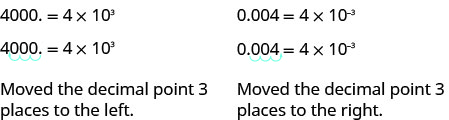
In both cases, the decimal was moved 3 places to get the first factor between 1 and 10.
英語のヒント
どちらも小数点を3桁動かし、最初の因数を1から10の間にした。
Example 6.101例題 6.101
How to Convert from Decimal Notation to Scientific Notation通常の小数表示から科学的記数法に直す手順
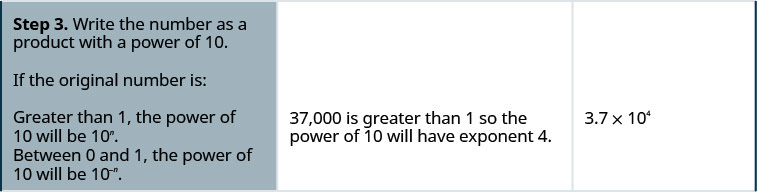
Write in scientific notation: 37,000.
英語のヒント
37,000を科学的記数法で表せ。
Solution解答



Try It (2)確認問題(2題)
Example 6.102例題 6.102
Write in scientific notation:
英語のヒント
科学的記数法で表す:
Solution解答
The original number, , is between 0 and 1 so we will have a negative power of 10.
英語のヒント
元の数は0と1の間なので、10の指数は負になる。
 |
|
Move the decimal point to get 5.2, a number between 1 and 10. 小数点を動かし、1と10の間の数である5.2にする。 |
 |
Count the number of decimal places the point was moved. 小数点を動かした桁数を数える。 |
 |
Write as a product with a power of 10. 10の累乗との積として書く。 |
 |
Check. 確かめる。 |
|
 |