第6章多項式
6.7 Integer Exponents and Scientific Notation6.7 整数の指数と科学的記数法
Learning Objectives学習目標
Learning Objectives学習目標
By the end of this section, you will be able to:
英語のヒント
この節を終えると、次のことができるようになる。
- Use the definition of a negative exponent
英語のヒント
負の指数の定義を使う - Simplify expressions with integer exponents
英語のヒント
整数の指数を含む式を簡単にする - Convert from decimal notation to scientific notation
英語のヒント
通常の小数表記から科学的記数法に直す - Convert scientific notation to decimal form
英語のヒント
科学的記数法から通常の小数表記に直す - Multiply and divide using scientific notation
英語のヒント
科学的記数法を使って掛け算と割り算をする
Before You Begin (3)準備問題(3題)
Use the Definition of a Negative Exponent負の指数の定義を使う
We saw that the Quotient Property for Exponents introduced earlier in this chapter, has two forms depending on whether the exponent is larger in the numerator or the denominator.
英語のヒント
この章で学んだ同じ底の累乗の商の法則には、分子と分母のどちらの指数が大きいかによって、二つの形があった。
What if we just subtract exponents regardless of which is larger?
英語のヒント
どちらが大きいかに関係なく、単純に指数を引いたらどうなるだろうか。
Let’s consider .
英語のヒント
を考えよう。
We subtract the exponent in the denominator from the exponent in the numerator.
英語のヒント
分子の指数から分母の指数を引く。
We can also simplify by dividing out common factors:
英語のヒント
共通の因数を約分して、を簡単にすることもできる。
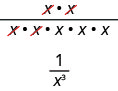
This implies that and it leads us to the definition of a negative exponent.
英語のヒント
このことはを意味し、ここから負の指数の定義が導かれる。
The negative exponent tells us we can re-write the expression by taking the reciprocal of the base and then changing the sign of the exponent.
英語のヒント
負の指数は、底の逆数を取り、指数の符号を変えて式を書き換えられることを示す。
Any expression that has negative exponents is not considered to be in simplest form. We will use the definition of a negative exponent and other properties of exponents to write the expression with only positive exponents.
英語のヒント
負の指数を含む式は、最も簡単な形とはみなさない。負の指数の定義とほかの指数法則を使い、正の指数だけを使う形に書き換える。
For example, if after simplifying an expression we end up with the expression , we will take one more step and write . The answer is considered to be in simplest form when it has only positive exponents.
英語のヒント
例えば、式を簡単にしてが得られたら、さらに一段階進めてと書く。答えに正の指数だけが含まれているとき、最も簡単な形とみなされる。
Example 6.89例題 6.89
Simplify: ⓐ ⓑ
英語のヒント
簡単にせよ:ⓐ ⓑ
Solution解答
ⓐ |
|
Use the definition of a negative exponent, . 負の指数の定義を使う。 |
|
Simplify. 簡単にする。 |
|
ⓑ |
|
Use the definition of a negative exponent, . 負の指数の定義を使う。 |
|
Simplify. 簡単にする。 |
Try It (2)確認問題(2題)
In Example 6.89 we raised an integer to a negative exponent. What happens when we raise a fraction to a negative exponent? We’ll start by looking at what happens to a fraction whose numerator is one and whose denominator is an integer raised to a negative exponent.
英語のヒント
例題6.89では、整数の負の累乗を求めた。分数を負の指数で累乗すると、どうなるだろうか。まず、分子が1で、分母が整数の負の累乗である分数を考えよう。
Use the definition of a negative exponent, . 負の指数の定義を使う。 |
|
Simplify the complex fraction. 繁分数を簡単にする。 |
|
Multiply. 掛ける。 |
This leads to the Property of Negative Exponents.
英語のヒント
ここから、負の指数の性質が得られる。
Example 6.90例題 6.90
Simplify: ⓐ ⓑ
英語のヒント
簡単にせよ:ⓐ ⓑ
Solution解答
ⓐ |
|
Use the property of a negative exponent, . 負の指数の性質を使う。 |
|
ⓑ |
|
Use the property of a negative exponent, . 負の指数の性質を使う。 |
|
Simplify. 簡単にする。 |
Try It (2)確認問題(2題)
Suppose now we have a fraction raised to a negative exponent. Let’s use our definition of negative exponents to lead us to a new property.
英語のヒント
次に、分数を負の指数で累乗した式を考える。負の指数の定義を使い、新しい性質を導こう。
Use the definition of a negative exponent, . 負の指数の定義を使う。 |
|
Simplify the denominator. 分母を簡単にする。 |
|
Simplify the complex fraction. 繁分数を簡単にする。 |
|
But we know that is . はであると分かっている。 |
|
This tells us that: したがって、次が分かる。 |
To get from the original fraction raised to a negative exponent to the final result, we took the reciprocal of the base—the fraction—and changed the sign of the exponent.
英語のヒント
元の分数の負の累乗から最終的な結果を得るために、底である分数の逆数を取り、指数の符号を変えた。
This leads us to the Quotient to a Negative Power Property.
英語のヒント
ここから、商の負の累乗の法則が得られる。
Example 6.91例題 6.91
Simplify: ⓐ ⓑ
英語のヒント
簡単にせよ:ⓐ ⓑ
Solution解答
ⓐ |
|
Use the Quotient to a Negative Exponent Property, . 商の負の累乗の法則を使う。 |
|
Take the reciprocal of the fraction and change the sign of the exponent. 分数の逆数を取り、指数の符号を変える。 |
|
Simplify. 簡単にする。 |
|
ⓑ |
|
Use the Quotient to a Negative Exponent Property, . 商の負の累乗の法則を使う。 |
|
Take the reciprocal of the fraction and change the sign of the exponent. 分数の逆数を取り、指数の符号を変える。 |
|
Simplify. 簡単にする。 |
Try It (2)確認問題(2題)
When simplifying an expression with exponents, we must be careful to correctly identify the base.
英語のヒント
指数を含む式を簡単にするときには、底を正しく見分けるよう注意しなければならない。
Example 6.92例題 6.92
Simplify: ⓐ ⓑ ⓒ ⓓ
英語のヒント
簡単にせよ。ⓐ ⓑ ⓒ ⓓ
Solution解答
ⓐ Here the exponent applies to the base . ⓐ ここでは、指数は底に作用する。 |
|
Take the reciprocal of the base and change the sign of the exponent. 底を逆数にし、指数の符号を変える。 |
|
Simplify. 簡単にする。 |
|
ⓑ The expression means "find the opposite of ." Here the exponent applies to the base . ⓑ 式は「の符号を逆にする」という意味である。ここでは、指数は底に作用する。 |
|
Rewrite as a product with . との積として書き換える。 |
|
Take the reciprocal of the base and change the sign of the exponent. 底を逆数にし、指数の符号を変える。 |
|
Simplify. 簡単にする。 |
|
ⓒ Here the exponent applies to the base . ⓒ ここでは、指数は底に作用する。 |
|
Take the reciprocal of the base and change the sign of the exponent. 底を逆数にし、指数の符号を変える。 |
|
Simplify. 簡単にする。 |
|
ⓓ The expression means "find the opposite of ." Here the exponent applies to the base . ⓓ 式は「の符号を逆にする」という意味である。ここでは、指数は底に作用する。 |
|
Rewrite as a product with . との積として書き換える。 |
|
Take the reciprocal of the base and change the sign of the exponent. 底を逆数にし、指数の符号を変える。 |
|
Simplify. 簡単にする。 |
Try It (2)確認問題(2題)
We must be careful to follow the Order of Operations. In the next example, parts (a) and (b) look similar, but the results are different.
英語のヒント
計算の順序に注意して従わなければならない。次の例の(a)と(b)は似ているが、結果は異なる。
Example 6.93例題 6.93
Simplify: ⓐ ⓑ
英語のヒント
簡単にせよ:ⓐ ⓑ
Solution解答
ⓐ Do exponents before multiplication. ⓐ 掛け算より先に累乗を計算する。 |
|
Use . を使う。 |
|
Simplify. 簡単にする。 |
|
ⓑ |
|
Simplify inside the parentheses first. まず括弧の中を簡単にする。 |
|
Use . を使う。 |
|
Simplify. 簡単にする。 |
Try It (2)確認問題(2題)
When a variable is raised to a negative exponent, we apply the definition the same way we did with numbers. We will assume all variables are non-zero.
英語のヒント
変数を負の指数で累乗する場合も、数の場合と同じように定義を適用する。すべての変数は0でないと仮定する。
Example 6.94例題 6.94
Simplify: ⓐ ⓑ
英語のヒント
簡単にせよ:ⓐ ⓑ
Solution解答
- ⓐⓐ
- ⓑⓑ
Try It (2)確認問題(2題)
When there is a product and an exponent we have to be careful to apply the exponent to the correct quantity. According to the Order of Operations, we simplify expressions in parentheses before applying exponents. We’ll see how this works in the next example.
英語のヒント
積と指数があるときは、指数を適切な量に作用させるよう注意する。計算の順序によると、累乗を計算する前に括弧の中の式を簡単にする。次の例で確かめよう。
Example 6.95例題 6.95
Simplify: ⓐ ⓑ ⓒ
英語のヒント
簡単にせよ。ⓐ ⓑ ⓒ
Solution解答
ⓐ
Notice the exponent applies to just the base y. Take the reciprocal of y and change the sign of the exponent. 指数は底yだけに作用する。yの逆数を取り、指数の符号を変える。 |
|
Simplify. 簡単にする。 |
ⓑ
Here the parentheses make the exponent apply to the base 5y. Take the reciprocal of 5y and change the sign of the exponent. ここでは括弧によって、指数が底5yに作用する。5yの逆数を取り、指数の符号を変える。 |
|
Simplify. 簡単にする。 |
ⓒ
The base here is −5y. Take the reciprocal of −5y and change the sign of the exponent. ここでの底は−5yである。−5yの逆数を取り、指数の符号を変える。 |
|
Simplify. 簡単にする。 |
|
Use を使う。 |
Try It (2)確認問題(2題)
With negative exponents, the Quotient Rule needs only one form , for . When the exponent in the denominator is larger than the exponent in the numerator, the exponent of the quotient will be negative.
英語のヒント
負の指数を使うと、商の法則は、に対してという一つの形だけで表せる。分母の指数が分子の指数より大きいとき、商の指数は負になる。