第6章多項式
6.1 Add and Subtract Polynomials6.1 多項式の加法と減法
Learning Objectives学習目標
Learning Objectives学習目標
By the end of this section, you will be able to:
英語のヒント
この節を終えると、次のことができるようになる。
- Identify polynomials, monomials, binomials, and trinomials
英語のヒント
多項式・単項式・二項式・三項式を見分ける - Determine the degree of polynomials
英語のヒント
多項式の次数を求める - Add and subtract monomials
英語のヒント
単項式の加法と減法 - Add and subtract polynomials
英語のヒント
多項式の加法と減法 - Evaluate a polynomial for a given value
英語のヒント
与えられた値に対する多項式の値を求める
Before You Begin (3)準備問題(3題)
Identify Polynomials, Monomials, Binomials and Trinomials多項式・単項式・二項式・三項式を見分ける
You have learned that a term is a constant or the product of a constant and one or more variables. When it is of the form , where is a constant and is a whole number, it is called a monomial. Some examples of monomial are .
英語のヒント
項とは、定数、または定数と一つ以上の変数との積であると学んだ。の形で表され、が定数、が非負整数である項を、単項式という。単項式の例としてがある。
A monomial, or two or more monomials combined by addition or subtraction, is a polynomial. Some polynomials have special names, based on the number of terms. A monomial is a polynomial with exactly one term. A binomial has exactly two terms, and a trinomial has exactly three terms. There are no special names for polynomials with more than three terms.
英語のヒント
一つの単項式、または二つ以上の単項式を足し算や引き算で結んだ式を、多項式という。多項式には、項の数によって特別な名前を持つものがある。単項式は項がちょうど一つの多項式である。二項式にはちょうど二つ、三項式にはちょうど三つの項がある。項が三つより多い多項式には、特別な名前はない。
Here are some examples of polynomials.
英語のヒント
多項式の例をいくつか挙げる。
Notice that every monomial, binomial, and trinomial is also a polynomial. They are just special members of the “family” of polynomials and so they have special names. We use the words monomial, binomial, and trinomial when referring to these special polynomials and just call all the rest polynomials.
英語のヒント
単項式、二項式、三項式は、どれも多項式でもあることに注意しよう。多項式という「家族」の特別な一員なので、特別な名前が付いている。これらを指すときは単項式、二項式、三項式という語を使い、それ以外は単に多項式と呼ぶ。
Example 6.1例題 6.1
Determine whether each polynomial is a monomial, binomial, trinomial, or other polynomial.
英語のヒント
それぞれの多項式が、単項式・二項式・三項式、またはそれ以外の多項式のどれかを判定する。
- ⓐ
- ⓑ
- ⓒ
- ⓓ
- ⓔ
Solution解答
Polynomial 多項式 |
Number of terms 項の数 |
Type 種類 |
|
ⓐ |
Trinomial 三項式 |
||
ⓑ |
Monomial 単項式 |
||
ⓒ |
Polynomial 多項式 |
||
ⓓ |
Binomial 二項式 |
||
ⓔ |
Monomial 単項式 |
Try It (2)確認問題(2題)
Determine the Degree of Polynomials多項式の次数を求める
The degree of a polynomial and the degree of its terms are determined by the exponents of the variable.
英語のヒント
多項式の次数と各項の次数は、変数の指数によって決まる。
A monomial that has no variable, just a constant, is a special case. The degree of a constant is 0—it has no variable.
英語のヒント
変数を含まず、定数だけからなる単項式は特別な場合である。定数の次数は0であり、変数を持たない。
Let’s see how this works by looking at several polynomials. We’ll take it step by step, starting with monomials, and then progressing to polynomials with more terms.
英語のヒント
いくつかの多項式を見て、この仕組みを確かめよう。単項式から始め、項の多い多項式へと段階的に進める。
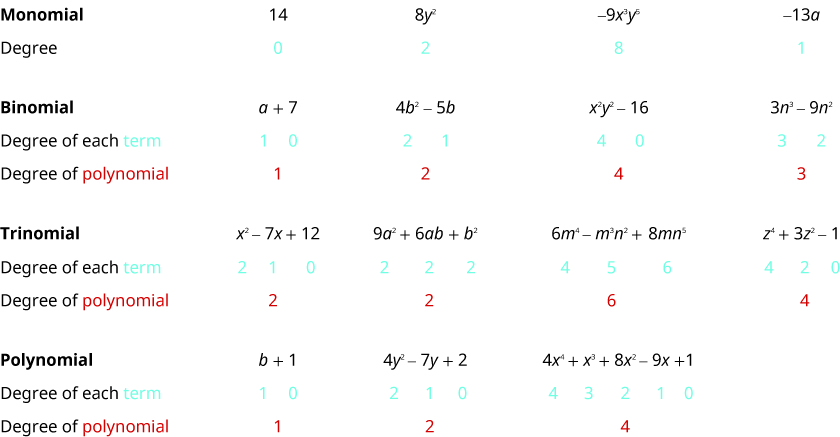
A polynomial is in standard form when the terms of a polynomial are written in descending order of degrees. Get in the habit of writing the term with the highest degree first.
英語のヒント
多項式の項を次数の高い順に並べた形を標準形という。次数が最も高い項を最初に書く習慣を付けよう。
Example 6.2例題 6.2
Find the degree of the following polynomials.
英語のヒント
次の多項式の次数を求めよ。
- ⓐ
- ⓑ
- ⓒ
- ⓓ
- ⓔ
Solution解答
ⓐ The exponent of is one. ⓐ の指数は1である。 |
The degree is 1. 次数は1である。 |
ⓑ The highest degree of all the terms is 3. ⓑ 各項の次数の最大値は3である。 |
The degree is 3. 次数は3である。 |
ⓒ The degree of a constant is 0. ⓒ 定数の次数は0である。 |
The degree is 0. 次数は0である。 |
ⓓ The highest degree of all the terms is 2. ⓓ 各項の次数の最大値は2である。 |
The degree is 2. 次数は2である。 |
ⓔ The highest degree of all the terms is 3. ⓔ 各項の次数の最大値は3である。 |
The degree is 3. 次数は3である。 |