第5章連立一次方程式
Determine the Number of Solutions of a Linear System連立一次方程式の解の個数を調べる
There will be times when we will want to know how many solutions there will be to a system of linear equations, but we might not actually have to find the solution. It will be helpful to determine this without graphing.
英語のヒント
連立一次方程式の解の数を知りたいが、解を実際に求める必要はないこともある。グラフを描かずに判定できると便利である。
We have seen that two lines in the same plane must either intersect or are parallel. The systems of equations in Example 5.2 through Example 5.6 all had two intersecting lines. Each system had one solution.
英語のヒント
A system with parallel lines, like Example 5.7, has no solution. What happened in Example 5.8? The equations have coincident lines, and so the system had infinitely many solutions.
英語のヒント
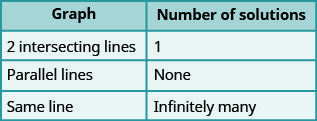
Figure 5.3図 5.3
Parallel lines have the same slope but different y-intercepts. So, if we write both equations in a system of linear equations in slope–intercept form, we can see how many solutions there will be without graphing! Look at the system we solved in Example 5.7.
英語のヒント
平行な直線は傾きが同じでy切片が異なる。したがって、連立一次方程式の両方を傾き切片形式にすれば、グラフを描かずに解の数が分かる。例題5.7で解いた連立方程式を見よう。
The two lines have the same slope but different y-intercepts. They are parallel lines.
英語のヒント
2本の直線は傾きが同じでy切片が異なる。平行な直線である。
Figure 5.4 shows how to determine the number of solutions of a linear system by looking at the slopes and intercepts.
英語のヒント
図5.4は、傾きと切片を見て連立一次方程式の解の数を判定する方法を示す。
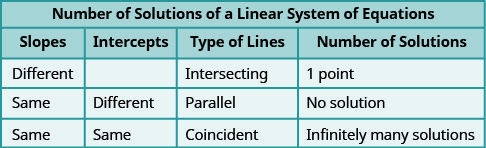
Figure 5.4図 5.4
Let’s take one more look at our equations in Example 5.7 that gave us parallel lines.
英語のヒント
平行な直線になった例題5.7の方程式を、もう一度見よう。
When both lines were in slope-intercept form we had:
英語のヒント
両方の直線を傾き切片形式にすると、次のようになった。
Do you recognize that it is impossible to have a single ordered pair that is a solution to both of those equations?
英語のヒント
その両方の方程式の解となる1つの順序対は存在しえないことが分かるだろうか。
We call a system of equations like this an inconsistent system. It has no solution.
英語のヒント
このような連立方程式を不整合な連立方程式という。解はない。
A system of equations that has at least one solution is called a consistent system.
英語のヒント
少なくとも1つの解がある連立方程式を、整合的な連立方程式という。
We also categorize the equations in a system of equations by calling the equations independent or dependent. If two equations are independent equations, they each have their own set of solutions. Intersecting lines and parallel lines are independent.
英語のヒント
連立方程式の各方程式を、独立か従属かで分類することもある。2つの方程式が独立なら、それぞれに固有の解の集合がある。交わる直線と平行な直線は独立である。
If two equations are dependent, all the solutions of one equation are also solutions of the other equation. When we graph two dependent equations, we get coincident lines.
英語のヒント
2つの方程式が従属なら、一方の方程式の解はすべて他方の解でもある。従属する2つの方程式のグラフを描くと、直線は一致する。
Let’s sum this up by looking at the graphs of the three types of systems. See Figure 5.5 and Figure 5.6.
英語のヒント
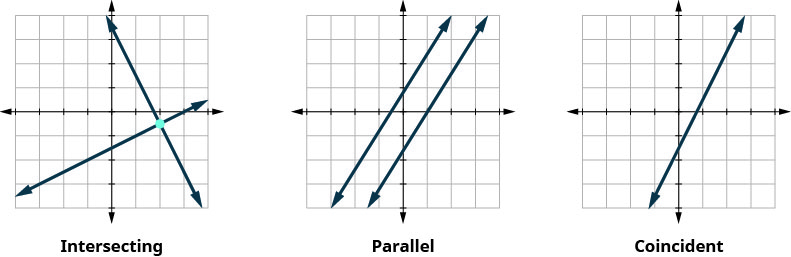
Figure 5.5図 5.5
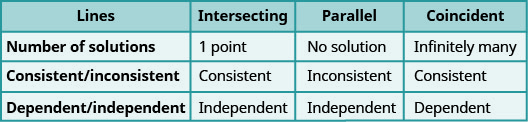
Figure 5.6図 5.6
Example 5.9例題 5.9
Without graphing, determine the number of solutions and then classify the system of equations:
英語のヒント
グラフをかかずに解の個数を調べ、その連立方程式を分類せよ:
Solution解答
We will compare the slopes and intercepts of the two lines. 2直線の傾きと切片を比較する。 |
|
The first equation is already in slope-intercept form. 最初の方程式はすでに傾き切片形式である。 |
|
Write the second equation in slope-intercept form. 2つ目の方程式を傾き切片形式に書く。 |
|
Find the slope and intercept of each line. それぞれの直線の傾きと切片を求める。 |
|
Since the slopes are the same and -intercepts are different, the lines are parallel. 傾きが同じで切片が異なるので、直線は平行である。 |
A system of equations whose graphs are parallel lines has no solution and is inconsistent and independent.
英語のヒント
グラフが平行な直線になる連立方程式には解がなく、不整合かつ独立である。
Try It (2)確認問題(2題)
Example 5.10例題 5.10
Without graphing, determine the number of solutions and then classify the system of equations:
英語のヒント
グラフをかかずに解の個数を調べ、その連立方程式を分類せよ:
Solution解答
We will compare the slope and intercepts of the two lines. 2本の直線の傾きと切片を比べる。 |
||
Write both equations in slope-intercept form. 両方の方程式を傾き切片形式に書く。 |
||
Find the slope and intercept of each line. それぞれの直線の傾きと切片を求める。 |
||
Since the slopes are different, the lines intersect. 傾きが異なるので、直線は交わる。 |
||
A system of equations whose graphs are intersect has 1 solution and is consistent and independent.
英語のヒント
グラフが交わる連立方程式には解が1つあり、整合的かつ独立である。
Try It (2)確認問題(2題)
Example 5.11例題 5.11
Without graphing, determine the number of solutions and then classify the system of equations.
英語のヒント
グラフを描かずに解の数を判定し、連立方程式を分類せよ。
Solution解答
We will compare the slopes and intercepts of the two lines. 2直線の傾きと切片を比較する。 |
|
Write the first equation in slope-intercept form. 最初の方程式を傾き切片形式に書く。 |
|
The second equation is already in slope-intercept form. 2つ目の方程式はすでに傾き切片形式である。 |
|
Since the slopes are the same, they have the same slope and same -intercept and so the lines are coincident. 傾きが同じなので、傾きも切片も同じとなり、直線は一致する。 |
A system of equations whose graphs are coincident lines has infinitely many solutions and is consistent and dependent.
英語のヒント
グラフが一致する直線になる連立方程式には無数の解があり、整合的かつ従属である。