第5章連立一次方程式
5.1 Solve Systems of Equations by Graphing5.1 グラフを使って連立方程式を解く
Learning Objectives学習目標
Learning Objectives学習目標
By the end of this section, you will be able to:
英語のヒント
この節を終えると、次のことができるようになる。
- Determine whether an ordered pair is a solution of a system of equations
英語のヒント
順序対が連立方程式の解かどうかを判定する - Solve a system of linear equations by graphing
英語のヒント
連立一次方程式をグラフで解く - Determine the number of solutions of linear system
英語のヒント
連立一次方程式の解の数を判定する - Solve applications of systems of equations by graphing
英語のヒント
連立方程式の応用問題をグラフで解く
Before You Begin (3)準備問題(3題)
Determine Whether an Ordered Pair is a Solution of a System of Equations順序対が連立方程式の解かどうかを判定する
In Solving Linear Equations and Inequalities we learned how to solve linear equations with one variable. Remember that the solution of an equation is a value of the variable that makes a true statement when substituted into the equation.
英語のヒント
「一次方程式と不等式を解く」では、1変数の一次方程式の解き方を学んだ。方程式の解とは、代入すると等式が成り立つ変数の値であることを思い出そう。
Now we will work with systems of linear equations, two or more linear equations grouped together.
英語のヒント
今度は、2つ以上の一次方程式をまとめた連立一次方程式を扱う。
We will focus our work here on systems of two linear equations in two unknowns. Later, you may solve larger systems of equations.
英語のヒント
ここでは、2つの未知数を含む2つの一次方程式の連立に集中する。今後、もっと大きな連立方程式を解くこともあるだろう。
An example of a system of two linear equations is shown below. We use a brace to show the two equations are grouped together to form a system of equations.
英語のヒント
2つの一次方程式からなる連立方程式の例を下に示す。2つの方程式をまとめて連立方程式にしていることを、波括弧で表す。
A linear equation in two variables, like 2x + y = 7, has an infinite number of solutions. Its graph is a line. Remember, every point on the line is a solution to the equation and every solution to the equation is a point on the line.
英語のヒント
2x+y=7のような2変数の一次方程式には、無数の解がある。グラフは直線になる。直線上のすべての点が方程式の解であり、方程式のすべての解が直線上の点であることを思い出そう。
To solve a system of two linear equations, we want to find the values of the variables that are solutions to both equations. In other words, we are looking for the ordered pairs (x, y) that make both equations true. These are called the solutions to a system of equations.
英語のヒント
2つの一次方程式の連立を解くには、両方の方程式の解となる変数の値を求めたい。言い換えれば、両方の方程式を成り立たせる順序対(x, y)を探す。これを連立方程式の解という。
To determine if an ordered pair is a solution to a system of two equations, we substitute the values of the variables into each equation. If the ordered pair makes both equations true, it is a solution to the system.
英語のヒント
順序対が2つの方程式の連立の解かどうかを調べるには、変数の値をそれぞれの方程式に代入する。両方の方程式が成り立つなら、その順序対は連立方程式の解である。
Let’s consider the system below:
英語のヒント
次の連立方程式を考えよう。
Is the ordered pair a solution?
英語のヒント
順序対は解か。
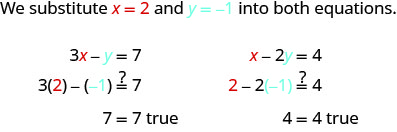
The ordered pair (2, −1) made both equations true. Therefore (2, −1) is a solution to this system.
英語のヒント
順序対(2, −1)は両方の方程式を成り立たせた。したがって、(2, −1)はこの連立方程式の解である。
Let’s try another ordered pair. Is the ordered pair (3, 2) a solution?
英語のヒント
別の順序対を試そう。(3, 2)は解か。
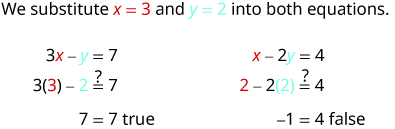
The ordered pair (3, 2) made one equation true, but it made the other equation false. Since it is not a solution to both equations, it is not a solution to this system.
英語のヒント
順序対(3, 2)は一方の方程式を成り立たせたが、他方は成り立たせなかった。両方の解ではないので、この連立方程式の解ではない。
Example 5.1例題 5.1
Determine whether the ordered pair is a solution to the system:
英語のヒント
その順序対が連立方程式の解かどうかを調べよ:
ⓐ ⓑ
Solution解答
- ⓐ
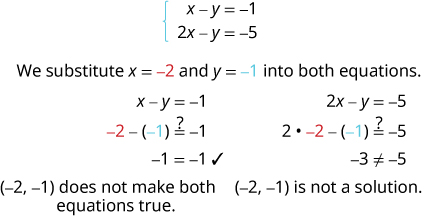
(–2, –1) does not make both equations true. (–2, –1) is not a solution.
ⓑ英語のヒント
(−2, −1)は両方の方程式を成り立たせない。(−2, −1)は解ではない。ⓑ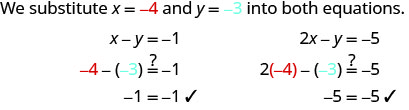
(–4, –3) does make both equations true. (–4, –3) is a solution.英語のヒント
(−4, −3)は確かに両方の方程式を成り立たせる。(−4, −3)は解である。
Try It (2)確認問題(2題)
Solve a System of Linear Equations by Graphingグラフを使って連立一次方程式を解く
In this chapter we will use three methods to solve a system of linear equations. The first method we’ll use is graphing.
英語のヒント
この章では、連立一次方程式を解く3つの方法を使う。最初はグラフによる方法である。
The graph of a linear equation is a line. Each point on the line is a solution to the equation. For a system of two equations, we will graph two lines. Then we can see all the points that are solutions to each equation. And, by finding what the lines have in common, we’ll find the solution to the system.
英語のヒント
一次方程式のグラフは直線である。直線上の各点は方程式の解である。2つの方程式の連立では、2本の直線を描く。それぞれの方程式の解となる点をすべて見ることができる。直線の共通部分を求めることで、連立方程式の解が得られる。
Most linear equations in one variable have one solution, but we saw that some equations, called contradictions, have no solutions and for other equations, called identities, all numbers are solutions.
英語のヒント
1変数の一次方程式の多くは解を1つ持つが、矛盾式と呼ばれる方程式には解がなく、恒等式と呼ばれる方程式ではすべての数が解となることを学んだ。
Similarly, when we solve a system of two linear equations represented by a graph of two lines in the same plane, there are three possible cases, as shown in Figure 5.2:
英語のヒント
同じように、同一平面上の2本の直線で表される連立一次方程式を解くときには、図5.2のように3つの場合がある。
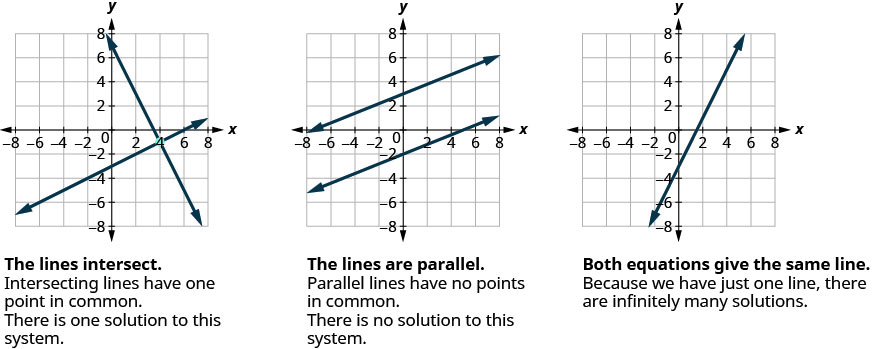
Figure 5.2図 5.2
For the first example of solving a system of linear equations in this section and in the next two sections, we will solve the same system of two linear equations. But we’ll use a different method in each section. After seeing the third method, you’ll decide which method was the most convenient way to solve this system.
英語のヒント
この節と次の2つの節では、連立一次方程式を解く最初の例として同じ2つの方程式を使うが、節ごとに異なる方法で解く。3つ目の方法を見た後で、どの方法がこの連立方程式に最も便利だったか判断しよう。
Example 5.2例題 5.2
How to Solve a System of Linear Equations by Graphingグラフによる連立一次方程式の解き方
Solve the system by graphing:
英語のヒント
グラフを使って連立方程式を解け:
Solution解答
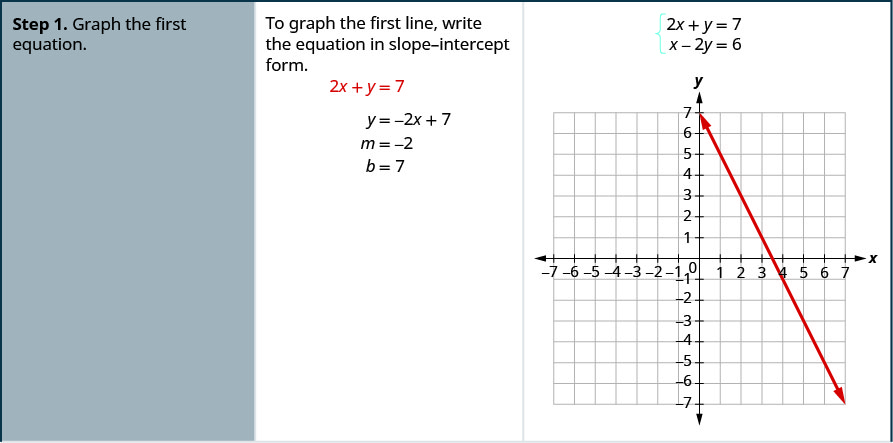
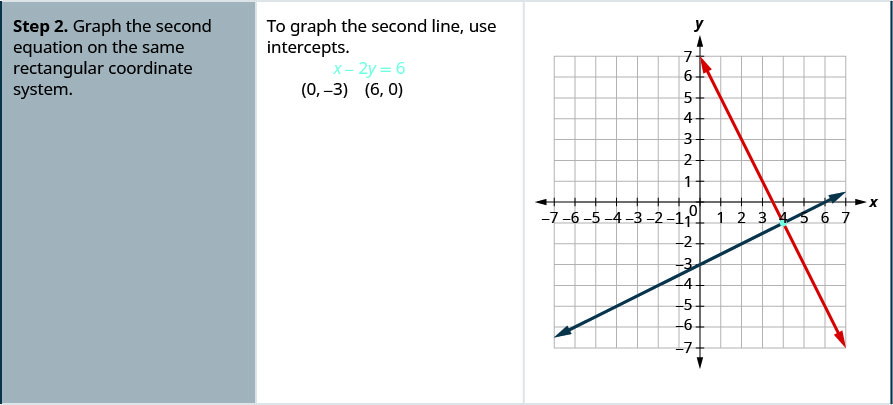

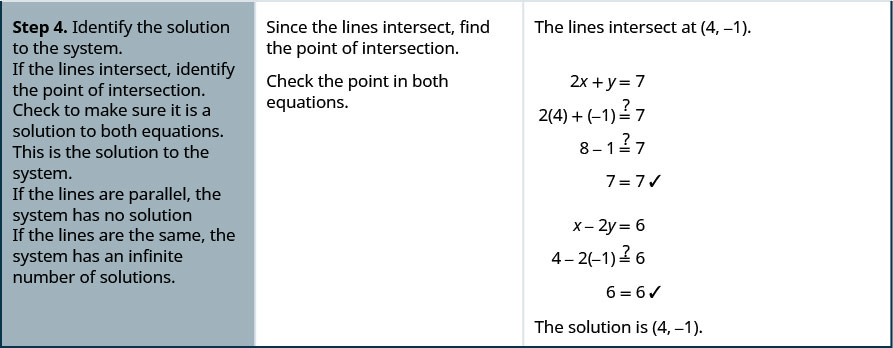
Try It (2)確認問題(2題)
The steps to use to solve a system of linear equations by graphing are shown below.
英語のヒント
連立一次方程式をグラフで解く手順を下に示す。
Example 5.3例題 5.3
Solve the system by graphing:
英語のヒント
グラフを使って連立方程式を解け:
Solution解答
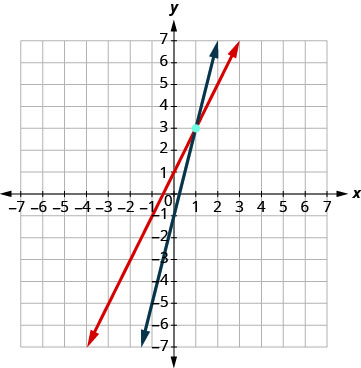
Both of the equations in this system are in slope-intercept form, so we will use their slopes and y-intercepts to graph them.
英語のヒント
両方の方程式が傾き切片形式なので、傾きとy切片を使ってグラフを描く。
Find the slope and y-intercept of the first equation. 1つ目の方程式の傾きとy切片を求める。 |
 |
Find the slope and y-intercept of the first equation. 1つ目の方程式の傾きとy切片を求める。 |
 |
Graph the two lines. 2本の直線を描く。 |
|
Determine the point of intersection. 交点を求める。 |
The lines intersect at (1, 3). 直線は(1, 3)で交わる。 |
 |
|
Check the solution in both equations. 解を両方の方程式に代入して確認する。 |
|
The solution is (1, 3). 解は(1, 3)である。 |
Try It (2)確認問題(2題)
Both equations in Example 5.3 were given in slope–intercept form. This made it easy for us to quickly graph the lines. In the next example, we’ll first re-write the equations into slope–intercept form.
英語のヒント
例題5.3では両方の方程式が傾き切片形式で与えられていたので、直線を簡単に素早く描けた。次の例では、まず方程式を傾き切片形式に書き換える。
Example 5.4例題 5.4
Solve the system by graphing:
英語のヒント
グラフを使って連立方程式を解け:
Solution解答
We’ll solve both of these equations for so that we can easily graph them using their slopes and y-intercepts.
英語のヒント
傾きとy切片を使って簡単にグラフを描けるよう、両方の方程式をについて解く。
Solve the first equation for y. Find the slope and y-intercept. Solve the second equation for y. Find the slope and y-intercept. 最初の方程式をyについて解き、傾きとy切片を求める。2つ目の方程式をyについて解き、傾きとy切片を求める。 |
|
Graph the lines. 直線のグラフをかく。 |
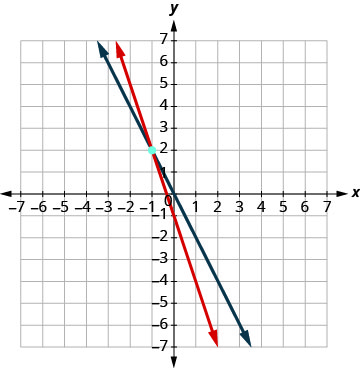 |
Determine the point of intersection. 交点を求める。 |
The lines intersect at (−1, 2). 直線は(−1, 2)で交わる。 |
Check the solution in both equations. 解を両方の方程式に代入して確認する。 |
|
The solution is (−1, 2). 解は(−1, 2)である。 |
Try It (2)確認問題(2題)
Usually when equations are given in standard form, the most convenient way to graph them is by using the intercepts. We’ll do this in Example 5.5.
英語のヒント
標準形の方程式では、普通、切片を使ってグラフを描くのが最も便利である。例題5.5でこの方法を使う。
Example 5.5例題 5.5
Solve the system by graphing:
英語のヒント
グラフを使って連立方程式を解け:
Solution解答
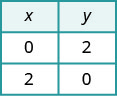
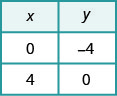
We will find the x- and y-intercepts of both equations and use them to graph the lines.
英語のヒント
両方の方程式のx切片とy切片を求め、それらを使って直線を描く。
 |
||
To find the intercepts, let x = 0 and solve for y, then let y = 0 and solve for x. 切片を求めるには、x=0としてyを求め、次にy=0としてxを求める。 |
 |
|
 |
||
To find the intercepts, let x = 0 then let y = 0. 切片を求めるには、x=0とし、次にy=0とする。 |
 |
|
Graph the line. 直線を描く。 |
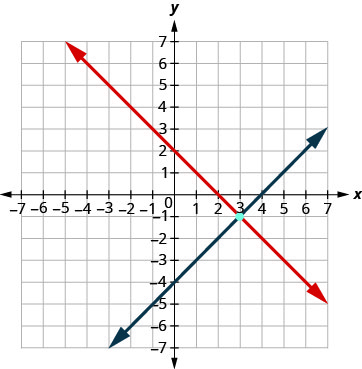 |
|
Determine the point of intersection. 交点を求める。 |
The lines intersect at (3, −1). 直線は(3, −1)で交わる。 |
|
Check the solution in both equations. 解を両方の方程式に代入して確認する。 |
The solution is (3, −1). 解は(3, −1)である。 |
Try It (2)確認問題(2題)
Do you remember how to graph a linear equation with just one variable? It will be either a vertical or a horizontal line.
英語のヒント
変数が1つだけの一次方程式のグラフの描き方を覚えているだろうか。垂直な直線か水平な直線になる。
Example 5.6例題 5.6
Solve the system by graphing:
英語のヒント
グラフを使って連立方程式を解け:
Solution解答
 |
|
We know the first equation represents a horizontal line whose y-intercept is 6. 最初の方程式は、y切片が6の水平な直線を表す。 |
 |
The second equation is most conveniently graphed using intercepts. 2つ目の方程式は切片を使って描くのが最も便利である。 |
 |
To find the intercepts, let x = 0 and then y = 0. 切片を求めるには、x=0とし、次にy=0とする。 |
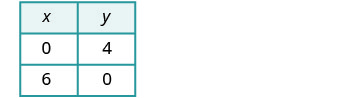 |
Graph the lines. 直線のグラフをかく。 |
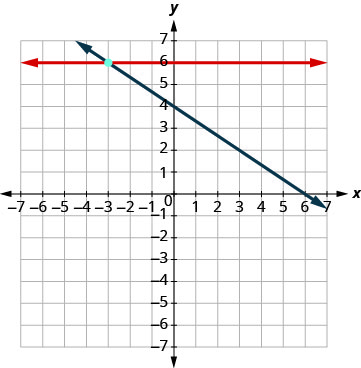 |
Determine the point of intersection. 交点を求める。 |
The lines intersect at (−3, 6). 直線は(−3, 6)で交わる。 |
Check the solution to both equations. 両方の方程式で解を確認する。 |
|
The solution is (−3, 6). 解は(−3, 6)である。 |
Try It (2)確認問題(2題)
In all the systems of linear equations so far, the lines intersected and the solution was one point. In the next two examples, we’ll look at a system of equations that has no solution and at a system of equations that has an infinite number of solutions.
英語のヒント
これまでの連立一次方程式では、直線は交わり、解は1点だった。次の2例では、解がない連立方程式と無数の解を持つ連立方程式を見る。
Example 5.7例題 5.7
Solve the system by graphing:
英語のヒント
グラフを使って連立方程式を解け:
Solution解答
 |
|
To graph the first equation, we will use its slope and y-intercept. 最初の方程式のグラフは、傾きとy切片を使って描く。 |
 |
 |
|
 |
|
To graph the second equation, we will use the intercepts. 2つ目の方程式のグラフは、切片を使って描く。 |
 |
 |
|
Graph the lines. 直線のグラフをかく。 |
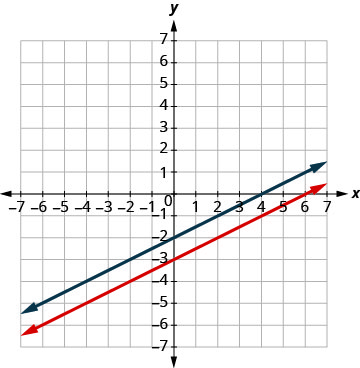 |
Determine the point of intersection. 交点を求める。 |
The lines are parallel. 直線は平行である。 |
Since no point is on both lines, there is no ordered pair that makes both equations true. There is no solution to this system. 両方の直線上にある点がないので、両方の方程式を成り立たせる順序対はない。この連立方程式に解はない。 |
Try It (2)確認問題(2題)
Example 5.8例題 5.8
Solve the system by graphing:
英語のヒント
グラフを使って連立方程式を解け:
Solution解答
 |
|
Find the slope and y-intercept of the first equation. 1つ目の方程式の傾きとy切片を求める。 |
 |
Find the intercepts of the second equation. 2つ目の方程式の切片を求める。 |
 |
 |
|
Graph the lines. 直線のグラフをかく。 |
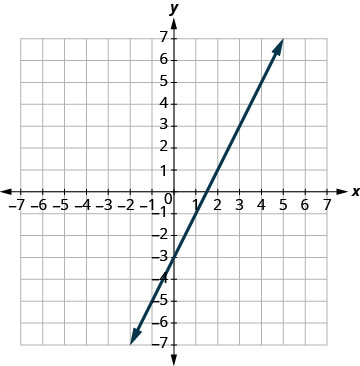 |
Determine the point of intersection. 交点を求める。 |
The lines are the same! 同じ直線である。 |
Since every point on the line makes both equations true, there are infinitely many ordered pairs that make both equations true. 直線上のすべての点が両方の方程式を成り立たせるので、両方を成り立たせる順序対は無数にある。 |
|
There are infinitely many solutions to this system. この連立方程式の解は無数にある。 |
Try It (2)確認問題(2題)
If you write the second equation in Example 5.8 in slope-intercept form, you may recognize that the equations have the same slope and same y-intercept.
英語のヒント
例題5.8の2つ目の方程式を傾き切片形式にすると、両方の方程式の傾きとy切片が同じだと気付くだろう。
When we graphed the second line in the last example, we drew it right over the first line. We say the two lines are coincident. Coincident lines have the same slope and same y-intercept.
英語のヒント
前の例で2つ目の直線を描いたとき、最初の直線にぴったり重なった。2本の直線は一致するという。一致する直線は、傾きとy切片が同じである。