第5章連立一次方程式
5.3 Solve Systems of Equations by Elimination5.3 加減法で連立方程式を解く
Learning Objectives学習目標
Learning Objectives学習目標
By the end of this section, you will be able to:
英語のヒント
この節を終えると、次のことができるようになる。
- Solve a system of equations by elimination
英語のヒント
加減法で連立方程式を解く - Solve applications of systems of equations by elimination
英語のヒント
加減法で連立方程式の応用問題を解く - Choose the most convenient method to solve a system of linear equations
英語のヒント
連立一次方程式を解く最も便利な方法を選ぶ
Before You Begin (2)準備問題(2題)
We have solved systems of linear equations by graphing and by substitution. Graphing works well when the variable coefficients are small and the solution has integer values. Substitution works well when we can easily solve one equation for one of the variables and not have too many fractions in the resulting expression.
英語のヒント
連立一次方程式をグラフと代入法で解いてきた。変数の係数が小さく、解が整数ならグラフが有効である。一方の方程式を変数について簡単に解け、得られる式に分数が多くなければ代入法が有効である。
The third method of solving systems of linear equations is called the Elimination Method. When we solved a system by substitution, we started with two equations and two variables and reduced it to one equation with one variable. This is what we’ll do with the elimination method, too, but we’ll have a different way to get there.
英語のヒント
連立一次方程式を解く3つ目の方法を加減法という。代入法では、2つの方程式と2つの変数から始め、変数が1つの方程式1つに減らした。加減法でも同じことをするが、そこまでの方法が異なる。
Solve a System of Equations by Elimination消去法で連立方程式を解く
The Elimination Method is based on the Addition Property of Equality. The Addition Property of Equality says that when you add the same quantity to both sides of an equation, you still have equality. We will extend the Addition Property of Equality to say that when you add equal quantities to both sides of an equation, the results are equal.
英語のヒント
加減法は等式の加法の性質に基づく。この性質は、等式の両辺に同じ量を足しても等しいままであるというものだ。これを拡張し、等式の両辺に等しい量を足すと結果も等しいと考える。
For any expressions a, b, c, and d,
英語のヒント
任意の式a、b、c、dについて、
To solve a system of equations by elimination, we start with both equations in standard form. Then we decide which variable will be easiest to eliminate. How do we decide? We want to have the coefficients of one variable be opposites, so that we can add the equations together and eliminate that variable.
英語のヒント
加減法で連立方程式を解くには、まず両方を標準形にする。次に、どの変数を消去するのが最も簡単かを決める。どう決めるのだろうか。一方の変数の係数を互いに符号が逆の数にし、方程式を足すとその変数が消えるようにしたい。
Notice how that works when we add these two equations together:
英語のヒント
次の2つの方程式を足すとどうなるか注目しよう。
The y’s add to zero and we have one equation with one variable.
英語のヒント
yの項の和は0になり、変数が1つの方程式1つになる。
Let’s try another one:
英語のヒント
別の例を試そう。
This time we don’t see a variable that can be immediately eliminated if we add the equations.
英語のヒント
今度は、方程式を足すだけですぐに消せる変数は見当たらない。
But if we multiply the first equation by −2, we will make the coefficients of x opposites. We must multiply every term on both sides of the equation by −2.
英語のヒント
しかし、最初の方程式に−2を掛ければ、xの係数を互いに符号が逆の数にできる。等式の両辺のすべての項に−2を掛けなければならない。
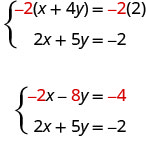
Now we see that the coefficients of the x terms are opposites, so x will be eliminated when we add these two equations.
英語のヒント
xの項の係数が互いに符号が逆の数になったので、2つの方程式を足すとxが消える。
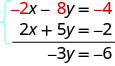
Add the equations yourself—the result should be −3y = −6. And that looks easy to solve, doesn’t it? Here is what it would look like.
英語のヒント
自分で方程式を足してみよう。結果は−3y=−6になるはずだ。簡単に解けそうではないだろうか。計算は次のようになる。
We’ll do one more:
英語のヒント
もう1つ試そう。
It doesn’t appear that we can get the coefficients of one variable to be opposites by multiplying one of the equations by a constant, unless we use fractions. So instead, we’ll have to multiply both equations by a constant.
英語のヒント
分数を使わない限り、一方の方程式に定数を掛けるだけでは、1つの変数の係数を互いに符号が逆の数にできそうにない。そこで、両方の方程式に定数を掛ける必要がある。
We can make the coefficients of x be opposites if we multiply the first equation by 3 and the second by −4, so we get 12x and −12x.
英語のヒント
最初の方程式に3、2つ目に−4を掛けると、xの項が12xと−12xになり、係数を互いに符号が逆の数にできる。
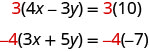
This gives us these two new equations:
英語のヒント
次の2つの新しい方程式が得られる。
When we add these equations,
英語のヒント
これらを足すと、
the x’s are eliminated and we just have −29y = 58.
英語のヒント
xの項が消え、−29y=58だけが残る。
Once we get an equation with just one variable, we solve it. Then we substitute that value into one of the original equations to solve for the remaining variable. And, as always, we check our answer to make sure it is a solution to both of the original equations.
英語のヒント
変数が1つの方程式になったら解く。その値を元の方程式の1つに代入し、残りの変数を求める。いつもどおり、元の両方の方程式の解であることを確かめる。
Now we’ll see how to use elimination to solve the same system of equations we solved by graphing and by substitution.
英語のヒント
今度は、グラフと代入法で解いたのと同じ連立方程式を加減法で解く方法を見る。
Example 5.25例題 5.25
How to Solve a System of Equations by Elimination加減法による連立方程式の解き方
Solve the system by elimination.
英語のヒント
消去法で連立方程式を解け。
Solution解答

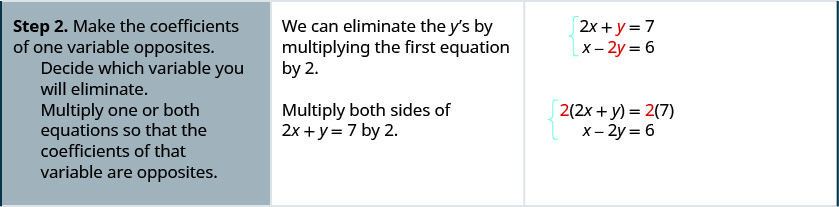





Try It (2)確認問題(2題)
The steps are listed below for easy reference.
英語のヒント
参照しやすいように、手順を下にまとめる。
First we’ll do an example where we can eliminate one variable right away.
英語のヒント
まず、すぐに1つの変数を消去できる例を扱う。
Example 5.26例題 5.26
Solve the system by elimination.
英語のヒント
消去法で連立方程式を解け。
Solution解答
 |
|
Both equations are in standard form. 両方の方程式は標準形である。 |
|
The coefficients of y are already opposites. yの係数はすでに互いに符号が逆の数である。 |
|
Add the two equations to eliminate y. The resulting equation has only 1 variable, x. 2つの方程式を足してyを消去する。得られる方程式の変数はxだけである。 |
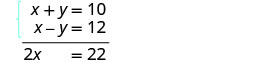 |
Solve for x, the remaining variable. Substitute x = 11 into one of the original equations. 残った変数xを求める。元の方程式の1つにx=11を代入する。 |
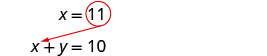 |
 |
|
Solve for the other variable, y. もう一方の変数yを求める。 |
 |
Write the solution as an ordered pair. 解を順序対で表す。 |
The ordered pair is (11, −1). 順序対は(11, −1)である。 |
Check that the ordered pair is a solution to both original equations. 順序対が元の両方の方程式の解か確かめる。 |
|
The solution is (11, −1). 解は(11, −1)である。 |
Try It (2)確認問題(2題)
In Example 5.27, we will be able to make the coefficients of one variable opposites by multiplying one equation by a constant.
英語のヒント
例題5.27では、一方の方程式に定数を掛けることで、1つの変数の係数を互いに符号が逆の数にできる。
Example 5.27例題 5.27
Solve the system by elimination.
英語のヒント
消去法で連立方程式を解け。
Solution解答
 |
|
Both equations are in standard form. 両方の方程式は標準形である。 |
|
None of the coefficients are opposites. 互いに符号が逆の係数はない。 |
|
We can make the coefficients of y opposites by multiplying the first equation by −3. 最初の方程式に−3を掛けると、yの係数を互いに符号が逆の数にできる。 |
 |
Simplify. 簡単にする。 |
 |
Add the two equations to eliminate y. 2つの方程式を足してyを消去する。 |
 |
Solve for the remaining variable, x. Substitute x = −4 into one of the original equations. 残った変数xを求める。元の方程式の1つにx=−4を代入する。 |
 |
 |
|
Solve for y. yについて解く。 |
   |
Write the solution as an ordered pair. 解を順序対で表す。 |
The ordered pair is (−4, −5). 順序対は(−4, −5)である。 |
Check that the ordered pair is a solution to both original equations. 順序対が元の両方の方程式の解か確かめる。 |
|
The solution is (−4, −5). 解は(−4, −5)である。 |
Try It (2)確認問題(2題)
Now we’ll do an example where we need to multiply both equations by constants in order to make the coefficients of one variable opposites.
英語のヒント
今度は、一方の変数の係数を互いに符号が逆の数にするため、両方の方程式に定数を掛ける必要がある例を扱う。
Example 5.28例題 5.28
Solve the system by elimination.
英語のヒント
消去法で連立方程式を解け。
Solution解答
In this example, we cannot multiply just one equation by any constant to get opposite coefficients. So we will strategically multiply both equations by a constant to get the opposites.
英語のヒント
この例では、片方だけに定数を掛けても係数を互いに符号が逆の数にできない。そこで、適切な定数を選んで両方に掛け、係数を互いに符号が逆の数にする。
 |
|
Both equations are in standard form. To get opposite coefficients of y, we will multiply the first equation by 2 and the second equation by 3. 両方の方程式は標準形である。yの係数を互いに符号が逆の数にするため、最初の方程式に2、2つ目に3を掛ける。 |
 |
Simplify. 簡単にする。 |
 |
Add the two equations to eliminate y. 2つの方程式を足してyを消去する。 |
 |
Solve for x. Substitute x = 0 into one of the original equations. xを求める。元の方程式の1つにx=0を代入する。 |
 |
 |
|
Solve for y. yについて解く。 |
 |
 |
|
Write the solution as an ordered pair. 解を順序対で表す。 |
The ordered pair is (0, −3). 順序対は(0, −3)である。 |
Check that the ordered pair is a solution to both original equations. 順序対が元の両方の方程式の解か確かめる。 |
|
The solution is (0, −3). 解は(0, −3)である。 |
What other constants could we have chosen to eliminate one of the variables? Would the solution be the same?
英語のヒント
一方の変数を消去するために、ほかにどの定数を選べただろうか。解は同じになるだろうか。
Try It (2)確認問題(2題)
When the system of equations contains fractions, we will first clear the fractions by multiplying each equation by its LCD.
英語のヒント
連立方程式に分数があるときは、まず各方程式にその最小公分母を掛け、分数をなくす。
Example 5.29例題 5.29
Solve the system by elimination.
英語のヒント
消去法で連立方程式を解け。
Solution解答
In this example, both equations have fractions. Our first step will be to multiply each equation by its LCD to clear the fractions.
英語のヒント
この例では両方の方程式に分数がある。最初に、それぞれに最小公分母を掛けて分数をなくす。
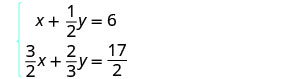 |
|
To clear the fractions, multiply each equation by its LCD. 分数をなくすため、それぞれの方程式に最小公分母を掛ける。 |
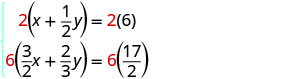 |
Simplify. 簡単にする。 |
 |
Now we are ready to eliminate one of the variables. Notice that both equations are in standard form. 1つの変数を消去する準備ができた。両方とも標準形であることに注意する。 |
|
We can eliminate y multiplying the top equation by −4. 上の方程式に−4を掛けるとyを消去できる。 |
 |
Simplify and add. Substitute x = 3 into one of the original equations. 簡単にして足す。元の方程式の1つにx=3を代入する。 |
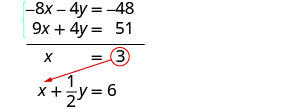 |
Solve for y. yについて解く。 |
 |
 |
|
 |
|
Write the solution as an ordered pair. 解を順序対で表す。 |
The ordered pair is (3, 6). 順序対は(3, 6)である。 |
Check that the ordered pair is a solution to both original equations. この順序対が元の両方の方程式の解であることを確かめる。 |
|
The solution is (3, 6). 解は(3, 6)である。 |
Try It (2)確認問題(2題)
In the Solving Systems of Equations by Graphing we saw that not all systems of linear equations have a single ordered pair as a solution. When the two equations were really the same line, there were infinitely many solutions. We called that a consistent system. When the two equations described parallel lines, there was no solution. We called that an inconsistent system.
英語のヒント
「グラフで連立方程式を解く」では、すべての連立一次方程式の解が1つの順序対になるわけではないことを見た。2つの方程式が同じ直線なら、解は無数にあった。これを整合的な連立方程式と呼んだ。平行な直線なら解はなく、不整合な連立方程式と呼んだ。
Example 5.30例題 5.30
Solve the system by elimination.
英語のヒント
消去法で連立方程式を解け。
Solution解答
Write the second equation in standard form. 2つ目の方程式を標準形に書く。 |
|
Clear the fractions by multiplying the second equation by 4. 2つ目の方程式に4を掛けて分数をなくす。 |
|
Simplify. 簡単にする。 |
|
To eliminate a variable, we multiply the second equation by . Simplify and add. 変数を消去するため、2つ目の方程式にを掛ける。簡単にして足す。 |
This is a true statement. The equations are consistent but dependent. Their graphs would be the same line. The system has infinitely many solutions.
英語のヒント
これは真である。方程式は整合的だが従属している。グラフは同じ直線になる。連立方程式の解は無数にある。
After we cleared the fractions in the second equation, did you notice that the two equations were the same? That means we have coincident lines.
英語のヒント
2つ目の方程式の分数をなくした後、両方が同じ式になったことに気付いただろうか。これは直線が一致するということである。
Try It (2)確認問題(2題)
Example 5.31例題 5.31
Solve the system by elimination.
英語のヒント
消去法で連立方程式を解け。
Solution解答
The equations are in standard form. 方程式は標準形である。 |
|
Multiply the second equation by 3 to eliminate a variable. 変数を消去するため、2つ目の方程式に3を掛ける。 |
|
Simplify and add. 簡単にして足す。 |
This statement is false. The equations are inconsistent and so their graphs would be parallel lines.
英語のヒント
これは偽である。方程式は不整合なので、グラフは平行な直線になる。
The system does not have a solution.
英語のヒント
この連立方程式に解はない。