第5章連立一次方程式
Solve Uniform Motion Applications等速運動の応用問題を解く
We used a table to organize the information in uniform motion problems when we introduced them earlier. We’ll continue using the table here. The basic equation was D = rt where D is the distance travelled, r is the rate, and t is the time.
英語のヒント
等速運動の問題を以前導入したとき、表で情報を整理した。ここでも表を使う。基本の式はD=rtで、Dは移動距離、rは速さ、tは時間である。
Our first example of a uniform motion application will be for a situation similar to some we have already seen, but now we can use two variables and two equations.
英語のヒント
等速運動の最初の応用例は、すでに見た例に似た状況だが、今度は2つの変数と2つの方程式を使える。
Example 5.42例題 5.42
Translate to a system of equations and then solve:
英語のヒント
連立方程式に表し、それを解け:
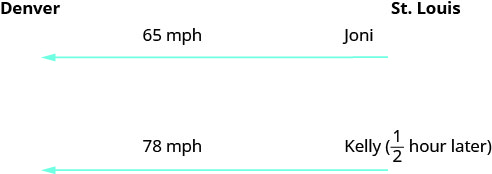
Joni left St. Louis on the interstate, driving west towards Denver at a speed of 65 miles per hour. Half an hour later, Kelly left St. Louis on the same route as Joni, driving 78 miles per hour. How long will it take Kelly to catch up to Joni?
英語のヒント
ジョニはセントルイスを出発し、州間高速道路を西のデンバーへ向けて時速65マイルで運転した。30分後、ケリーはセントルイスを出発し、同じ経路を時速78マイルで運転した。ケリーがジョニに追い付くまで何時間かかるか。
Solution解答
A diagram is useful in helping us visualize the situation.
英語のヒント
図は状況を思い描く助けになる。
Identify and name what we are looking for. A chart will help us organize the data. We know the rates of both Joni and Kelly, and so we enter them in the chart. 求めるものを特定して名前を付ける。表を使うとデータを整理しやすい。ジョニとケリーの速さは分かっているので表に記入する。 |
|
We are looking for the length of time Kelly, k, and Joni, j, will each drive. Since we can fill in the Distance column. ケリーの運転時間kとジョニの運転時間jを求める。なので、距離の列を埋められる。 |
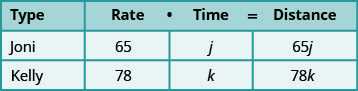 |
Translate into a system of equations. To make the system of equations, we must recognize that Kelly and Joni will drive the same distance. So, Also, since Kelly left later, her time will be hour less than Joni’s time. So, 連立方程式に表す。ケリーとジョニは同じ距離を走ることを認識する必要がある。したがって。また、ケリーは遅れて出発したので、運転時間はジョニより時間短い。したがって。 |
|
Now we have the system. 連立方程式が得られた。 |
 |
Solve the system of equations by substitution. 代入法で連立方程式を解く。 |
 |
Substitute into the second equation, then solve for j. 2つ目の方程式にを代入してjを求める。 |
 |
 |
|
 |
|
 |
|
To find Kelly’s time, substitute j = 3 into the first equation, then solve for k. ケリーの時間を求めるには、最初の方程式にj=3を代入してkを求める。 |
 |
 |
|
 |
|
Check the answer in the problem. Joni 3 hours (65 mph) = 195 miles. Kelly hours (78 mph) = 195 miles. Yes, they will have traveled the same distance when they meet. 答えを問題に戻して確かめる。ジョニは3時間×時速65マイル=195マイル。ケリーは時間×時速78マイル=195マイル。確かに、出会うときの移動距離は同じである。 |
|
Answer the question. 問いに答える。 |
Kelly will catch up to Joni in hours. By then, Joni will have traveled 3 hours. ケリーは時間でジョニに追い付く。その時点でジョニは3時間走っている。 |
Try It (2)確認問題(2題)
Many real-world applications of uniform motion arise because of the effects of currents—of water or air—on the actual speed of a vehicle. Cross-country airplane flights in the United States generally take longer going west than going east because of the prevailing wind currents.
英語のヒント
等速運動の実際の応用問題の多くは、水や空気の流れが乗り物の実際の速さに与える影響から生じる。米国の大陸横断飛行は、卓越する風の流れのため、一般に東行きより西行きのほうが時間がかかる。
Let’s take a look at a boat travelling on a river. Depending on which way the boat is going, the current of the water is either slowing it down or speeding it up.
英語のヒント
川を進むボートを見よう。進む方向によって、水流はボートを遅くすることも速くすることもある。
Figure 5.7 and Figure 5.8 show how a river current affects the speed at which a boat is actually travelling. We’ll call the speed of the boat in still water b and the speed of the river current c.
英語のヒント
In Figure 5.7 the boat is going downstream, in the same direction as the river current. The current helps push the boat, so the boat’s actual speed is faster than its speed in still water. The actual speed at which the boat is moving is b + c.
英語のヒント
図5.7ではボートは川の流れと同じ向きに下流へ進む。水流がボートを押すので、実際の速さは静水中より速い。実際の速さはb+cである。
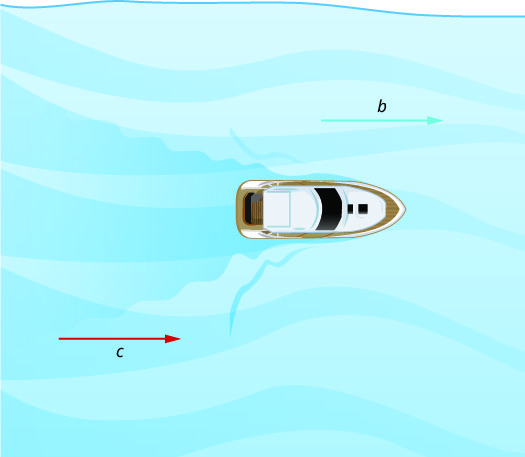
Figure 5.7図 5.7
In Figure 5.8 the boat is going upstream, opposite to the river current. The current is going against the boat, so the boat’s actual speed is slower than its speed in still water. The actual speed of the boat is .
英語のヒント
図5.8ではボートは川の流れに逆らって上流へ進む。水流が逆向きに働くので、実際の速さは静水中より遅い。実際の速さはである。
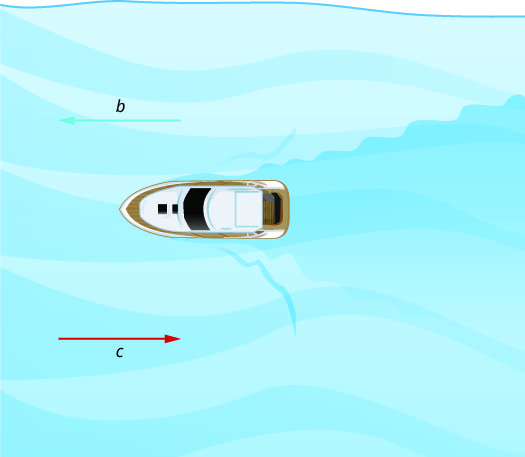
Figure 5.8図 5.8
Example 5.43例題 5.43
Translate to a system of equations and then solve:
英語のヒント
連立方程式に表し、それを解け:
A river cruise ship sailed 60 miles downstream for 4 hours and then took 5 hours sailing upstream to return to the dock. Find the speed of the ship in still water and the speed of the river current.
英語のヒント
遊覧船は川を下って60マイルを4時間で進み、上流の船着き場へ戻るのに5時間かかった。静水中の船の速さと川の流れの速さを求めよ。
Solution解答
Read the problem.
英語のヒント
問題を読む。
This is a uniform motion problem and a picture will help us visualize the situation.
英語のヒント
等速運動の問題なので、図で状況を思い描くとよい。
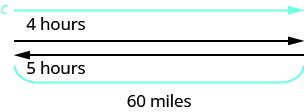
Identify what we are looking for. 何を求めるのかを明らかにする。 |
We are looking for the speed of the ship in still water and the speed of the current. 静水中の船の速さと水流の速さを求める。 |
Name what we are looking for. 求めるものに名前を付ける。 |
Let the rate of the ship in still water. the rate of the current 静水中の船の速さ、水流の速さ、とする。 |
A chart will help us organize the information. The ship goes downstream and then upstream. Going downstream, the current helps the ship; therefore, the ship’s actual rate is s + c. Going upstream, the current slows the ship; therefore, the actual rate is s − c. 表を使うと情報を整理しやすい。船は下流へ進んでから上流へ戻る。下りでは水流が助けるので、実際の速さはs+cである。上りでは水流が船を遅くするので、実際の速さはs−cである。 |
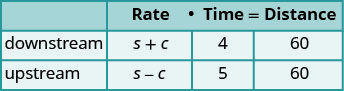 |
Downstream it takes 4 hours. Upstream it takes 5 hours. Each way the distance is 60 miles. 下りは4時間、上りは5時間かかる。どちらも距離は60マイルである。 |
|
Translate into a system of equations. Since rate times time is distance, we can write the system of equations. 連立方程式に表す。速さと時間の積が距離なので、連立方程式を書ける。 |
 |
Solve the system of equations. Distribute to put both equations in standard form, then solve by elimination. 連立方程式を解く。分配法則で両方を標準形にして、加減法で解く。 |
 |
Multiply the top equation by 5 and the bottom equation by 4. Add the equations, then solve for s. 上の方程式に5、下に4を掛ける。方程式を足してsを求める。 |
 |
Substitute s = 13.5 into one of the original equations. 元の方程式の1つにs=13.5を代入する。 |
 |
 |
|
 |
|
 |
|
 |
|
Check the answer in the problem. The downstream rate would be 13.5 + 1.5 = 15 mph. In 4 hours the ship would travel 15 · 4 = 60 miles. The upstream rate would be 13.5 − 1.5 = 12 mph. In 5 hours the ship would travel 12 · 5 = 60 miles. 答えを問題に戻して確かめる。下りの速さは13.5+1.5=15マイル毎時で、4時間に15×4=60マイル進む。上りの速さは13.5−1.5=12マイル毎時で、5時間に12×5=60マイル進む。 |
|
Answer the question. 問いに答える。 |
The rate of the ship is 13.5 mph and the rate of the current is 1.5 mph. 船の速さは時速13.5マイル、水流の速さは時速1.5マイルである。 |
Try It (2)確認問題(2題)
Wind currents affect airplane speeds in the same way as water currents affect boat speeds. We’ll see this in Example 5.44. A wind current in the same direction as the plane is flying is called a tailwind. A wind current blowing against the direction of the plane is called a headwind.
英語のヒント
水流が船の速さに影響するのと同じように、風は飛行機の速さに影響する。例題5.44で見よう。飛行機の進行方向と同じ向きの風を追い風、逆向きの風を向かい風という。
Example 5.44例題 5.44
Translate to a system of equations and then solve:
英語のヒント
連立方程式に表し、それを解け:
A private jet can fly 1095 miles in three hours with a tailwind but only 987 miles in three hours into a headwind. Find the speed of the jet in still air and the speed of the wind.
英語のヒント
自家用ジェット機は、追い風なら3時間で1095マイル飛べるが、向かい風では同じ3時間で987マイルしか飛べない。無風時の機体の速さと風速を求めよ。
Solution解答
Solution解答
Read the problem.
英語のヒント
問題を読む。
This is a uniform motion problem and a picture will help us visualize.
英語のヒント
等速運動の問題なので、図で状況を思い描くとよい。
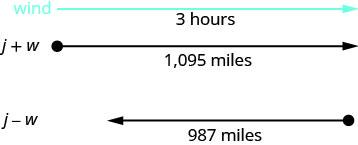
Identify what we are looking for. 何を求めるのかを明らかにする。 |
We are looking for the speed of the jet in still air and the speed of the wind. 無風時のジェット機の速さと風速を求める。 |
Name what we are looking for. 求めるものに名前を付ける。 |
Let the speed of the jet in still air. the speed of the wind 無風時のジェット機の速さ、風速、とする。 |
A chart will help us organize the information. The jet makes two trips-one in a tailwind and one in a headwind. In a tailwind, the wind helps the jet and so the rate is j + w. In a headwind, the wind slows the jet and so the rate is j − w. 表を使うと情報を整理しやすい。ジェット機は追い風と向かい風で1回ずつ飛ぶ。追い風では風が助けるので速さはj+w、向かい風では風が遅くするので速さはj−wである。 |
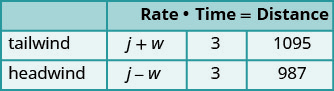 |
Each trip takes 3 hours. In a tailwind the jet flies 1095 miles. In a headwind the jet flies 987 miles. どちらの飛行も3時間かかる。追い風では1095マイル、向かい風では987マイル飛ぶ。 |
|
Translate into a system of equations. Since rate times time is distance, we get the system of equations. 連立方程式に表す。速さと時間の積が距離なので、連立方程式が得られる。 |
 |
Solve the system of equations. Distribute, then solve by elimination. 連立方程式を解く。分配法則を使ってから加減法で解く。 |
 |
Add, and solve for j. Substitute j = 347 into one of the original equations, then solve for w. 足してjを求める。元の方程式の1つにj=347を代入してwを求める。 |
 |
 |
|
 |
|
 |
|
 |
|
Check the answer in the problem. With the tailwind, the actual rate of the jet would be 347 + 18 = 365 mph. In 3 hours the jet would travel 365 · 3 = 1095 miles. Going into the headwind, the jet’s actual rate would be 347 − 18 = 329 mph. In 3 hours the jet would travel 329 · 3 = 987 miles. 答えを問題に戻して確かめる。追い風での実際の速さは347+18=365マイル毎時で、3時間に365×3=1095マイル飛ぶ。向かい風での実際の速さは347−18=329マイル毎時で、3時間に329×3=987マイル飛ぶ。 |
|
Answer the question. 問いに答える。 |
The rate of the jet is 347 mph and the rate of the wind is 18 mph. ジェット機の速さは時速347マイル、風速は時速18マイルである。 |