第10章固定軸まわりの回転
10.1 Rotational Variables10.1 回転を表す量
Learning Objectives学習目標
Learning Objectives学習目標
By the end of this section, you will be able to:
英語のヒント
この節を終えると、次のことができるようになる。
- Describe the physical meaning of rotational variables as applied to fixed-axis rotation
英語のヒント
固定軸の周りの回転に用いる、回転を表す量の物理的意味を述べる。 - Explain how angular velocity is related to tangential speed
英語のヒント
角速度と接線方向の速さの関係を説明する。 - Calculate the instantaneous angular velocity given the angular position function
英語のヒント
角位置の関数が与えられたとき、瞬間角速度を計算する。 - Find the angular velocity and angular acceleration in a rotating system
英語のヒント
回転する系の角速度と角加速度を求める。 - Calculate the average angular acceleration when the angular velocity is changing
英語のヒント
角速度が変化するときの平均角加速度を計算する。 - Calculate the instantaneous angular acceleration given the angular velocity function
英語のヒント
角速度の関数が与えられたとき、瞬間角加速度を計算する。
So far in this text, we have mainly studied translational motion, including the variables that describe it: displacement, velocity, and acceleration. Now we expand our description of motion to rotation—specifically, rotational motion about a fixed axis. We will find that rotational motion is described by a set of related variables similar to those we used in translational motion.
英語のヒント
本書ではここまで、並進運動と、それを記述する量である変位、速度、加速度を主に学んできた。ここから運動の記述を回転、特に固定軸の周りの回転運動へ広げる。回転運動も、並進運動で用いたものと似た、互いに関係する一組の量で記述されることが分かる。
Angular Velocity角速度
Uniform circular motion (discussed previously in Motion in Two and Three Dimensions) is motion in a circle at constant speed. Although this is the simplest case of rotational motion, it is very useful for many situations, and we use it here to introduce rotational variables.
英語のヒント
等速円運動(「2次元と3次元の運動」で扱った)とは、円周上を一定の速さで動く運動である。これは回転運動の最も単純な場合だが、多くの状況で非常に有用である。ここでは、回転を表す量を導入するために使う。
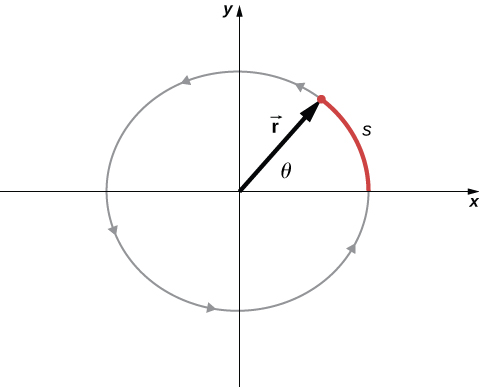
In Figure 10.2, we show a particle moving in a circle. The coordinate system is fixed and serves as a frame of reference to define the particle’s position. Its position vector from the origin of the circle to the particle sweeps out the angle , which increases in the counterclockwise direction as the particle moves along its circular path. The angle is called the angular position of the particle. As the particle moves in its circular path, it also traces an arc length s. The particle may complete more than one revolution around the circle, and so the angle may be greater than , and the arc length s may be greater than the circumference, .
英語のヒント
図10.2に円周上を動く粒子を示す。座標系は固定され、粒子の位置を定める基準系となる。円の原点から粒子へ向かう位置ベクトルが掃く角をとする。粒子が円形の経路を進むにつれ、この角は反時計回りの方向へ増える。角を粒子の角位置と呼ぶ。円周上を動く粒子は、長さsの弧も描く。粒子は円を1周以上することもあるので、角はより大きくなり、弧長sは円周より長くなることもある。
OpenStax / Rice University, University Physics Volume 1, CC BY 4.0. Source-book artwork retained. · CC BY 4.0 · Source出典

Figure 10.2図 10.2
A particle follows a circular path. As it moves counterclockwise, it sweeps out a positive angle with respect to the x-axis and traces out an arc length s.
英語のヒント
粒子が円形の経路をたどる。反時計回りに動くにつれ、x軸から測った正の角を掃き、長さsの弧を描く。
The angle is related to the radius of the circle and the arc length by
英語のヒント
角は、円の半径と弧長に次のように関係する。
The angle , the angular position of the particle along its path, has units of radians (rad). There are radians in Note that the radian measure is a ratio of length measurements, and therefore is a dimensionless quantity. As the particle moves along its circular path, its angular position changes and it undergoes angular displacements
英語のヒント
角は、経路上の粒子の角位置を表し、単位はラジアン(rad)である。はラジアンに等しい。ラジアンによる角の値は長さ同士の比であり、無次元量であることに注意しよう。粒子が円形の経路を進むと角位置が変わり、角変位を生じる。
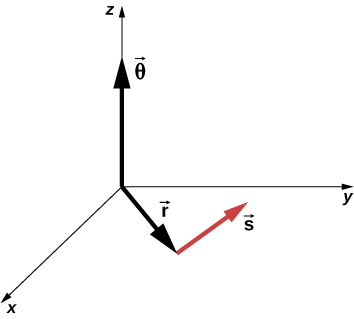
We can assign vectors to the quantities in Equation 10.1. The angle is a vector out of the page in Figure 10.2. The angular position vector and the arc length both lie in the plane of the page. These three vectors are related to each other by
英語のヒント
(10.2)
That is, the arc length is the cross product of the angle vector and the position vector, as shown in Figure 10.3.
英語のヒント
つまり、図10.3に示すように、弧長は角ベクトルと位置ベクトルの外積である。
OpenStax / Rice University, University Physics Volume 1, CC BY 4.0. Source-book artwork retained. · CC BY 4.0 · Source出典

Figure 10.3図 10.3
The angle vector points along the z-axis and the position vector and arc length vector both lie in the xy-plane. We see that . All three vectors are perpendicular to each other.
英語のヒント
角ベクトルはz軸に沿い、位置ベクトルと弧長ベクトルはどちらもxy平面内にある。であり、三つのベクトルは互いに垂直である。
The magnitude of the angular velocity, denoted by , is the time rate of change of the angle as the particle moves in its circular path. The instantaneous angular velocity is defined as the limit in which in the average angular velocity :
英語のヒント
で表す角速度の大きさは、円形経路を動く粒子の角の時間変化率である。瞬間角速度は、平均角速度でとした極限として定義する。
where is the angle of rotation (Figure 10.2). The units of angular velocity are radians per second (rad/s). Angular velocity can also be referred to as the rotation rate in radians per second. In many situations, we are given the rotation rate in revolutions/s or cycles/s. To find the angular velocity, we must multiply revolutions/s by , since there are radians in one complete revolution. Since the direction of a positive angle in a circle is counterclockwise, we take counterclockwise rotations as being positive and clockwise rotations as negative.
英語のヒント
ここで、は回転角である(図10.2)。角速度の単位はラジアン毎秒(rad/s)である。角速度は、毎秒何ラジアン回転するかという回転の割合とも言える。多くの場合、回転の割合は回転毎秒やサイクル毎秒で与えられる。角速度を求めるには、回転毎秒の値にを掛けなければならない。1回転がラジアンだからである。円の正の角は反時計回りなので、反時計回りの回転を正、時計回りの回転を負とする。
We can see how angular velocity is related to the tangential speed of the particle by differentiating Equation 10.1 with respect to time. We rewrite Equation 10.1 as
英語のヒント
Taking the derivative with respect to time and noting that the radius r is a constant, we have
英語のヒント
半径rが一定であることに注意して時間で微分すると、次を得る。
where . Here is just the tangential speed of the particle in Figure 10.2. Thus, by using Equation 10.3, we arrive at
英語のヒント
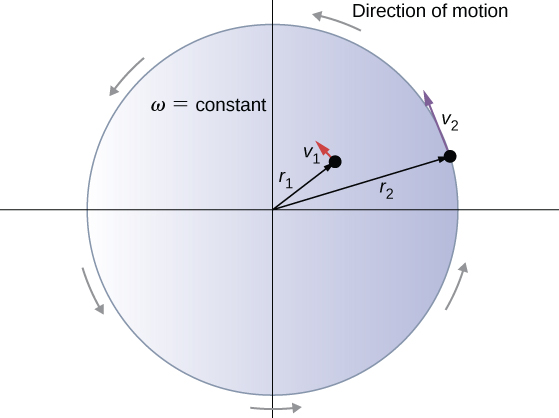
That is, the tangential speed of the particle is its angular velocity times the radius of the circle. From Equation 10.4, we see that the tangential speed of the particle increases with its distance from the axis of rotation for a constant angular velocity. This effect is shown in Figure 10.4. Two particles are placed at different radii on a rotating disk with a constant angular velocity. As the disk rotates, the tangential speed increases linearly with the radius from the axis of rotation. In Figure 10.4, we see that and . But the disk has a constant angular velocity, so . This means or . Thus, since , .
英語のヒント
OpenStax / Rice University, University Physics Volume 1, CC BY 4.0. Source-book artwork retained. · CC BY 4.0 · Source出典

Figure 10.4図 10.4
Two particles on a rotating disk have different tangential speeds, depending on their distance to the axis of rotation.
英語のヒント
回転する円板上の二つの粒子は、回転軸からの距離に応じて、接線方向の速さが異なる。
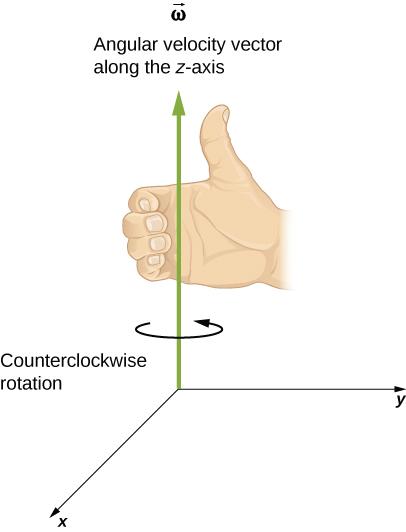
Up until now, we have discussed the magnitude of the angular velocity which is a scalar quantity—the change in angular position with respect to time. The vector is the vector associated with the angular velocity and points along the axis of rotation. This is useful because when a rigid body is rotating, we want to know both the axis of rotation and the direction that the body is rotating about the axis, clockwise or counterclockwise. The angular velocity gives us this information. The angular velocity has a direction determined by what is called the right-hand rule. The right-hand rule is such that if the fingers of your right hand wrap counterclockwise from the x-axis (the direction in which increases) toward the y-axis, your thumb points in the direction of the positive z-axis (Figure 10.5). An angular velocity that points along the positive z-axis therefore corresponds to a counterclockwise rotation, whereas an angular velocity that points along the negative z-axis corresponds to a clockwise rotation.
英語のヒント
ここまでは、角速度の大きさ、つまり角位置の時間変化率というスカラー量を扱った。ベクトルは角速度に対応するベクトルで、回転軸に沿う。剛体が回転するときには、回転軸と、その軸の周りに時計回りか反時計回りかという回転の向きの両方を知りたいので、このベクトルが役立つ。角速度はその情報を与える。角速度の向きは、右手の法則と呼ぶ規則で定まる。右手の指を、x軸からy軸へ反時計回り(が増える向き)に曲げると、親指がz軸の正方向を指す(図10.5)。したがって、正のz軸に沿う角速度は反時計回りの回転に対応し、負のz軸に沿う角速度は時計回りの回転に対応する。
OpenStax / Rice University, University Physics Volume 1, CC BY 4.0. Source-book artwork retained. · CC BY 4.0 · Source出典

Figure 10.5図 10.5
For counterclockwise rotation in the coordinate system shown, the angular velocity points in the positive z-direction by the right-hand-rule.
英語のヒント
図の座標系で反時計回りに回転する場合、右手の法則によって、角速度はzの正方向へ向く。
Similar to Equation 10.2, one can state a cross product relation to the vector of the tangential velocity as stated in Equation 10.4. Therefore, we have
英語のヒント
(10.5)
That is, the tangential velocity is the cross product of the angular velocity and the position vector, as shown in Figure 10.6. From part (a) of this figure, we see that with the angular velocity in the positive z-direction, the rotation in the xy-plane is counterclockwise. In part (b), the angular velocity is in the negative z-direction, giving a clockwise rotation in the xy-plane.
英語のヒント
つまり、図10.6に示すように、接線速度は角速度と位置ベクトルの外積である。(a)では角速度がzの正方向にあると、xy平面内の回転は反時計回りになる。(b)では角速度がzの負方向にあり、xy平面内の回転は時計回りになる。
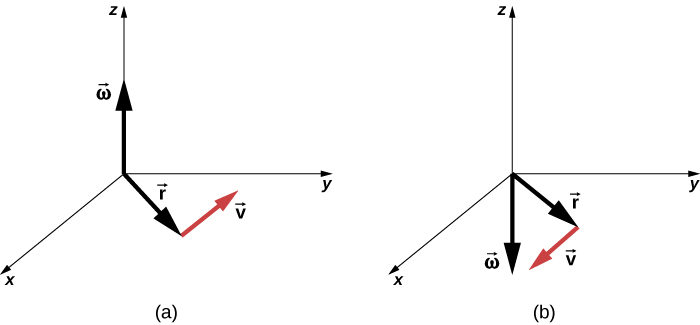
OpenStax / Rice University, University Physics Volume 1, CC BY 4.0. Source-book artwork retained. · CC BY 4.0 · Source出典

Figure 10.6図 10.6
The vectors shown are the angular velocity, position, and tangential velocity. (a) The angular velocity points in the positive z-direction, giving a counterclockwise rotation in the xy-plane. (b) The angular velocity points in the negative z-direction, giving a clockwise rotation.
英語のヒント
角速度、位置、接線速度の各ベクトル。(a)角速度がzの正方向にあると、xy平面内の回転は反時計回りになる。(b)角速度がzの負方向にあると、回転は時計回りになる。
Example 10.1例題 10.1
Rotation of a Flywheelはずみ車の回転
A flywheel rotates such that it sweeps out an angle at the rate of radians. The wheel rotates counterclockwise when viewed in the plane of the page. (a) What is the angular velocity of the flywheel? (b) What direction is the angular velocity? (c) How many radians does the flywheel rotate through in 30 s? (d) What is the tangential speed of a point on the flywheel 10 cm from the axis of rotation?
英語のヒント
はずみ車が回転し、掃く角度がラジアンで与えられる。車輪は、紙面内で見ると反時計回りに回転する。(a)はずみ車の角速度は何か。(b)角速度の向きは何か。(c)30 s間に何ラジアン回転するか。(d)回転軸から10 cm離れた点の接線方向の速さは何か。
Strategy方針
The functional form of the angular position of the flywheel is given in the problem as , so by taking the derivative with respect to time, we can find the angular velocity. We use the right-hand rule to find the angular velocity. To find the angular displacement of the flywheel during 30 s, we seek the angular displacement , where the change in angular position is between 0 and 30 s. To find the tangential speed of a point at a distance from the axis of rotation, we multiply its distance times the angular velocity of the flywheel.
英語のヒント
はずみ車の角位置はという関数の形で与えられているので、時間で微分すれば角速度を求められる。角速度の向きには右手の法則を使う。30 s間の角変位を求めるには、0 sと30 sの間の角位置の変化を求める。回転軸からある距離にある点の接線方向の速さは、その距離にはずみ車の角速度を掛けて求める。
Solution解答
- . We see that the angular velocity is a constant.
英語のヒント
。角速度が一定であることが分かる。 - By the right-hand rule, we curl the fingers in the direction of rotation, which is counterclockwise in the plane of the page, and the thumb points in the direction of the angular velocity, which is out of the page.
英語のヒント
右手の法則に従い、指を回転の向き、つまり紙面内の反時計回りに曲げる。すると親指は角速度の向き、つまり紙面から手前へ向く。 - .
- .
Significance考察
In 30 s, the flywheel has rotated through quite a number of revolutions, about 215 if we divide the angular displacement by . A massive flywheel can be used to store energy in this way, if the losses due to friction are minimal. Recent research has considered superconducting bearings on which the flywheel rests, with zero energy loss due to friction.
英語のヒント
30 sの間にはずみ車はかなりの回数を回転している。角変位をで割ると、約215回転になる。摩擦による損失が最小限なら、このような方法で重いはずみ車にエネルギーを蓄えられる。近年の研究では、はずみ車を支える超伝導軸受を使い、摩擦によるエネルギー損失を0にすることが検討されている。