第10章固定軸まわりの回転
A uniform thin rod with axis at the end一端を通る軸を持つ一様な細い棒
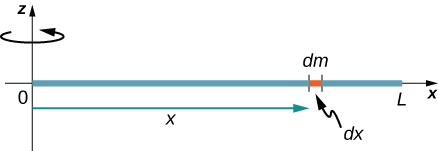
Now consider the same uniform thin rod of mass M and length L, but this time we move the axis of rotation to the end of the rod. We wish to find the moment of inertia about this new axis (Figure 10.26). The quantity dm is again defined to be a small element of mass making up the rod. Just as before, we obtain
英語のヒント
同じ質量M、長さLの一様な細い棒で、今度は回転軸を棒の端へ移す。この新しい軸の慣性モーメントを求める(図10.26)。dmは再び、棒を構成する小さな質量要素とする。先ほどと同様に、次を得る。
However, this time we have different limits of integration. The rod extends from to , since the axis is at the end of the rod at . Therefore we find
英語のヒント
ただし、今回は積分範囲が異なる。軸は棒の端のにあるので、棒はからまで延びる。したがって、
OpenStax / Rice University, University Physics Volume 1, CC BY 4.0. Source-book artwork retained. · CC BY 4.0 · Source出典

Figure 10.26図 10.26
Calculation of the moment of inertia I for a uniform thin rod about an axis through the end of the rod.
英語のヒント
一様な細い棒について、一端を通る軸に対する慣性モーメントIを計算する。
Note the rotational inertia of the rod about its endpoint is larger than the rotational inertia about its center (consistent with the barbell example) by a factor of four.
英語のヒント
棒の端に対する回転の慣性は、中心に対するものの4倍大きい。バーベルの例と整合する結果である。
The Parallel-Axis Theorem平行軸の定理
The similarity between the process of finding the moment of inertia of a rod about an axis through its middle and about an axis through its end is striking, and suggests that there might be a simpler method for determining the moment of inertia for a rod about any axis parallel to the axis through the center of mass. Such an axis is called a parallel axis. There is a theorem for this, called the parallel-axis theorem, which we state here but do not derive in this text.
英語のヒント
棒の中央を通る軸と、一端を通る軸についての慣性モーメントの求め方は、驚くほど似ている。質量中心を通る軸と平行な任意の軸について、もっと簡単に求める方法がありそうだ。このような軸を平行軸という。そのための定理が、平行軸の定理である。ここでは述べるだけにして、本書では証明しない。
Let’s apply this to the rod examples solved above:
英語のヒント
これを、先ほど解いた棒の例へ適用しよう。
This result agrees with our more lengthy calculation from above. This is a useful equation that we apply in some of the examples and problems.
英語のヒント
この結果は、先ほどの長い計算の結果と一致する。この有用な式を、いくつかの例題や問題で使う。
A uniform thin disk about an axis through the center中心を通る軸の周りに回る一様な薄い円板
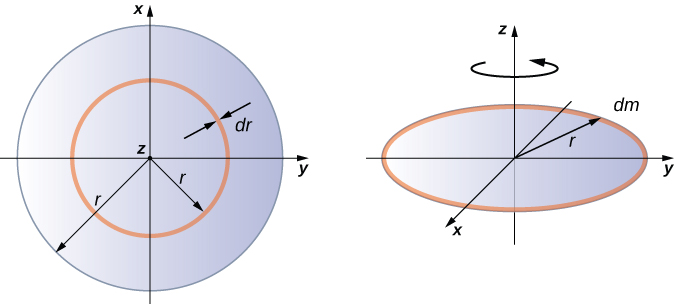
Integrating to find the moment of inertia of a two-dimensional object is a little bit trickier, but one shape is commonly done at this level of study—a uniform thin disk about an axis through its center (Figure 10.27).
英語のヒント
2次元の物体の慣性モーメントを積分で求めるのは、少し難しくなる。この段階でよく扱う形として、中心を通る軸の周りに回る、一様な薄い円板がある(図10.27)。
OpenStax / Rice University, University Physics Volume 1, CC BY 4.0. Source-book artwork retained. · CC BY 4.0 · Source出典

Figure 10.27図 10.27
Calculating the moment of inertia for a thin disk about an axis through its center.
英語のヒント
薄い円板について、中心を通る軸の慣性モーメントを計算する。
Since the disk is thin, we can take the mass as distributed entirely in the xy-plane. We again start with the relationship for the surface mass density, which is the mass per unit surface area. Since it is uniform, the surface mass density is constant:
英語のヒント
円板は薄いので、質量はすべてxy平面に分布すると考えられる。再び、単位面積あたりの質量である面密度の関係から始める。一様なので、面密度は一定である。
Now we use a simplification for the area. The area can be thought of as made up of a series of thin rings, where each ring is a mass increment dm of radius r equidistant from the axis, as shown in part (b) of the figure. The infinitesimal area of each ring dA is therefore given by the length of each ring () times the infinitesimal width of each ring dr:
英語のヒント
次に、面積を簡単に扱う。図(b)のように、面積はいくつもの細い輪からなると考えられる。各輪は半径rにあり、軸から等距離にある質量の増分dmである。各輪の無限小面積dAは、輪の長さと無限小の幅drの積で与えられる。
The full area of the disk is then made up from adding all the thin rings with a radius range from 0 to R. This radius range then becomes our limits of integration for dr, that is, we integrate from to . Putting this all together, we have
英語のヒント
半径0からRまでのすべての細い輪を足し合わせると、円板全体の面積になる。この半径の範囲がdrの積分範囲であり、からまで積分する。まとめると、次を得る。
Calculating the moment of inertia for compound objects複合物体の慣性モーメントを計算する
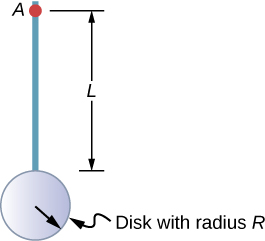
Now consider a compound object such as that in Figure 10.28, which depicts a thin disk at the end of a thin rod. This cannot be easily integrated to find the moment of inertia because it is not a uniformly shaped object. However, if we go back to the initial definition of moment of inertia as a summation, we can reason that a compound object’s moment of inertia can be found from the sum of each part of the object:
英語のヒント
次に、細い棒の先に薄い円板を付けた、図10.28のような複合物体を考える。一様な形でないため、そのまま積分して慣性モーメントを求めるのは簡単でない。しかし、慣性モーメントを総和で表す最初の定義へ戻れば、複合物体の慣性モーメントは、各部分の慣性モーメントの和から得られると分かる。
It is important to note that the moments of inertia of the objects in Equation 10.21 are about a common axis. In the case of this object, that would be a rod of length L rotating about its end, and a thin disk of radius R rotating about an axis shifted off of the center by a distance , where R is the radius of the disk. Let’s define the mass of the rod to be and the mass of the disk to be
英語のヒント
式10.21の各慣性モーメントは、共通の軸に対する値でなければならない。この物体では、一端の周りに回る長さLの棒と、中心から距離だけずれた軸の周りに回る、半径Rの薄い円板を考える。Rは円板の半径である。棒の質量を、円板の質量をと定める。
OpenStax / Rice University, University Physics Volume 1, CC BY 4.0. Source-book artwork retained. · CC BY 4.0 · Source出典

Figure 10.28図 10.28
Compound object consisting of a disk at the end of a rod. The axis of rotation is located at A.
英語のヒント
棒の先に円板を付けた複合物体。回転軸はAにある。
The moment of inertia of the rod is simply , but we have to use the parallel-axis theorem to find the moment of inertia of the disk about the axis shown. The moment of inertia of the disk about its center is and we apply the parallel-axis theorem to find
英語のヒント
棒の慣性モーメントは単にだが、図の軸に対する円板の慣性モーメントには平行軸の定理が必要となる。円板の中心に対する慣性モーメントはなので、平行軸の定理を使い、次を得る。
Adding the moment of inertia of the rod plus the moment of inertia of the disk with a shifted axis of rotation, we find the moment of inertia for the compound object to be
英語のヒント
棒の慣性モーメントと、回転軸をずらした円板の慣性モーメントを加えると、複合物体の慣性モーメントは次のようになる。