第10章固定軸まわりの回転
10.6 Torque10.6 トルク
Learning Objectives学習目標
Learning Objectives学習目標
By the end of this section, you will be able to:
英語のヒント
この節を終えると、次のことができるようになる。
- Describe how the magnitude of a torque depends on the magnitude of the lever arm and the angle the force vector makes with the lever arm
英語のヒント
トルクの大きさが、腕の長さと、力のベクトルが腕となす角度にどう依存するかを説明する。 - Determine the sign (positive or negative) of a torque using the right-hand rule
英語のヒント
右手の法則を使い、トルクの符号(正または負)を求める。 - Calculate individual torques about a common axis and sum them to find the net torque
英語のヒント
共通の軸の周りの個々のトルクを計算し、それらを加えて合トルクを求める。
An important quantity for describing the dynamics of a rotating rigid body is torque. We see the application of torque in many ways in our world. We all have an intuition about torque, as when we use a large wrench to unscrew a stubborn bolt. Torque is at work in unseen ways, as when we press on the accelerator in a car, causing the engine to put additional torque on the drive train. Or every time we move our bodies from a standing position, we apply a torque to our limbs. In this section, we define torque and make an argument for the equation for calculating torque for a rigid body with fixed-axis rotation.
英語のヒント
回転する剛体の力学を記述する重要な量がトルクである。身の回りには、トルクが応用される場面が数多くある。固く締まったボルトを大きなレンチで緩めるときのように、誰もがトルクを直感的に理解している。自動車のアクセルを踏み、エンジンから駆動系へさらにトルクを与えるときなど、目に見えないところでもトルクは働いている。また、立った姿勢から体を動かすたびに、手足にトルクを加えている。この節ではトルクを定義し、固定軸の周りを回転する剛体のトルクを計算する式の根拠を示す。
Defining Torqueトルクの定義
So far we have defined many variables that are rotational equivalents to their translational counterparts. Let’s consider what the counterpart to force must be. Since forces change the translational motion of objects, the rotational counterpart must be related to changing the rotational motion of an object about an axis. We call this rotational counterpart torque.
英語のヒント
ここまでに、並進運動の量に対応する回転運動の量を数多く定義してきた。力に対応する量は何かを考えよう。力は物体の並進運動を変えるので、回転において対応する量は、軸の周りの物体の回転運動を変えることに関係しているはずである。この回転における対応量をトルクと呼ぶ。
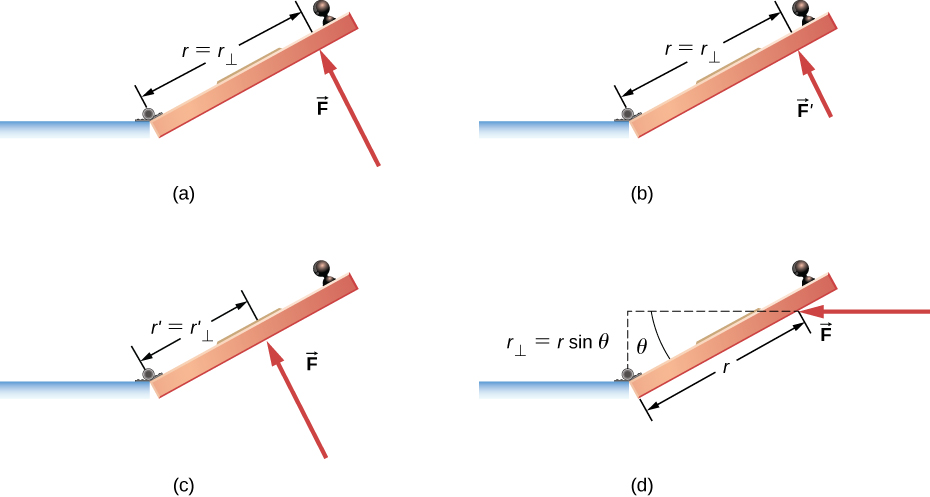
In everyday life, we rotate objects about an axis all the time, so intuitively we already know much about torque. Consider, for example, how we rotate a door to open it. First, we know that a door opens slowly if we push too close to its hinges; it is more efficient to rotate a door open if we push far from the hinges. Second, we know that we should push perpendicular to the plane of the door; if we push parallel to the plane of the door, we are not able to rotate it. Third, the larger the force, the more effective it is in opening the door; the harder you push, the more rapidly the door opens. The first point implies that the farther the force is applied from the axis of rotation, the greater the angular acceleration; the second implies that the effectiveness depends on the angle at which the force is applied; the third implies that the magnitude of the force must also be part of the equation. Note that for rotation in a plane, torque has two possible directions. Torque is either clockwise or counterclockwise relative to the chosen pivot point. Figure 10.31 shows counterclockwise rotations.
英語のヒント
日常生活では、物体を軸の周りに回すことがよくある。そのため、トルクについてすでに多くを直感的に知っている。たとえば、ドアを回転させて開ける動作を考えよう。第一に、蝶番に近すぎる場所を押すとドアはゆっくり開く。蝶番から離れた場所を押すほうが効率よく開けられる。第二に、ドアの面に垂直に押す必要がある。ドアの面と平行に押しても回転させられない。第三に、力が大きいほどドアを開ける効果が大きい。強く押すほど、ドアは速く開く。第一の点は、回転軸から離れた場所に力を加えるほど角加速度が大きいことを意味する。第二の点は、その効果が力を加える角度に依存することを意味する。第三の点は、力の大きさも式に含まれなければならないことを意味する。平面内の回転では、トルクには二つの向きがある。選んだ支点に対して時計回りか反時計回りである。図10.31は反時計回りの回転を示している。
OpenStax / Rice University, University Physics Volume 1, CC BY 4.0. Source-book artwork retained. · CC BY 4.0 · Source出典

Figure 10.31図 10.31
Torque is the turning or twisting effectiveness of a force, illustrated here for door rotation on its hinges (as viewed from overhead). Torque has both magnitude and direction. (a) A counterclockwise torque is produced by a force acting at a distance r from the hinges (the pivot point). (b) A smaller counterclockwise torque is produced when a smaller force acts at the same distance r from the hinges. (c) The same force as in (a) produces a smaller counterclockwise torque when applied at a smaller distance from the hinges. (d) A smaller counterclockwise torque is produced by the same magnitude force as (a) acting at the same distance as (a) but at an angle that is less than .
英語のヒント
トルクは、物体を回したりねじったりする力の効果を表す。ここでは、蝶番の周りを回転するドアを上から見た図で示している。トルクには大きさと向きがある。(a)蝶番(支点)から距離rの位置に働く力が、反時計回りのトルクを生む。(b)蝶番から同じ距離rの位置に、より小さい力が働くと、反時計回りのトルクも小さくなる。(c)(a)と同じ力を蝶番に近い位置に加えると、反時計回りのトルクは小さくなる。(d)(a)と同じ大きさの力を同じ距離の位置に加えても、その角度がより小さければ、反時計回りのトルクは小さくなる。
Now let’s consider how to define torques in the general three-dimensional case.
英語のヒント
次に、一般的な3次元の場合にトルクをどう定義するか考えよう。
OpenStax / Rice University, University Physics Volume 1, CC BY 4.0. Source-book artwork retained. · CC BY 4.0 · Source出典

Figure 10.32図 10.32
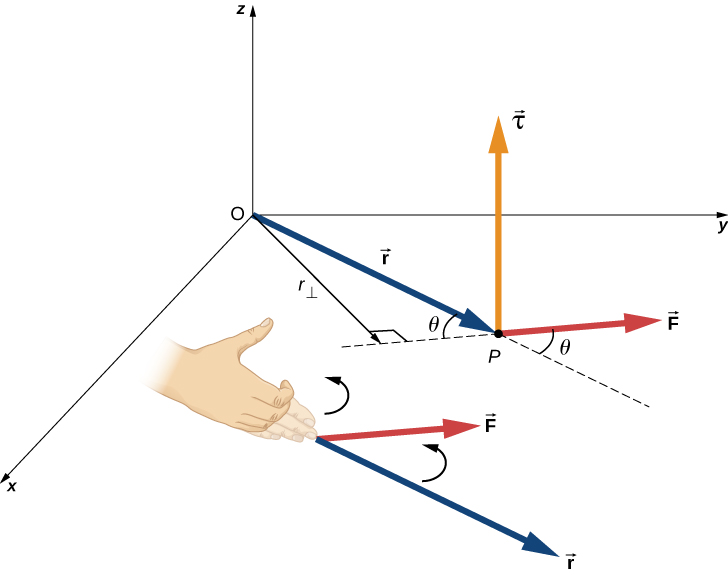
The torque is perpendicular to the plane defined by and its direction is determined by the right-hand rule.
英語のヒント
トルクはが定める平面に垂直で、その向きは右手の法則で決まる。
From the definition of the cross product, the torque is perpendicular to the plane containing and has magnitude
英語のヒント
外積の定義から、トルクはを含む平面に垂直で、その大きさは次のようになる。
where is the angle between the vectors and . The SI unit of torque is newtons times meters, usually written as . The quantity is the perpendicular distance from O to the line determined by the vector and is called the lever arm. Note that the greater the lever arm, the greater the magnitude of the torque. In terms of the lever arm, the magnitude of the torque is
英語のヒント
ここで、はベクトルとの間の角である。トルクのSI単位はニュートンとメートルの積で、通常と書く。量は、Oからベクトルが定める直線までの垂直距離であり、腕の長さと呼ばれる。腕の長さが大きいほど、トルクの大きさも大きくなる。腕の長さを使うと、トルクの大きさは次のようになる。
The cross product also tells us the sign of the torque. In Figure 10.32, the cross product is along the positive z-axis, which by convention is a positive torque. If is along the negative z-axis, this produces a negative torque.
英語のヒント
外積から、トルクの符号も分かる。図10.32では、外積はz軸の正方向を向いており、慣例に従ってこれを正のトルクとする。がz軸の負方向を向く場合は、負のトルクとなる。
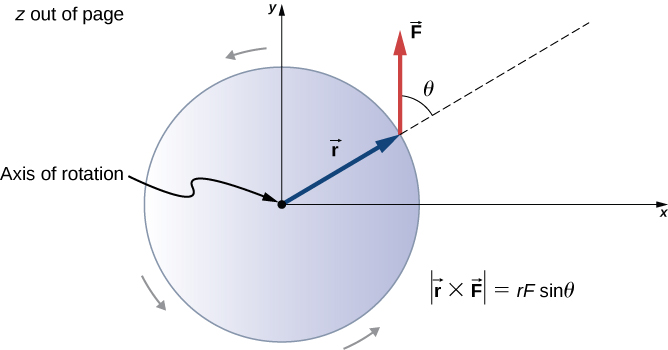
If we consider a disk that is free to rotate about an axis through the center, as shown in Figure 10.33, we can see how the angle between the radius and the force affects the magnitude of the torque. If the angle is zero, the torque is zero; if the angle is , the torque is maximum. The torque in Figure 10.33 is positive because the direction of the torque by the right-hand rule is out of the page along the positive z-axis. The disk rotates counterclockwise due to the torque, in the same direction as a positive angular acceleration.
英語のヒント
OpenStax / Rice University, University Physics Volume 1, CC BY 4.0. Source-book artwork retained. · CC BY 4.0 · Source出典

Figure 10.33図 10.33
A disk is free to rotate about its axis through the center. The magnitude of the torque on the disk is .When , the torque is zero and the disk does not rotate. When , the torque is maximum and the disk rotates with maximum angular acceleration.
英語のヒント
円板は中心を通る軸の周りを自由に回転できる。円板に働くトルクの大きさはである。のとき、トルクは0となり、円板は回転しない。のとき、トルクは最大となり、円板は最大の角加速度で回転する。
Any number of torques can be calculated about a given axis. The individual torques add to produce a net torque about the axis. When the appropriate sign (positive or negative) is assigned to the magnitudes of individual torques about a specified axis, the net torque about the axis is the sum of the individual torques:
英語のヒント
ある軸の周りのトルクは、いくつでも計算できる。個々のトルクを加えると、その軸の周りの合トルクが得られる。指定した軸の周りの各トルクの大きさに、適切な符号(正または負)を付けると、その軸の周りの合トルクは個々のトルクの和となる。