第10章固定軸まわりの回転
10.8 Work and Power for Rotational Motion10.8 回転運動の仕事と仕事率
Learning Objectives学習目標
Learning Objectives学習目標
By the end of this section, you will be able to:
英語のヒント
この節を終えると、次のことができるようになる。
- Use the work-energy theorem to analyze rotation to find the work done on a system when it is rotated about a fixed axis for a finite angular displacement
英語のヒント
仕事とエネルギーの定理を使って回転を解析し、固定軸の周りを有限の角度だけ回転する系になされる仕事を求める。 - Solve for the angular velocity of a rotating rigid body using the work-energy theorem
英語のヒント
仕事とエネルギーの定理を使い、回転する剛体の角速度を求める。 - Find the power delivered to a rotating rigid body given the applied torque and angular velocity
英語のヒント
加えるトルクと角速度から、回転する剛体に供給される仕事率を求める。 - Summarize the rotational variables and equations and relate them to their translational counterparts
英語のヒント
回転の変数と式をまとめ、対応する並進の変数や式との関係を示す。
Thus far in the chapter, we have extensively addressed kinematics and dynamics for rotating rigid bodies around a fixed axis. In this final section, we define work and power within the context of rotation about a fixed axis, which has applications to both physics and engineering. The discussion of work and power makes our treatment of rotational motion almost complete, with the exception of rolling motion and angular momentum, which are discussed in Angular Momentum. We begin this section with a treatment of the work-energy theorem for rotation.
英語のヒント
この章ではここまで、固定軸の周りを回転する剛体の運動学と動力学を詳しく扱ってきた。最後の節では、物理学と工学の両方に応用される、固定軸の周りの回転における仕事と仕事率を定義する。仕事と仕事率を扱えば、角運動量で取り上げる転がり運動と角運動量を除き、回転運動についての議論はほぼ完成する。まず、回転における仕事とエネルギーの定理から始めよう。
Work for Rotational Motion回転運動の仕事
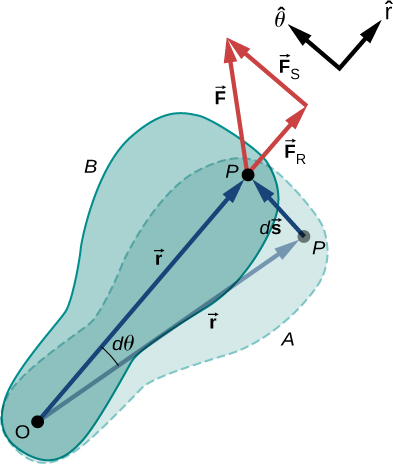
Now that we have determined how to calculate kinetic energy for rotating rigid bodies, we can proceed with a discussion of the work done on a rigid body rotating about a fixed axis. Figure 10.39 shows a rigid body that has rotated through an angle from A to B while under the influence of a force . The external force is applied to point P, whose position is , and the rigid body is constrained to rotate about a fixed axis that is perpendicular to the page and passes through O. The rotational axis is fixed, so the vector moves in a circle of radius r, and the vector is perpendicular to
英語のヒント
回転する剛体の運動エネルギーの求め方が分かったので、固定軸の周りを回転する剛体になされる仕事の議論へ進める。図10.39は、力の作用によってAからBまで角度だけ回転した剛体を示す。外力は位置の点Pに加えられ、剛体はOを通って紙面に垂直な固定軸の周りを回転するよう拘束されている。回転軸が固定されているので、ベクトルは半径rの円に沿って動き、ベクトルはに垂直である。
OpenStax / Rice University, University Physics Volume 1, CC BY 4.0. Source-book artwork retained. · CC BY 4.0 · Source出典

Figure 10.39図 10.39
A rigid body rotates through an angle from A to B by the action of an external force applied to point P.
英語のヒント
剛体は、点Pに加わる外力の作用により、AからBまで角度だけ回転する。
Thus,
英語のヒント
したがって、
Note that is zero because is fixed on the rigid body from the origin O to point P. Using the definition of work, we obtain
英語のヒント
は原点Oから点Pまで剛体上に固定されているので、は0である。仕事の定義を使うと、次式が得られる。
where we used the identity . Noting that , we arrive at the expression for the rotational work done on a rigid body:
英語のヒント
ここでは恒等式を使った。に注意すると、剛体になされる回転の仕事の式が得られる。
(10.27)
The total work done on a rigid body is the sum of the torques integrated over the angle through which the body rotates. The incremental work is
英語のヒント
剛体になされる全仕事は、トルクの和を、剛体が回転する角度にわたって積分したものである。微小な仕事は次式で表される。
where we have taken the dot product in Equation 10.27, leaving only torques along the axis of rotation. In a rigid body, all particles rotate through the same angle; thus the work of every external force is equal to the torque times the common incremental angle . The quantity is the net torque on the body due to external forces.
英語のヒント
ここでは式10.27の内積を取り、回転軸に沿うトルクだけを残した。剛体ではすべての粒子が同じ角度だけ回転するため、各外力の仕事は、トルクと共通の微小角度の積に等しい。量は、外力によって物体に働く合トルクである。
Similarly, we found the kinetic energy of a rigid body rotating around a fixed axis by summing the kinetic energy of each particle that makes up the rigid body. Since the work-energy theorem is valid for each particle, it is valid for the sum of the particles and the entire body.
英語のヒント
同様に、固定軸の周りを回転する剛体の運動エネルギーは、剛体を構成する各粒子の運動エネルギーを加え合わせて求めた。仕事とエネルギーの定理は各粒子について成り立つので、粒子全体の和についても、物体全体についても成り立つ。
We give a strategy for using this equation when analyzing rotational motion.
英語のヒント
回転運動の解析でこの式を使う際の方針を示す。
Let’s look at two examples and use the work-energy theorem to analyze rotational motion.
英語のヒント
二つの例を見て、仕事とエネルギーの定理を使い、回転運動を解析しよう。
Example 10.17例題 10.17
Rotational Work and Energy回転の仕事とエネルギー
A torque is applied to a flywheel that rotates about a fixed axis and has a moment of inertia of . If the flywheel is initially at rest, what is its angular velocity after it has turned through eight revolutions?
英語のヒント
固定軸の周りを回転し、慣性モーメントがのはずみ車に、のトルクを加える。はずみ車が初め静止していた場合、8回転した後の角速度はいくらか。
Strategy方針
We apply the work-energy theorem. We know from the problem description what the torque is and the angular displacement of the flywheel. Then we can solve for the final angular velocity.
英語のヒント
仕事とエネルギーの定理を適用する。問題文から、トルクとはずみ車の角変位が分かっている。したがって、最後の角速度を求められる。
Solution解答
The flywheel turns through eight revolutions, which is radians. The work done by the torque, which is constant and therefore can come outside the integral in Equation 10.30, is
英語のヒント
はずみ車の8回転は、ラジアンに相当する。トルクは一定なので、式10.30の積分の外に出せる。このトルクのする仕事は、
We apply the work-energy theorem:
英語のヒント
仕事とエネルギーの定理を適用する。
With , we have
英語のヒント
より、
Therefore,
英語のヒント
したがって、
This is the angular velocity of the flywheel after eight revolutions.
英語のヒント
これが、8回転した後のはずみ車の角速度である。
Significance考察
The work-energy theorem provides an efficient way to analyze rotational motion, connecting torque with rotational kinetic energy.
英語のヒント
仕事とエネルギーの定理は、トルクと回転の運動エネルギーを結び付け、回転運動を効率よく解析する方法を与える。
Example 10.18例題 10.18
Rotational Work: A Pulley回転の仕事:滑車
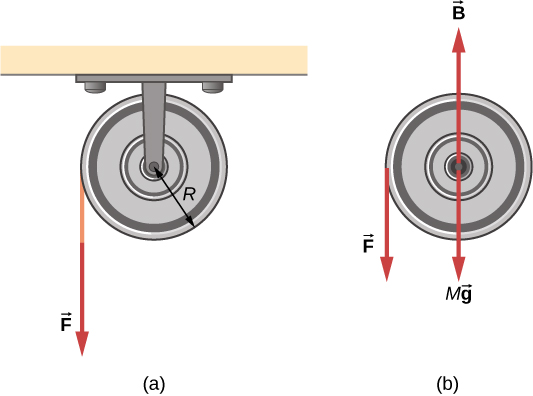
A string wrapped around the pulley in Figure 10.40 is pulled with a constant downward force of magnitude 50 N. The radius R and moment of inertia I of the pulley are 0.10 m and , respectively. If the string does not slip, what is the angular velocity of the pulley after 1.0 m of string has unwound? Assume the pulley starts from rest.
英語のヒント
図10.40の滑車に巻き付いたひもを、大きさ50 Nの一定の下向きの力で引く。滑車の半径Rと慣性モーメントIは、それぞれ0.10 mとである。ひもが滑らない場合、1.0 mのひもがほどけた後の滑車の角速度はいくらか。滑車は静止状態から回転を始めるものとする。
OpenStax / Rice University, University Physics Volume 1, CC BY 4.0. Source-book artwork retained. · CC BY 4.0 · Source出典

Figure 10.40図 10.40
(a) A string is wrapped around a pulley of radius R. (b) The free-body diagram.
英語のヒント
(a)半径Rの滑車にひもが巻き付いている。(b)力の図。
Strategy方針
Looking at the free-body diagram, we see that neither , the force on the bearings of the pulley, nor, the weight of the pulley, exerts a torque around the rotational axis, and therefore does no work on the pulley. As the pulley rotates through an angle acts through a distance d such that
英語のヒント
力の図を見ると、滑車の軸受に働く力も、滑車の重力も、回転軸の周りのトルクを生じさせず、したがって滑車に仕事をしない。滑車が角度だけ回転すると、は距離dにわたって作用し、となる。
Solution解答
Since the torque due to has magnitude , we have
英語のヒント
によるトルクの大きさはなので、
If the force on the string acts through a distance of 1.0 m, we have, from the work-energy theorem,
英語のヒント
ひもに働く力が1.0 mの距離にわたって作用すると、仕事とエネルギーの定理から、
Solving for , we obtain
英語のヒント
について解くと、