第10章固定軸まわりの回転
10.3 Relating Angular and Translational Quantities10.3 角度に関する量と並進に関する量の関係
Learning Objectives学習目標
Learning Objectives学習目標
By the end of this section, you will be able to:
英語のヒント
この節を終えると、次のことができるようになる。
- Given the linear kinematic equation, write the corresponding rotational kinematic equation
英語のヒント
与えられた直線の運動学の式に対応する、回転の運動学の式を書く。 - Calculate the linear distances, velocities, and accelerations of points on a rotating system given the angular velocities and accelerations
英語のヒント
角速度と角加速度が与えられたとき、回転する系の各点の並進距離、速度、加速度を計算する。
In this section, we relate each of the rotational variables to the translational variables defined in Motion Along a Straight Line and Motion in Two and Three Dimensions. This will complete our ability to describe rigid-body rotations.
英語のヒント
本節では、回転を表す各量を、「直線に沿う運動」と「2次元と3次元の運動」で定義した並進の量へ関係づける。これにより、剛体の回転を記述するための準備がそろう。
Angular vs. Linear Variables角度の量と直線の量
In Rotational Variables, we introduced angular variables. If we compare the rotational definitions with the definitions of linear kinematic variables from Motion Along a Straight Line and Motion in Two and Three Dimensions, we find that there is a mapping of the linear variables to the rotational ones. Linear position, velocity, and acceleration have their rotational counterparts, as we can see when we write them side by side:
英語のヒント
「回転を表す量」で、角度に関する量を導入した。その定義を、「直線に沿う運動」と「2次元と3次元の運動」での直線の運動学の量と比べると、直線の量から回転の量への対応があると分かる。位置、速度、加速度には、それぞれ回転で対応する量がある。並べて書くと、次のようになる。
Linear 直線 |
Rotational 回転 |
|
|---|---|---|
Position 位置 |
x |
|
Velocity 速度 |
||
Acceleration 加速度 |
Let’s compare the linear and rotational variables individually. The linear variable of position has physical units of meters, whereas the angular position variable has dimensionless units of radians, as can be seen from the definition of , which is the ratio of two lengths. The linear velocity has units of m/s, and its counterpart, the angular velocity, has units of rad/s. In Rotational Variables, we saw in the case of circular motion that the linear tangential speed of a particle at a radius r from the axis of rotation is related to the angular velocity by the relation . This could also apply to points on a rigid body rotating about a fixed axis. Here, we consider only circular motion. In circular motion, both uniform and nonuniform, there exists a centripetal acceleration (Motion in Two and Three Dimensions). The centripetal acceleration vector points inward from the particle executing circular motion toward the axis of rotation. The derivation of the magnitude of the centripetal acceleration is given in Motion in Two and Three Dimensions. From that derivation, the magnitude of the centripetal acceleration was found to be
英語のヒント
直線の量と回転の量を、一つずつ比較しよう。直線の位置の単位はメートルであるのに対し、角位置の単位は無次元のラジアンである。二つの長さの比である定義から、そのことが分かる。直線の速度の単位はm/sで、それに対応する角速度の単位はrad/sである。「回転を表す量」では、円運動において、回転軸から半径rにある粒子の接線方向の速さが、によって角速度と関係することを見た。この関係は、固定軸の周りに回転する剛体上の点にも適用できる。ここでは円運動だけを考える。円運動には、等速でも非等速でも向心加速度がある(「2次元と3次元の運動」参照)。向心加速度ベクトルは、円運動する粒子から回転軸へ向かう内向きである。その大きさの導出は「2次元と3次元の運動」で行い、次の式を得た。
(10.14)
where r is the radius of the circle.
英語のヒント
ここで、rは円の半径である。
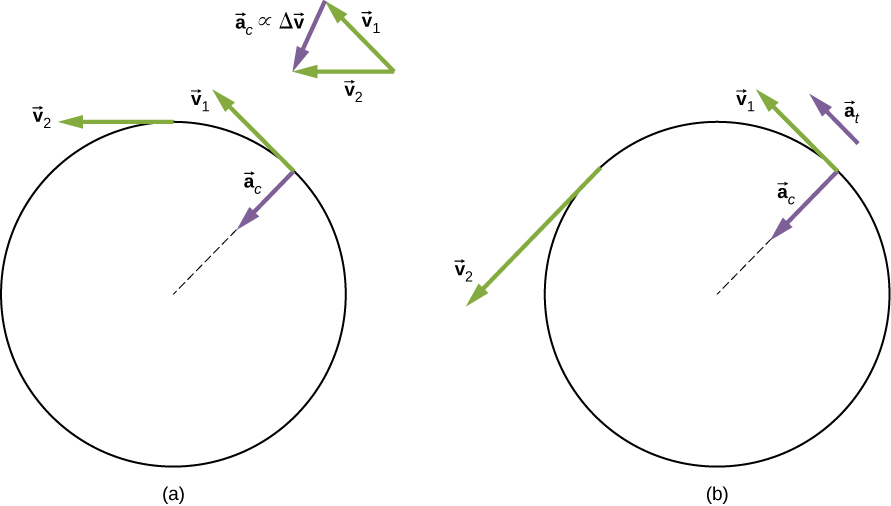
Thus, in uniform circular motion when the angular velocity is constant and the angular acceleration is zero, we have a linear acceleration—that is, centripetal acceleration—since the tangential speed in Equation 10.14 is a constant. If nonuniform circular motion is present, the rotating system has an angular acceleration, and we have both a linear centripetal acceleration that is changing (because is changing) as well as a linear tangential acceleration. These relationships are shown in Figure 10.14, where we show the centripetal and tangential accelerations for uniform and nonuniform circular motion.
英語のヒント
OpenStax / Rice University, University Physics Volume 1, CC BY 4.0. Source-book artwork retained. · CC BY 4.0 · Source出典

Figure 10.14図 10.14
(a) Uniform circular motion: The centripetal acceleration has its vector inward toward the axis of rotation. There is no tangential acceleration. (b) Nonuniform circular motion: An angular acceleration produces an inward centripetal acceleration that is changing in magnitude, plus a tangential acceleration .
英語のヒント
(a)等速円運動。向心加速度のベクトルは、回転軸へ向かう内向きである。接線加速度はない。(b)非等速円運動。角加速度により、大きさの変化する内向きの向心加速度と、接線加速度が生じる。
The centripetal acceleration is due to the change in the direction of tangential velocity, whereas the tangential acceleration is due to any change in the magnitude of the tangential velocity. The tangential and centripetal acceleration vectors and are always perpendicular to each other, as seen in Figure 10.14. To complete this description, we can assign a total linear acceleration vector to a point on a rotating rigid body or a particle executing circular motion at a radius r from a fixed axis. The total linear acceleration vector is the vector sum of the centripetal and tangential accelerations,
英語のヒント
向心加速度は接線速度の向きの変化によって生じ、接線加速度は接線速度の大きさの変化によって生じる。図10.14のように、接線加速度ベクトルと向心加速度ベクトルは、常に互いに垂直である。記述を完成させるため、回転する剛体上の点や、固定軸から半径rで円運動する粒子に、全並進加速度ベクトルを対応させる。全並進加速度ベクトルは、向心加速度と接線加速度のベクトル和である。
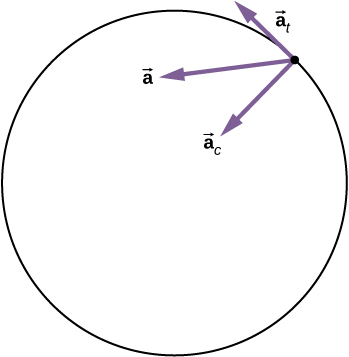
The total linear acceleration vector in the case of nonuniform circular motion points at an angle between the centripetal and tangential acceleration vectors, as shown in Figure 10.15. Since , the magnitude of the total linear acceleration is
英語のヒント
非等速円運動の全並進加速度ベクトルは、図10.15のように、向心加速度ベクトルと接線加速度ベクトルの間の向きにある。なので、その大きさは次のようになる。
Note that if the angular acceleration is zero, the total linear acceleration is equal to the centripetal acceleration.
英語のヒント
角加速度が0の場合、全並進加速度は向心加速度に等しくなる。
OpenStax / Rice University, University Physics Volume 1, CC BY 4.0. Source-book artwork retained. · CC BY 4.0 · Source出典

Figure 10.15図 10.15
A particle is executing circular motion and has an angular acceleration. The total linear acceleration of the particle is the vector sum of the centripetal acceleration and tangential acceleration vectors. The total linear acceleration vector is at an angle in between the centripetal and tangential accelerations.
英語のヒント
円運動する粒子が角加速度を持つ。粒子の全並進加速度は、向心加速度と接線加速度のベクトル和である。そのベクトルは、向心加速度と接線加速度の間の角度にある。