第10章固定軸まわりの回転
Applying Rotational Kinetic Energy回転の運動エネルギーを使う
Now let’s apply the ideas of rotational kinetic energy and the moment of inertia table to get a feeling for the energy associated with a few rotating objects. The following examples will also help get you comfortable using these equations. First, let’s look at a general problem-solving strategy for rotational energy.
英語のヒント
回転の運動エネルギーの考えと慣性モーメントの表を使い、いくつかの回転物体が持つエネルギーの規模をつかもう。次の例は、これらの式に慣れる助けにもなる。まず、回転のエネルギーに関する一般的な問題解法の方針を見る。
Example 10.9例題 10.9
Calculating Helicopter Energiesヘリコプターのエネルギーを計算する
A typical small rescue helicopter has four blades: Each is 4.00 m long and has a mass of 50.0 kg (Figure 10.21). The blades can be approximated as thin rods that rotate about one end of an axis perpendicular to their length. The helicopter has a total loaded mass of 1000 kg. (a) Calculate the rotational kinetic energy in the blades when they rotate at 300 rpm. (b) Calculate the translational kinetic energy of the helicopter when it flies at 20.0 m/s, and compare it with the rotational energy in the blades.
英語のヒント
典型的な小型救助ヘリコプターには4枚の羽根があり、それぞれ長さ4.00 m、質量50.0 kgである(図10.21)。羽根は、長さに垂直で一端を通る軸の周りに回る細い棒で近似できる。積載物を含めたヘリコプターの総質量は1000 kgである。(a)羽根が300 rpmで回るときの回転の運動エネルギーを求めよ。(b)ヘリコプターが20.0 m/sで飛ぶときの並進の運動エネルギーを求め、羽根の回転のエネルギーと比較せよ。
Image omitted because its reuse rights could not be verified.権利の確認ができないため画像を割愛。
Figure 10.21図 10.21
(a) Sketch of a four-blade helicopter. (b) A water rescue operation featuring a helicopter from the Auckland Westpac Rescue Helicopter Service. (credit b: modification of work by “111 Emergency”/Flickr)
英語のヒント
(a)4枚羽根のヘリコプターの概略図。(b)オークランド・ウェストパック救助ヘリコプターサービスの機体による水難救助。(出典b:「111 Emergency」/Flickrの作品を改変)
Strategy方針
Rotational and translational kinetic energies can be calculated from their definitions. The wording of the problem gives all the necessary constants to evaluate the expressions for the rotational and translational kinetic energies.
英語のヒント
回転と並進の運動エネルギーは、それぞれの定義から計算できる。問題文には、両者の式の値を求めるために必要な定数がすべて与えられている。
Solution解答
- The rotational kinetic energy is
英語のヒント
回転の運動エネルギーは、次のようになる。We must convert the angular velocity to radians per second and calculate the moment of inertia before we can find K. The angular velocity is英語のヒント
Kを求める前に、角速度をラジアン毎秒へ換算し、慣性モーメントを計算しなければならない。角速度は次のようになる。The moment of inertia of one blade is that of a thin rod rotated about its end, listed in Figure 10.20. The total I is four times this moment of inertia because there are four blades. Thus,英語のヒント
1枚の羽根の慣性モーメントは、図10.20の、一端の周りに回る細い棒と同じである。羽根が4枚あるので、全体のIはその4倍となる。したがって、Entering and I into the expression for rotational kinetic energy gives英語のヒント
とIを回転の運動エネルギーの式へ代入すると、次を得る。 - Entering the given values into the equation for translational kinetic energy, we obtain
英語のヒント
並進の運動エネルギーの式へ既知の値を代入すると、次を得る。To compare kinetic energies, we take the ratio of translational kinetic energy to rotational kinetic energy. This ratio is英語のヒント
運動エネルギーを比較するため、回転の運動エネルギーに対する並進の運動エネルギーの比を取る。その比は次のようになる。
Significance考察
The ratio of translational energy to rotational kinetic energy is only 0.380. This ratio tells us that most of the kinetic energy of the helicopter is in its spinning blades.
英語のヒント
回転の運動エネルギーに対する並進のエネルギーの比は、わずか0.380である。この比は、ヘリコプターの運動エネルギーの大半が、回転する羽根にあることを示す。
Example 10.10例題 10.10
Energy in a Boomerangブーメランのエネルギー
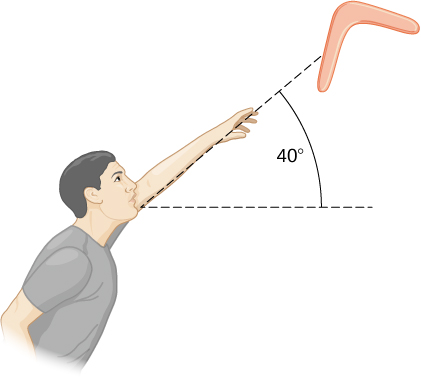
A person hurls a boomerang into the air with a velocity of 30.0 m/s at an angle of with respect to the horizontal (Figure 10.22). It has a mass of 1.0 kg and is rotating at 10.0 rev/s. The moment of inertia of the boomerang is given as where . (a) What is the total energy of the boomerang when it leaves the hand? (b) How high does the boomerang go from the elevation of the hand, neglecting air resistance?
英語のヒント
ブーメランを、水平方向となす角、速度30.0 m/sで空中へ投げる(図10.22)。質量は1.0 kgで、10.0 rev/sで回転している。慣性モーメントはで与えられ、とする。(a)手を離れるときの全エネルギーは何か。(b)空気抵抗を無視すると、ブーメランは手の位置からどれだけ高く上がるか。
OpenStax / Rice University, University Physics Volume 1, CC BY 4.0. Source-book artwork retained. · CC BY 4.0 · Source出典

Figure 10.22図 10.22
A boomerang is hurled into the air at an initial angle of .
英語のヒント
初めの角度で空中へ投げたブーメラン。
Strategy方針
We use the definitions of rotational and linear kinetic energy to find the total energy of the system. The problem states to neglect air resistance, so we don’t have to worry about energy loss. In part (b), we use conservation of mechanical energy to find the maximum height of the boomerang.
英語のヒント
回転と並進の運動エネルギーの定義から、系の全エネルギーを求める。問題では空気抵抗を無視するので、エネルギー損失を考える必要はない。(b)では、力学的エネルギーの保存からブーメランの最高到達点の高さを求める。
Solution解答
- Moment of inertia: .
Angular velocity: .
The rotational kinetic energy is therefore英語のヒント
慣性モーメントは、角速度はである。したがって、回転の運動エネルギーは次のようになる。The translational kinetic energy is英語のヒント
並進の運動エネルギーは次のようになる。Thus, the total energy in the boomerang is英語のヒント
したがって、ブーメランの全エネルギーは次のようになる。 - We use conservation of mechanical energy. Since the boomerang is launched at an angle, we need to write the total energies of the system in terms of its linear kinetic energies using the velocity in the x- and y-directions. The total energy when the boomerang leaves the hand is
英語のヒント
力学的エネルギーの保存を使う。ブーメランは角度を付けて投げられるため、x方向とy方向の速度を使い、系の全エネルギーを並進の運動エネルギーで表す必要がある。手を離れるときの全エネルギーは次のようになる。The total energy at maximum height is英語のヒント
最高点での全エネルギーは次のようになる。By conservation of mechanical energy, so we have, after canceling like terms,英語のヒント
力学的エネルギーの保存からなので、同じ項を消去すると次を得る。Since , we find英語のヒント
なので、次を得る。
Significance考察
In part (b), the solution demonstrates how energy conservation is an alternative method to solve a problem that normally would be solved using kinematics. In the absence of air resistance, the rotational kinetic energy was not a factor in the solution for the maximum height.
英語のヒント
(b)の解は、通常は運動学を使って解く問題にも、エネルギー保存という別の解法が使えることを示す。空気抵抗がない場合、回転の運動エネルギーは最高到達点の高さを求める計算には関わらなかった。