第10章固定軸まわりの回転
Applying the Rotational Dynamics Equation回転の運動方程式の応用
Before we apply the rotational dynamics equation to some everyday situations, let’s review a general problem-solving strategy for use with this category of problems.
英語のヒント
回転の運動方程式を身近な状況に適用する前に、この種の問題に用いる一般的な解法の方針を確認しよう。
Example 10.16例題 10.16
Calculating the Effect of Mass Distribution on a Merry-Go-Round回転遊具の質量分布の効果を計算する
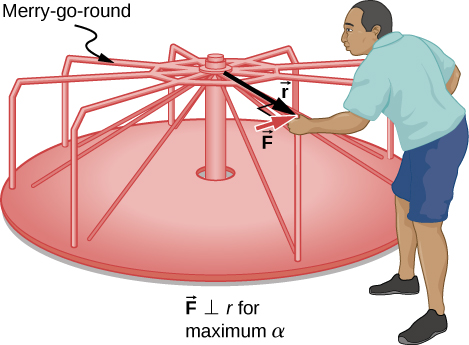
Consider the father pushing a playground merry-go-round in Figure 10.38. He exerts a force of 250 N at the edge of the 50.0-kg merry-go-round, which has a 1.50-m radius. Calculate the angular acceleration produced (a) when no one is on the merry-go-round and (b) when an 18.0-kg child sits 1.25 m away from the center. Consider the merry-go-round itself to be a uniform disk with negligible friction.
英語のヒント
図10.38で、公園の回転遊具を押している父親を考えよう。父親は、質量50.0 kg、半径1.50 mの遊具の縁に250 Nの力を加えている。(a)誰も乗っていない場合と、(b)質量18.0 kgの子どもが中心から1.25 mの位置に座っている場合について、生じる角加速度を求めよ。遊具自体は一様な円板とし、摩擦は無視できるものとする。
OpenStax / Rice University, University Physics Volume 1, CC BY 4.0. Source-book artwork retained. · CC BY 4.0 · Source出典

Figure 10.38図 10.38
A father pushes a playground merry-go-round at its edge and perpendicular to its radius to achieve maximum torque.
英語のヒント
父親は、最大のトルクを得るため、回転遊具の縁を半径に垂直な方向へ押している。
Strategy方針
The net torque is given directly by the expression , To solve for , we must first calculate the net torque (which is the same in both cases) and moment of inertia I (which is greater in the second case).
英語のヒント
合トルクは式から直接得られる。を求めるには、まず合トルク(どちらの場合も同じ)と、慣性モーメントI(後者のほうが大きい)を計算しなければならない。
Solution解答
- The moment of inertia of a solid disk about this axis is given in Figure 10.20 to be
英語のヒント
この軸に対する中実円板の慣性モーメントは、図10.20より次式で与えられる。We have and , so英語のヒント
、なので、To find the net torque, we note that the applied force is perpendicular to the radius and friction is negligible, so that英語のヒント
合トルクを求める際には、加える力が半径に垂直で、摩擦が無視できることに注目する。したがって、Now, after we substitute the known values, we find the angular acceleration to be英語のヒント
既知の値を代入すると、角加速度は次のようになる。 - We expect the angular acceleration for the system to be less in this part because the moment of inertia is greater when the child is on the merry-go-round. To find the total moment of inertia I, we first find the child’s moment of inertia by approximating the child as a point mass at a distance of 1.25 m from the axis. Then
英語のヒント
子どもが遊具に乗ると慣性モーメントが大きくなるので、この場合の系の角加速度は小さくなると予想できる。全慣性モーメントIを求めるには、まず子どもを軸から1.25 mの位置にある質点とみなして、子どもの慣性モーメントを求める。すると、The total moment of inertia is the sum of the moments of inertia of the merry-go-round and the child (about the same axis):英語のヒント
全慣性モーメントは、遊具と子どもの、同じ軸に対する慣性モーメントの和である。Substituting known values into the equation for α gives英語のヒント
αの式に既知の値を代入すると、
Significance考察
The angular acceleration is less when the child is on the merry-go-round than when the merry-go-round is empty, as expected. The angular accelerations found are quite large, partly due to the fact that friction was considered to be negligible. If, for example, the father kept pushing perpendicularly for 2.00 s, he would give the merry-go-round an angular velocity of 13.3 rad/s when it is empty but only 8.89 rad/s when the child is on it. In terms of revolutions per second, these angular velocities are 2.12 rev/s and 1.41 rev/s, respectively. The father would end up running at about 50 km/h in the first case.
英語のヒント
予想したとおり、子どもが遊具に乗っている場合の角加速度は、誰も乗っていない場合より小さい。得られた角加速度はかなり大きいが、その理由の一つは摩擦を無視したことである。たとえば、父親が2.00 sにわたり垂直に押し続けると、遊具の角速度は、誰も乗っていなければ13.3 rad/sとなるが、子どもが乗っていれば8.89 rad/sにとどまる。毎秒の回転数で表すと、それぞれ2.12 rev/sと1.41 rev/sである。前者では、父親は最後には約50 km/hで走ることになる。
Summaryまとめ
- Newton’s second law for rotation, , says that the sum of the torques on a rotating system about a fixed axis equals the product of the moment of inertia and the angular acceleration. This is the rotational analog to Newton’s second law of linear motion.
英語のヒント
回転に対するニュートンの第2法則は、固定軸の周りを回転する系に働くトルクの和が、慣性モーメントと角加速度の積に等しいことを表す。これは、並進運動に対するニュートンの第2法則の回転版である。 - In the vector form of Newton’s second law for rotation, the torque vector is in the same direction as the angular acceleration . If the angular acceleration of a rotating system is positive, the torque on the system is also positive, and if the angular acceleration is negative, the torque is negative.
英語のヒント
ベクトル形式の回転に対するニュートンの第2法則では、トルクのベクトルは角加速度と同じ方向を向く。回転する系の角加速度が正なら系に働くトルクも正であり、角加速度が負ならトルクも負である。