第10章固定軸まわりの回転
10.5 Calculating Moments of Inertia10.5 慣性モーメントの計算
Learning Objectives学習目標
Learning Objectives学習目標
By the end of this section, you will be able to:
英語のヒント
この節を終えると、次のことができるようになる。
- Calculate the moment of inertia for uniformly shaped, rigid bodies
英語のヒント
一様な形の剛体の慣性モーメントを計算する。 - Apply the parallel axis theorem to find the moment of inertia about any axis parallel to one already known
英語のヒント
平行軸の定理を適用し、すでに値が分かる軸と平行な任意の軸について、慣性モーメントを求める。 - Calculate the moment of inertia for compound objects
英語のヒント
複合物体の慣性モーメントを計算する。
In the preceding section, we defined the moment of inertia but did not show how to calculate it. In this section, we show how to calculate the moment of inertia for several standard types of objects, as well as how to use known moments of inertia to find the moment of inertia for a shifted axis or for a compound object. This section is very useful for seeing how to apply a general equation to complex objects (a skill that is critical for more advanced physics and engineering courses).
英語のヒント
前節では慣性モーメントを定義したが、計算の方法は示さなかった。本節では、いくつかの標準的な物体の慣性モーメントの求め方を示す。また、既知の慣性モーメントを利用して、軸をずらした場合や、複数の部分を組み合わせた物体の慣性モーメントを求める方法も示す。一般的な式を複雑な物体へどう適用するかを見るうえで、この節は役立つ。この技能は、より進んだ物理学や工学を学ぶために欠かせない。
Moment of Inertia慣性モーメント
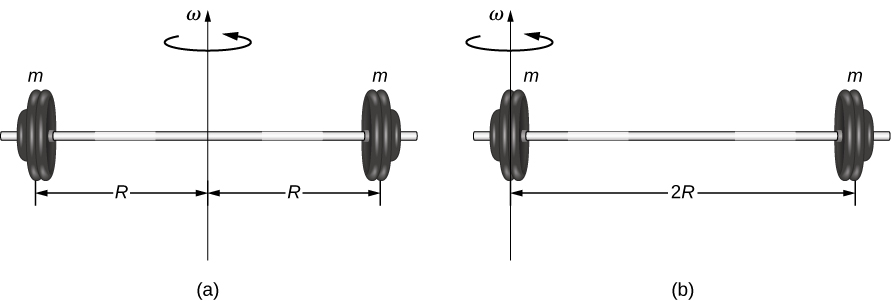
We defined the moment of inertia I of an object to be for all the point masses that make up the object. Because r is the distance to the axis of rotation from each piece of mass that makes up the object, the moment of inertia for any object depends on the chosen axis. To see this, let’s take a simple example of two masses at the end of a massless (negligibly small mass) rod (Figure 10.23) and calculate the moment of inertia about two different axes. In this case, the summation over the masses is simple because the two masses at the end of the barbell can be approximated as point masses, and the sum therefore has only two terms.
英語のヒント
物体の慣性モーメントIは、物体を構成するすべての質点についてと定義した。rは各小質量から回転軸までの距離なので、どの物体の慣性モーメントも、選んだ軸に依存する。これを見るため、質量のない(無視できるほど小さい)棒の両端に二つのおもりを置く簡単な例(図10.23)を考え、二つの異なる軸について計算しよう。この場合、バーベルの両端のおもりは質点で近似できるので、総和は二つの項だけになり、計算は簡単である。
In the case with the axis in the center of the barbell, each of the two masses m is a distance R away from the axis, giving a moment of inertia of
英語のヒント
軸がバーベルの中心にある場合、二つの質量mはそれぞれ軸から距離Rにあり、慣性モーメントは次のようになる。
In the case with the axis at the end of the barbell—passing through one of the masses—the moment of inertia is
英語のヒント
軸がバーベルの端にあり、一方のおもりを通る場合、慣性モーメントは次のようになる。
From this result, we can conclude that it is twice as hard to rotate the barbell about the end than about its center.
英語のヒント
この結果から、バーベルを端の周りに回すのは、中心の周りに回す場合の2倍難しいと結論できる。
OpenStax / Rice University, University Physics Volume 1, CC BY 4.0. Source-book artwork retained. · CC BY 4.0 · Source出典

Figure 10.23図 10.23
(a) A barbell with an axis of rotation through its center; (b) a barbell with an axis of rotation through one end.
英語のヒント
(a)中心を通る回転軸を持つバーベル。(b)一端を通る回転軸を持つバーベル。
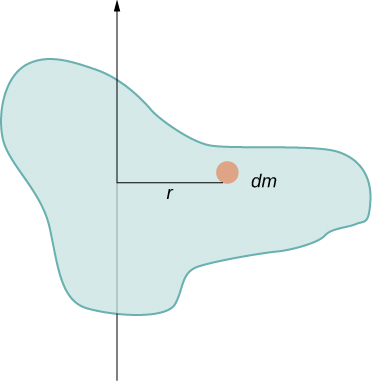
In this example, we had two point masses and the sum was simple to calculate. However, to deal with objects that are not point-like, we need to think carefully about each of the terms in the equation. The equation asks us to sum over each ‘piece of mass’ a certain distance from the axis of rotation. But what exactly does each ‘piece of mass’ mean? Recall that in our derivation of this equation, each piece of mass had the same magnitude of velocity, which means the whole piece had to have a single distance r to the axis of rotation. However, this is not possible unless we take an infinitesimally small piece of mass dm, as shown in Figure 10.24.
英語のヒント
この例は二つの質点なので、和は簡単に計算できた。しかし点状でない物体を扱うには、式の各項を注意深く考える必要がある。式は、回転軸からある距離にある「小さな質量部分」をすべて足し合わせるよう求めている。では、「小さな質量部分」とは正確には何だろうか。この式の導出では、各部分の速度の大きさは一つに定まっていた。そのため、部分全体が回転軸から単一の距離rになければならない。図10.24のように、無限小の質量dmを取らなければ、それはできない。
OpenStax / Rice University, University Physics Volume 1, CC BY 4.0. Source-book artwork retained. · CC BY 4.0 · Source出典

Figure 10.24図 10.24
Using an infinitesimally small piece of mass to calculate the contribution to the total moment of inertia.
英語のヒント
無限小の質量部分を用いて、全慣性モーメントへの寄与を計算する。
The need to use an infinitesimally small piece of mass dm suggests that we can write the moment of inertia by evaluating an integral over infinitesimal masses rather than doing a discrete sum over finite masses:
英語のヒント
無限小の質量dmを用いる必要があることから、有限の質量について離散的な和を取る代わりに、無限小の質量について積分して慣性モーメントを書けると分かる。
This, in fact, is the form we need to generalize the equation for complex shapes. It is best to work out specific examples in detail to get a feel for how to calculate the moment of inertia for specific shapes. This is the focus of most of the rest of this section.
英語のヒント
これが、複雑な形へ式を一般化するのに必要な形である。特定の形の慣性モーメントを計算する感覚をつかむには、具体例を詳しく解くのがよい。本節の残りの大半では、その計算を扱う。
A uniform thin rod with an axis through the center中心を通る軸を持つ一様な細い棒
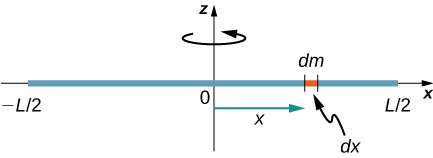
Consider a uniform (density and shape) thin rod of mass M and length L as shown in Figure 10.25. We want a thin rod so that we can assume the cross-sectional area of the rod is small and the rod can be thought of as a string of masses along a one-dimensional straight line. In this example, the axis of rotation is perpendicular to the rod and passes through the midpoint for simplicity. Our task is to calculate the moment of inertia about this axis. We orient the axes so that the z-axis is the axis of rotation and the x-axis passes through the length of the rod, as shown in the figure. This is a convenient choice because we can then integrate along the x-axis.
英語のヒント
図10.25のように、質量M、長さLで、密度と形が一様な細い棒を考える。細い棒にするのは、断面積が小さく、1次元の直線上に質量が連なるものとみなすためである。この例では、簡単にするため、回転軸は棒に垂直で、中点を通る。この軸に対する慣性モーメントを求める。図のように、z軸を回転軸、x軸を棒の長さに沿う向きに取る。そうすればx軸に沿って積分できるので便利である。
OpenStax / Rice University, University Physics Volume 1, CC BY 4.0. Source-book artwork retained. · CC BY 4.0 · Source出典

Figure 10.25図 10.25
Calculation of the moment of inertia I for a uniform thin rod about an axis through the center of the rod.
英語のヒント
一様な細い棒について、中心を通る軸に対する慣性モーメントIを計算する。
We define dm to be a small element of mass making up the rod. The moment of inertia integral is an integral over the mass distribution. However, we know how to integrate over space, not over mass. We therefore need to find a way to relate mass to spatial variables. We do this using the linear mass density of the object, which is the mass per unit length. Since the mass density of this object is uniform, we can write
英語のヒント
棒を構成する小さな質量要素をdmとする。慣性モーメントの積分は、質量分布についての積分である。しかし、慣れているのは空間についての積分であって、質量についての積分ではない。そのため、質量を空間の変数へ関係づける必要がある。単位長さあたりの質量である線密度を用いる。この物体の質量密度は一様なので、次のように書ける。
If we take the differential of each side of this equation, we find
英語のヒント
この式の両辺の微分を取ると、次を得る。
since is constant. We chose to orient the rod along the x-axis for convenience—this is where that choice becomes very helpful. Note that a piece of the rod dl lies completely along the x-axis and has a length dx; in fact, in this situation. We can therefore write , giving us an integration variable that we know how to deal with. The distance of each piece of mass dm from the axis is given by the variable x, as shown in the figure. Putting this all together, we obtain
英語のヒント
が一定だからである。便宜上、棒をx軸に沿わせたが、ここでその選択が役立つ。棒の部分dlは完全にx軸に沿い、長さはdxである。実際、この場合はとなる。したがって、と書け、扱い方が分かる積分変数が得られる。図のように、各質量dmの軸からの距離は変数xで与えられる。まとめると、次を得る。
The last step is to be careful about our limits of integration. The rod extends from to , since the axis is in the middle of the rod at . This gives us
英語のヒント
最後は積分範囲に注意する。軸は棒の中央のにあるので、棒はからまで延びる。したがって、
Next, we calculate the moment of inertia for the same uniform thin rod but with a different axis choice so we can compare the results. We would expect the moment of inertia to be smaller about an axis through the center of mass than the endpoint axis, just as it was for the barbell example at the start of this section. This happens because more mass is distributed farther from the axis of rotation.
英語のヒント
次に、同じ一様な細い棒について軸だけを変えて計算し、結果を比較する。本節の冒頭のバーベルの例と同様に、質量中心を通る軸の慣性モーメントは、端を通る軸より小さいと予想できる。後者では、より多くの質量が回転軸から遠くに分布するからである。