第10章固定軸まわりの回転
10.7 Newton’s Second Law for Rotation10.7 回転に対するニュートンの第2法則
Learning Objectives学習目標
Learning Objectives学習目標
By the end of this section, you will be able to:
英語のヒント
この節を終えると、次のことができるようになる。
- Calculate the torques on rotating systems about a fixed axis to find the angular acceleration
英語のヒント
固定軸の周りを回転する系に働くトルクを計算し、角加速度を求める。 - Explain how changes in the moment of inertia of a rotating system affect angular acceleration with a fixed applied torque
英語のヒント
一定のトルクが加わる回転系で、慣性モーメントの変化が角加速度にどう影響するかを説明する。
In this section, we put together all the pieces learned so far in this chapter to analyze the dynamics of rotating rigid bodies. We have analyzed motion with kinematics and rotational kinetic energy but have not yet connected these ideas with force and/or torque. In this section, we introduce the rotational equivalent to Newton’s second law of motion and apply it to rigid bodies with fixed-axis rotation.
英語のヒント
この節では、この章でこれまで学んできた内容を組み合わせ、回転する剛体の力学を解析する。これまで運動学と回転の運動エネルギーによって運動を解析してきたが、これらの考え方を力やトルクとまだ結び付けていない。ここでは、ニュートンの運動の第2法則に対応する回転の法則を導入し、固定軸の周りを回転する剛体に適用する。
Newton’s Second Law for Rotation回転に対するニュートンの第2法則
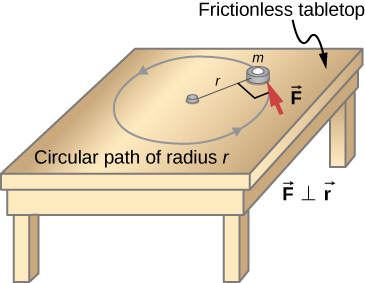
We have thus far found many counterparts to the translational terms used throughout this text, most recently, torque, the rotational analog to force. This raises the question: Is there an analogous equation to Newton’s second law, which involves torque and rotational motion? To investigate this, we start with Newton’s second law for a single particle rotating around an axis and executing circular motion. Let’s exert a force on a point mass m that is at a distance r from a pivot point (Figure 10.37). The particle is constrained to move in a circular path with fixed radius and the force is tangent to the circle. We apply Newton’s second law to determine the magnitude of the acceleration in the direction of . Recall that the magnitude of the tangential acceleration is proportional to the magnitude of the angular acceleration by . Substituting this expression into Newton’s second law, we obtain
英語のヒント
これまで、本書全体で用いてきた並進運動の用語に対応する回転運動の量を数多く見いだしてきた。直近では、力に対応する回転の量であるトルクを扱った。すると、トルクと回転運動を含み、ニュートンの第2法則に対応する式はあるのか、という疑問が生じる。これを調べるために、軸の周りで円運動する一つの質点に対するニュートンの第2法則から出発する。支点から距離rの位置にある質量mの質点に、力を加えよう(図10.37)。質点は半径が一定の円軌道に沿って動くよう拘束されており、力は円の接線方向を向く。ニュートンの第2法則を適用し、の方向の加速度の大きさを求める。接線加速度の大きさは、によって角加速度の大きさに比例する。この式をニュートンの第2法則に代入すると、次式が得られる。
OpenStax / Rice University, University Physics Volume 1, CC BY 4.0. Source-book artwork retained. · CC BY 4.0 · Source出典

Figure 10.37図 10.37
An object is supported by a horizontal frictionless table and is attached to a pivot point by a cord that supplies centripetal force. A force is applied to the object perpendicular to the radius r, causing it to accelerate about the pivot point. The force is perpendicular to r.
英語のヒント
物体は摩擦のない水平な台に支えられ、向心力を与えるひもで支点につながっている。半径rに垂直な力を物体に加えると、物体は支点の周りで加速する。この力はrに垂直である。
Multiply both sides of this equation by r,
英語のヒント
この式の両辺にrを掛ける。
Note that the left side of this equation is the torque about the axis of rotation, where r is the lever arm and F is the force, perpendicular to r. Recall that the moment of inertia for a point particle is. The torque applied perpendicularly to the point mass in Figure 10.37 is therefore
英語のヒント
この式の左辺は、回転軸の周りのトルクである。rは腕の長さで、Fはrに垂直な力である。質点の慣性モーメントはなので、図10.37の質点に垂直に加えられたトルクは次のようになる。
The torque on the particle is equal to the moment of inertia about the rotation axis times the angular acceleration. We can generalize this equation to a rigid body rotating about a fixed axis.
英語のヒント
質点に働くトルクは、回転軸の周りの慣性モーメントと角加速度の積に等しい。この式を、固定軸の周りを回転する剛体へ一般化できる。
The term is a scalar quantity and can be positive or negative (counterclockwise or clockwise) depending upon the sign of the net torque. Remember the convention that counterclockwise angular acceleration is positive. Thus, if a rigid body is rotating clockwise and experiences a positive torque (counterclockwise), the angular acceleration is positive.
英語のヒント
項はスカラー量であり、合トルクの符号に応じて正または負(反時計回りまたは時計回り)となる。反時計回りの角加速度を正とする取り決めを思い出そう。したがって、時計回りに回転している剛体に正のトルク(反時計回り)が働くと、角加速度は正になる。
Equation 10.25 is Newton’s second law for rotation and tells us how to relate torque, moment of inertia, and rotational kinematics. This is called the equation for rotational dynamics. With this equation, we can solve a whole class of problems involving force and rotation. It makes sense that the relationship for how much force it takes to rotate a body would include the moment of inertia, since that is the quantity that tells us how easy or hard it is to change the rotational motion of an object.
英語のヒント
式10.25は回転に対するニュートンの第2法則であり、トルク、慣性モーメント、回転の運動学をどう結び付けるかを示す。これは回転の運動方程式と呼ばれる。この式を使えば、力と回転を含む一連の問題を解ける。物体を回転させるのにどれだけの力が必要かを表す関係に、慣性モーメントが含まれるのは理にかなっている。慣性モーメントは、物体の回転運動を変えるのがどれほど容易または困難かを示す量だからである。
Deriving Newton’s Second Law for Rotation in Vector Form回転に対するニュートンの第2法則をベクトル形式で導く
As before, when we found the angular acceleration, we may also find the torque vector. The second law tells us the relationship between net force and how to change the translational motion of an object. We have a vector rotational equivalent of this equation, which can be found by using Equation 10.7 and Figure 10.8. Equation 10.7 relates the angular acceleration to the position and tangential acceleration vectors:
英語のヒント
We form the cross product of this equation with and use a cross product identity (note that ):
英語のヒント
この式ととの外積を取り、外積の恒等式を使う(であることに注意する)。
We now form the cross product of Newton’s second law with the position vector
英語のヒント
次に、ニュートンの第2法則と位置ベクトルとの外積を取る。
Identifying the first term on the left as the sum of the torques, and as the moment of inertia, we arrive at Newton’s second law of rotation in vector form:
英語のヒント
左辺の最初の項がトルクの和、が慣性モーメントであると分かるので、回転に対するニュートンの第2法則がベクトル形式で得られる。
(10.26)
This equation is exactly Equation 10.25 but with the torque and angular acceleration as vectors. An important point is that the torque vector is in the same direction as the angular acceleration.
英語のヒント
この式は、トルクと角加速度をベクトルにした式10.25そのものである。重要なのは、トルクのベクトルが角加速度と同じ向きを持つことである。