第10章固定軸まわりの回転
Applying the Equations for Rotational Motion回転運動の式を使う
Now we can apply the key kinematic relations for rotational motion to some simple examples to get a feel for how the equations can be applied to everyday situations.
英語のヒント
回転運動の主要な運動学的関係を簡単な例へ適用し、日常の状況にどう使うかをつかもう。
Example 10.4例題 10.4
Calculating the Acceleration of a Fishing Reel釣り用リールの加速度を計算する
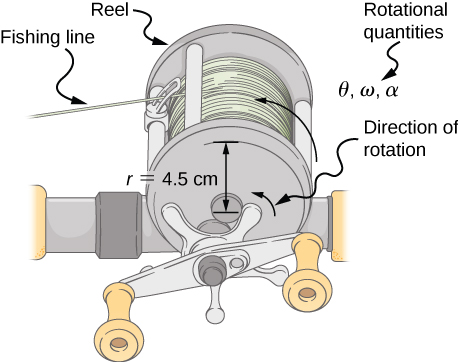
A deep-sea fisherman hooks a big fish that swims away from the boat, pulling the fishing line from his fishing reel. The whole system is initially at rest, and the fishing line unwinds from the reel at a radius of 4.50 cm from its axis of rotation. The reel is given an angular acceleration of for 2.00 s (Figure 10.11).
英語のヒント
深海釣りをする人が大きな魚を針に掛けると、魚は釣り糸をリールから引き出しながら、船から離れて泳ぐ。最初は系全体が静止しており、釣り糸は回転軸から半径4.50 cmの位置でリールからほどける。リールは、2.00 sにわたって角加速度を与えられる(図10.11)。
(a) What is the final angular velocity of the reel after 2 s?
英語のヒント
(a)2 s後のリールの最終角速度は何か。
(b) How many revolutions does the reel make?
英語のヒント
(b)リールは何回転するか。
OpenStax / Rice University, University Physics Volume 1, CC BY 4.0. Source-book artwork retained. · CC BY 4.0 · Source出典

Figure 10.11図 10.11
Fishing line coming off a rotating reel moves linearly.
英語のヒント
回転するリールから出る釣り糸は、直線的に動く。
Strategy方針
Identify the knowns and compare with the kinematic equations for constant acceleration. Look for the appropriate equation that can be solved for the unknown, using the knowns given in the problem description.
英語のヒント
既知量を特定し、一定加速度の運動学の式と照合する。問題文の既知量を使い、未知量について解ける適切な式を探す。
Solution解答
- We are given and t and want to determine . The most straightforward equation to use is , since all terms are known besides the unknown variable we are looking for. We are given that (it starts from rest), so
英語のヒント
とtが与えられ、を求める。最も直接的に使える式はで、求める未知量以外の項がすべて分かっている。静止状態から始まるためであり、次を得る。 - We are asked to find the number of revolutions. Because , we can find the number of revolutions by finding in radians. We are given and t, and we know is zero, so we can obtain by using
英語のヒント
求めるのは回転数である。なので、をラジアンで求めれば回転数を得られる。とtが与えられ、が0と分かっているので、次の式でを求められる。Converting radians to revolutions gives英語のヒント
ラジアンを回転数へ換算すると、次を得る。
Significance考察
This example illustrates that relationships among rotational quantities are highly analogous to those among linear quantities. The answers to the questions are realistic. After unwinding for two seconds, the reel is found to spin at 220 rad/s, which is 2100 rpm. (No wonder reels sometimes make high-pitched sounds.)
英語のヒント
この例は、回転の量の間の関係が、並進の量の間の関係と非常によく似ていることを示す。設問への答えは現実的である。2 s間糸がほどけた後、リールは220 rad/s、つまり2100 rpmで回転する。(リールが時に甲高い音を出すのも不思議ではない。)
In the preceding example, we considered a fishing reel with a positive angular acceleration. Now let us consider what happens with a negative angular acceleration.
英語のヒント
前の例では、角加速度が正の釣り用リールを考えた。今度は、角加速度が負の場合に何が起こるかを考えよう。
Example 10.5例題 10.5
Calculating the Duration When the Fishing Reel Slows Down and Stopsリールが減速して止まるまでの時間を計算する
Now the fisherman applies a brake to the spinning reel, achieving an angular acceleration of . How long does it take the reel to come to a stop?
英語のヒント
釣り人が回転中のリールにブレーキをかけ、角加速度を生じさせる。リールが止まるまでにどれだけ時間がかかるか。
Strategy方針
We are asked to find the time t for the reel to come to a stop. The initial and final conditions are different from those in the previous problem, which involved the same fishing reel. Now we see that the initial angular velocity is and the final angular velocity is zero. The angular acceleration is given as Examining the available equations, we see all quantities but t are known in , making it easiest to use this equation.
英語のヒント
求めるのはリールが停止するまでの時間tである。同じリールを扱っているが、初期条件と最終条件は前問と異なる。初めの角速度はで、最後の角速度は0である。角加速度はと与えられる。使える式を調べると、ではt以外のすべての量が分かっている。そのため、この式を使うのが最も簡単である。
Solution解答
The equation states
英語のヒント
式は次のようになる。
We solve the equation algebraically for t and then substitute the known values as usual, yielding
英語のヒント
通常どおり、式を代数的にtについて解いてから既知の値を代入し、次を得る。
Significance考察
Note that care must be taken with the signs that indicate the directions of various quantities. Also, note that the time to stop the reel is fairly small because the acceleration is rather large. Fishing lines sometimes snap because of the accelerations involved, and fishermen often let the fish swim for a while before applying brakes on the reel. A tired fish is slower, requiring a smaller acceleration.
英語のヒント
各量の向きを示す符号には注意が必要である。また、加速度の大きさがかなり大きいため、リールが停止する時間は比較的短い。釣り糸は関わる加速度によって切れることがあり、釣り人はしばらく魚を泳がせてからリールへブレーキをかけることが多い。疲れた魚は遅くなるため、必要な加速度が小さくなる。
Example 10.6例題 10.6
Angular Acceleration of a Propellerプロペラの角加速度
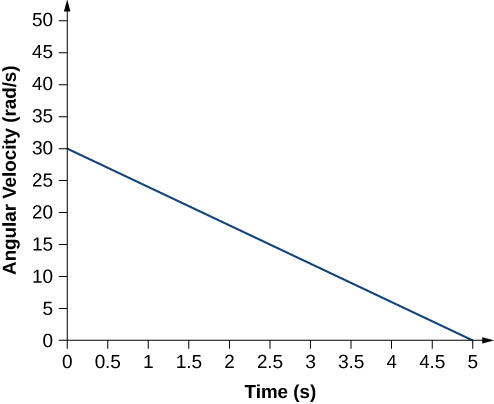
Figure 10.12 shows a graph of the angular velocity of a propeller on an aircraft as a function of time. Its angular velocity starts at 30 rad/s and drops linearly to 0 rad/s over the course of 5 seconds. (a) Find the angular acceleration of the object and verify the result using the kinematic equations. (b) Find the angle through which the propeller rotates during these 5 seconds and verify your result using the kinematic equations.
英語のヒント
図10.12は、航空機のプロペラの角速度を時間の関数として示したグラフである。角速度は30 rad/sから始まり、5 s間に直線的に0 rad/sまで減る。(a)角加速度を求め、運動学の式で結果を確かめよ。(b)この5 s間にプロペラが回る角度を求め、運動学の式で結果を確かめよ。
OpenStax / Rice University, University Physics Volume 1, CC BY 4.0. Source-book artwork retained. · CC BY 4.0 · Source出典

Figure 10.12図 10.12
A graph of the angular velocity of a propeller versus time.
英語のヒント
時間に対するプロペラの角速度のグラフ。
Strategy方針
- Since the angular velocity varies linearly with time, we know that the angular acceleration is constant and does not depend on the time variable. The angular acceleration is the slope of the angular velocity vs. time graph, . To calculate the slope, we read directly from Figure 10.12, and see that at and at . Then, we can verify the result using .
英語のヒント
角速度が時間に対して直線的に変わるので、角加速度は一定で、時間には依存しない。角加速度は角速度と時間のグラフの傾きである。傾きを求めるため図10.12から直接読み取ると、で、でである。次に、で結果を確かめられる。 - We use the equation since the time derivative of the angle is the angular velocity, we can find the angular displacement by integrating the angular velocity, which from the figure means taking the area under the angular velocity graph. In other words:
英語のヒント
という式を使う。角の時間微分は角速度なので、角速度を積分すれば角変位を得られる。図で言えば、角速度のグラフの下の面積を求めることである。つまり、Then we use the kinematic equations for constant acceleration to verify the result.英語のヒント
次に、一定加速度の運動学の式を使って結果を確かめる。
Solution解答
- Calculating the slope, we get
英語のヒント
傾きを計算すると、次を得る。We see that this is exactly Equation 10.11 with a little rearranging of terms.英語のヒント
これは、項を少し整理しただけの式10.11である。 - We can find the area under the curve by calculating the area of the right triangle, as shown in Figure 10.13.
英語のヒント
図10.13のように、直角三角形の面積を計算すれば、曲線の下の面積を求められる。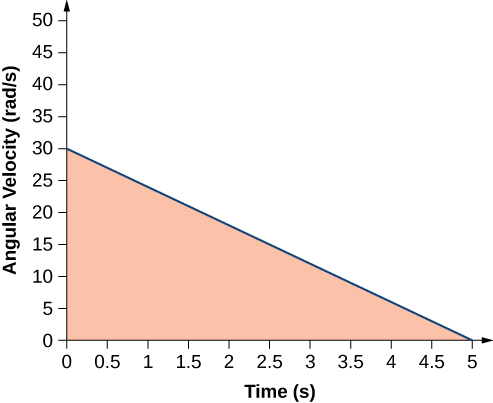
OpenStax / Rice University, University Physics Volume 1, CC BY 4.0. Source-book artwork retained. · CC BY 4.0 · Source出典
Figure 10.13図 10.13The area under the curve is the area of the right triangle.英語のヒント
曲線の下の面積は、直角三角形の面積である。Setting , we have英語のヒント
と置くと、次を得る。This verifies the solution found from finding the area under the curve.英語のヒント
これで、曲線の下の面積から得た解が確認できた。

Significance考察
We see from part (b) that there are alternative approaches to analyzing fixed-axis rotation with constant acceleration. We started with a graphical approach and verified the solution using the rotational kinematic equations. Since , we could do the same graphical analysis on an angular acceleration-vs.-time curve. The area under an curve gives us the change in angular velocity. Since the angular acceleration is constant in this section, this is a straightforward exercise.
英語のヒント
(b)から、一定の加速度での固定軸の周りの回転には、別の分析方法もあると分かる。まずグラフで考え、回転の運動学の式を使って解を確認した。なので、角加速度と時間の曲線でも同じようなグラフによる分析ができる。曲線の下の面積は、角速度の変化を与える。本節では角加速度が一定なので、これは簡単な演習となる。