第13章万有引力
The Cavendish Experimentキャヴェンディッシュの実験
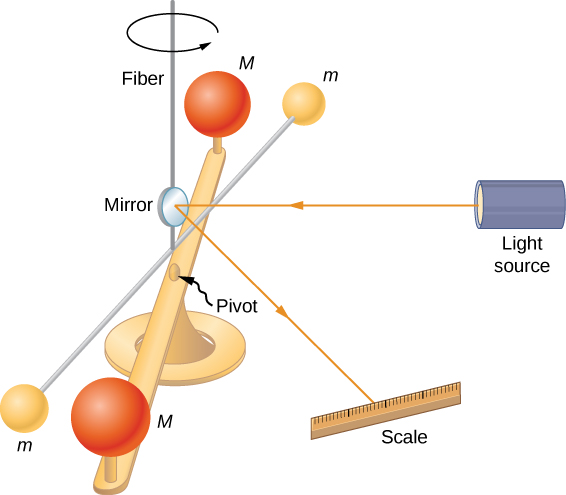
A century after Newton published his law of universal gravitation, Henry Cavendish determined the proportionality constant G by performing a painstaking experiment. He constructed a device similar to that shown in Figure 13.3, in which small masses are suspended from a wire. Once in equilibrium, two fixed, larger masses are placed symmetrically near the smaller ones. The gravitational attraction creates a torsion (twisting) in the supporting wire that can be measured.
英語のヒント
ニュートンが万有引力の法則を発表してから1世紀後、ヘンリー・キャヴェンディッシュは、丹念な実験によって比例定数Gを求めた。図13.3のように、小さな質量を針金でつり下げた装置を作った。つり合いに達したところで、小さな質量の近くに、より大きな二つの固定された質量を対称に配置する。重力による引力によって支持用の針金にねじれが生じ、そのねじれを測定できる。
The constant G is called the universal gravitational constant and Cavendish determined it to be . The word ‘universal’ indicates that scientists think that this constant applies to masses of any composition and that it is the same throughout the Universe. The value of G is an incredibly small number, showing that the force of gravity is very weak. The attraction between masses as small as our bodies, or even objects the size of skyscrapers, is incredibly small. For example, two 1.0-kg masses located 1.0 meter apart exert a force of on each other. This is the weight of a typical grain of pollen.
英語のヒント
定数Gは万有引力定数と呼ばれ、キャヴェンディッシュはその値をと求めた。「万有」という語は、科学者たちが、この定数はどのような組成の物体にも適用され、宇宙全体で同じ値を取ると考えていることを示す。Gは驚くほど小さな数であり、重力が非常に弱いことを示している。私たちの体ほどの質量の間や、高層ビルほどの大きさの物体の間でさえ、引力は驚くほど小さい。たとえば、1.0 m離れた二つの1.0 kgの質量は、互いにの力を及ぼす。これは典型的な花粉1粒の重さに相当する。
OpenStax / Rice University, University Physics Volume 1, CC BY 4.0. Source-book artwork retained. · CC BY 4.0 · Source出典

Figure 13.3図 13.3
Cavendish used an apparatus similar to this to measure the gravitational attraction between two spheres (m) suspended from a wire and two stationary spheres (M). This is a common experiment performed in undergraduate laboratories, but it is quite challenging. Passing trucks outside the laboratory can create vibrations that overwhelm the gravitational forces.
英語のヒント
キャヴェンディッシュはこれに似た装置を使い、針金につり下げた二つの球(m)と、静止した二つの球(M)の間に働く引力を測った。これは大学学部の実験でよく行われるが、かなり難しい。実験室の外を通るトラックが、重力による作用を上回る振動を生じさせることもある。
Although gravity is the weakest of the four fundamental forces of nature, its attractive nature is what holds us to Earth, causes the planets to orbit the Sun and the Sun to orbit our galaxy, and binds galaxies into clusters, ranging from a few to millions. Gravity is the force that forms the Universe.
英語のヒント
重力は自然界の四つの基本的な力のうち最も弱いが、その引き合う性質こそが、私たちを地球につなぎ止め、惑星を太陽のまわりで、太陽を銀河のまわりで公転させ、数個から数百万個もの銀河を集団に束縛している。重力は宇宙を形作る力である。
Example 13.1例題 13.1
A Collision in Orbit軌道上の衝突
Consider two nearly spherical Soyuz payload vehicles, in orbit about Earth, each with mass 9000 kg and diameter 4.0 m. They are initially at rest relative to each other, 10.0 m from center to center. (Both orbit Earth at the same speed and interact nearly the same as if they were isolated in deep space.) Determine the gravitational force between them and their initial acceleration toward each other (parallel to their orbital motion). Estimate how long it takes for them to drift together, and how fast they are moving upon impact.
英語のヒント
地球を公転する、ほぼ球形のソユーズの積載機体を二つ考える。それぞれの質量は9000 kg、直径は4.0 mである。初めは互いに対して静止しており、中心間の距離は10.0 mである。(両者は同じ速さで地球を公転しており、深宇宙で孤立している場合とほぼ同じように相互作用する。)両者の間に働く引力と、互いに近づく向きの初めの加速度(軌道運動と平行)を求めよ。また、互いに近づいて接触するまでの時間と、衝突時の速さを見積もれ。
Strategy方針
We use Newton’s law of gravitation to determine the force between them and then use Newton’s second law to find the acceleration of each. For the estimate, we find the final acceleration as well and assume the acceleration is constant at its average value, and we use the constant-acceleration equations from Motion along a Straight Line to find the time and speed of the collision.
英語のヒント
ニュートンの万有引力の法則で両者の間の力を求め、次にニュートンの第2法則でそれぞれの加速度を求める。見積もりでは、最後の加速度も求め、その平均値で加速度が一定だと仮定する。そして「直線に沿う運動」で扱った等加速度運動の式を用いて、衝突までの時間と速さを求める。
Solution解答
The magnitude of the force is
英語のヒント
力の大きさは次のとおりである。
The initial acceleration of each payload is
英語のヒント
各機体の初めの加速度は次のとおりである。
The vehicles are 4.0 m in diameter, so the vehicles move from 10.0 m to 4.0 m apart, or a distance of 3.0 m each. A similar calculation to that above, for when the vehicles are 4.0 m apart, yields an acceleration of , and the average of these two values is . If we assume a constant acceleration of this value and they start from rest, then the vehicles collide with speed given by
英語のヒント
機体の直径は4.0 mなので、両者の間隔は10.0 mから4.0 mへ縮まり、それぞれが3.0 m移動する。間隔が4.0 mとなったときについて上と同様に計算すると、加速度はとなり、二つの値の平均はである。この値の一定の加速度を仮定し、両者が静止から動き始めるとすれば、衝突時の速さは次の式から求められる。
so
英語のヒント
したがって、
We use to find or about 4.6 hours.
英語のヒント
を用いると、、すなわち約4.6時間と求まる。
Significance考察
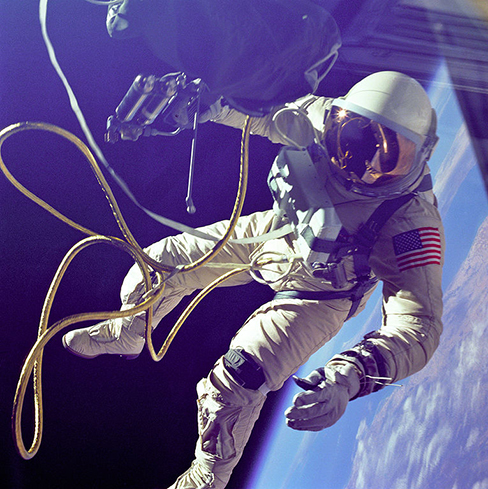
These calculations—including the initial force—are only estimates, as the vehicles are probably not spherically symmetrical. But you can see that the force is incredibly small. Astronauts must tether themselves when doing work outside even the massive International Space Station (ISS), as in Figure 13.4, because the gravitational attraction cannot save them from even the smallest push away from the station.
英語のヒント
機体はおそらく球対称ではないので、初めの力を含め、これらの計算は見積もりにすぎない。それでも力が驚くほど小さいことは分かる。図13.4のように、巨大な国際宇宙ステーション(ISS)の外で作業する場合でさえ、宇宙飛行士は体を命綱でつないでおかなければならない。ステーションからごくわずかに押し出されただけでも、重力による引力では引き留められないからである。
(credit: NASA) NASA imagery used for educational publication; no NASA endorsement is implied. · NASA media use permission; OpenStax additions CC BY 4.0 · Source出典

Figure 13.4図 13.4
This photo shows Ed White tethered to the Space Shuttle during a spacewalk. (credit: NASA)
英語のヒント
この写真は、宇宙遊泳中にスペースシャトルへ命綱でつながれたエド・ホワイトを示している。(出典:NASA)
The effect of gravity between two objects with masses on the order of these space vehicles is indeed small. Yet, the effect of gravity on you from Earth is significant enough that a fall into Earth of only a few feet can be dangerous. We examine the force of gravity near Earth’s surface in the next section.
英語のヒント
これらの宇宙機ほどの質量を持つ二つの物体間では、重力の効果は確かに小さい。しかし、地球が私たちに及ぼす重力の効果は十分に大きく、数フィート落下して地面にぶつかるだけでも危険になりうる。次の節では、地表付近の重力を調べる。
Example 13.2例題 13.2
Attraction between Galaxies銀河間の引力
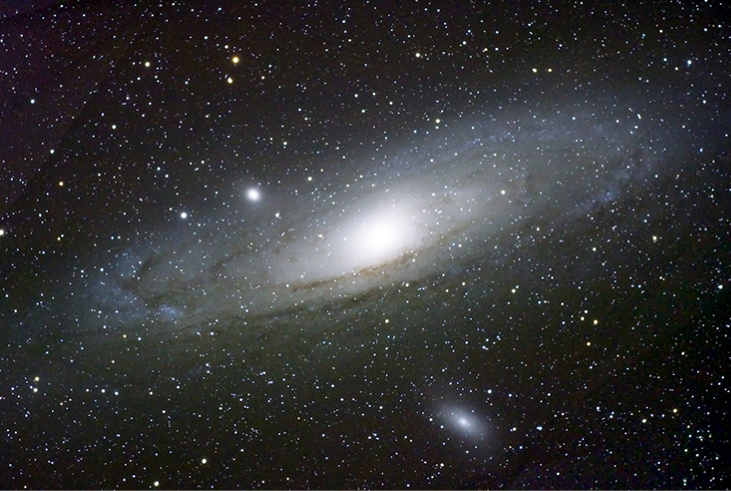
Find the acceleration of our galaxy, the Milky Way, due to the nearest comparably sized galaxy, the Andromeda galaxy (Figure 13.5). The approximate mass of each galaxy is 800 × 109 solar masses (a solar mass is the mass of our Sun), and they are separated by 2.5 million light-years. (Note that the mass of Andromeda is not so well known but is believed to be slightly larger than our galaxy.) Each galaxy has a diameter of roughly 100,000 light-years .
英語のヒント
私たちの銀河である天の川銀河が、同程度の大きさで最も近いアンドロメダ銀河(図13.5)から受ける加速度を求めよ。各銀河のおよその質量は800 × 109太陽質量(1太陽質量は太陽の質量)で、両者は250万光年離れている。アンドロメダ銀河の質量はそれほどよく分かっていないが、天の川銀河より少し大きいと考えられている点に注意せよ。各銀河の直径は約10万光年である。
Boris Štromar, M31bobo. Modified in OpenStax University Physics Volume 1. CC BY 3.0. · CC BY 3.0 · Source出典

Figure 13.5図 13.5
Galaxies interact gravitationally over immense distances. The Andromeda galaxy is the nearest spiral galaxy to the Milky Way, and they will eventually collide. (credit: Boris Štromar)
英語のヒント
銀河は途方もなく遠い距離を隔てても重力によって相互作用する。アンドロメダ銀河は天の川銀河に最も近い渦巻銀河であり、両者はやがて衝突する。(出典:Boris Štromar)
Strategy方針
As in the preceding example, we use Newton’s law of gravitation to determine the force between them and then use Newton’s second law to find the acceleration of the Milky Way. We can consider the galaxies to be point masses, since their sizes are about 25 times smaller than their separation. The mass of the Sun (see Appendix D) is and a light-year is the distance light travels in one year, .
英語のヒント
前の例題と同様に、ニュートンの万有引力の法則で両者の間に働く力を求め、次にニュートンの第2法則で天の川銀河の加速度を求める。銀河の大きさは両者の間隔の約25分の1なので、質点と考えられる。太陽の質量(付録D参照)はであり、1光年は光が1年間に進む距離、である。
Solution解答
The magnitude of the force is
英語のヒント
力の大きさは次のとおりである。
The acceleration of the Milky Way is
英語のヒント
天の川銀河の加速度は次のとおりである。
Significance考察
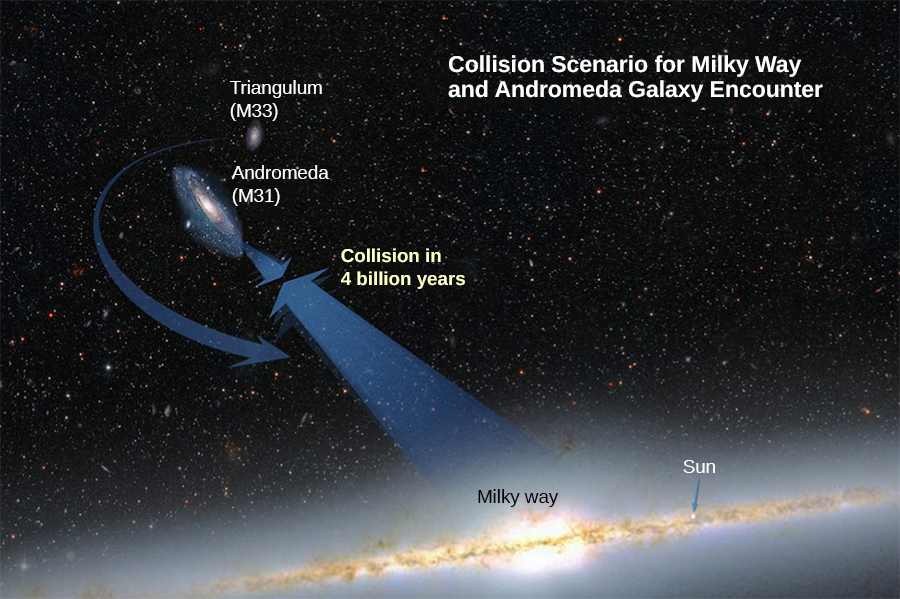
Does this value of acceleration seem astoundingly small? If they start from rest, then they would accelerate directly toward each other, “colliding” at their center of mass. Let’s estimate the time for this to happen. The initial acceleration is , so using , we see that it would take for each galaxy to reach a speed of 1.0 m/s, and they would be only closer. That is nine orders of magnitude smaller than the initial distance between them. In reality, such motions are rarely simple. These two galaxies, along with about 50 other smaller galaxies, are all gravitationally bound into our local cluster. Our local cluster is gravitationally bound to other clusters in what is called a supercluster. All of this is part of the great cosmic dance that results from gravitation, as shown in Figure 13.6.
英語のヒント
この加速度の値は、驚くほど小さく思えるだろうか。両者が静止から動き始めるなら、互いにまっすぐ近づくように加速し、共通の重心で「衝突」する。そこまでの時間を見積もってみよう。初めの加速度はなので、を用いると、各銀河が1.0 m/sの速さになるにはかかり、その間に近づく距離はわずかである。これは初めの銀河間隔より9桁小さい。実際には、このような運動が単純になることはめったにない。この二つの銀河は、ほかの約50個の小さな銀河とともに、重力によって私たちの局所的な銀河の集団に束縛されている。この集団は、超銀河団と呼ばれる構造の中で、ほかの集団と重力によって結び付いている。これらすべては、図13.6に示すように、重力が生み出す壮大な宇宙の舞踏の一部である。
NASA; ESA; A. Feild and R. van der Marel, STScI. Modified in OpenStax University Physics Volume 1. · CC BY 4.0 · Source出典

Figure 13.6図 13.6
Based on the results of this example, plus what astronomers have observed elsewhere in the Universe, our galaxy will collide with the Andromeda Galaxy in about 4 × 10⁹ years. (credit: modification of work by NASA; ESA; A. Feild and R. van der Marel, STScI)
英語のヒント
この例題の結果と、天文学者が宇宙のほかの場所で観測した事柄に基づくと、天の川銀河は約4 × 10⁹年後にアンドロメダ銀河と衝突する。(出典:NASA、ESA、A. FeildおよびR. van der Marel、STScIの作品を改変)