第13章万有引力
13.5 Kepler's Laws of Planetary Motion13.5 ケプラーの惑星運動の法則
Learning Objectives学習目標
Learning Objectives学習目標
By the end of this section, you will be able to:
英語のヒント
この節を終えると、次のことができるようになる。
- Describe the conic sections and how they relate to orbital motion
英語のヒント
円錐曲線と、それが軌道運動にどう関係するかを説明する。 - Describe how orbital velocity is related to conservation of angular momentum
英語のヒント
軌道の速度が角運動量保存にどう関係するかを説明する。 - Determine the period of an elliptical orbit from its major axis
英語のヒント
楕円軌道の長軸から、その周期を求める。
Using the precise data collected by Tycho Brahe, Johannes Kepler carefully analyzed the positions in the sky of all the known planets and the Moon, plotting their positions at regular intervals of time. From this analysis, he formulated three laws, which we address in this section.
英語のヒント
ヨハネス・ケプラーは、ティコ・ブラーエが集めた精密なデータを用い、当時知られていたすべての惑星と月の天球上の位置を注意深く分析した。位置を一定の時間間隔でプロットし、その分析から三つの法則を定式化した。この節では、それらを扱う。
Kepler’s First Lawケプラーの第1法則
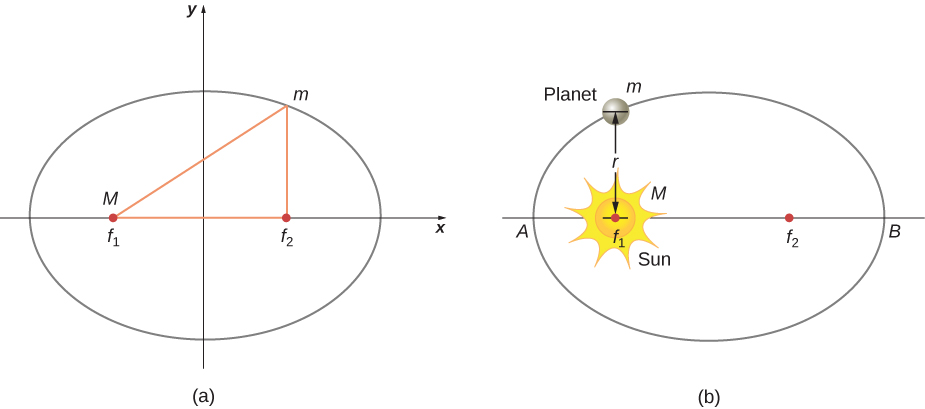
The prevailing view during the time of Kepler was that all planetary orbits were circular. The data for Mars presented the greatest challenge to this view and that eventually encouraged Kepler to give up the popular idea. Kepler’s first law states that every planet moves along an ellipse, with the Sun located at a focus of the ellipse. An ellipse is defined as the set of all points such that the sum of the distance from each point to two foci is a constant. Figure 13.17 shows an ellipse and describes a simple way to create it.
英語のヒント
ケプラーの時代には、惑星の軌道はすべて円形だという考えが支配的だった。火星のデータはこの考えに最も大きな難題を突き付け、やがてケプラーが広く受け入れられた考えを捨てるきっかけとなった。ケプラーの第1法則によれば、すべての惑星は、太陽を一つの焦点とする楕円上を動く。楕円は、二つの焦点からの距離の和が一定となる点すべての集合として定義される。図13.17は楕円と、その簡単な描き方を示す。
OpenStax / Rice University, University Physics Volume 1, CC BY 4.0. Source-book artwork retained. · CC BY 4.0 · Source出典

Figure 13.17図 13.17
(a) An ellipse is a curve in which the sum of the distances from a point on the curve to two foci is a constant. From this definition, you can see that an ellipse can be created in the following way. Place a pin at each focus, then place a loop of string around a pencil and the pins. Keeping the string taught, move the pencil around in a complete circuit. If the two foci occupy the same place, the result is a circle—a special case of an ellipse. (b) For an elliptical orbit, if , then m follows an elliptical path with M at one focus. More exactly, both m and M move in their own ellipse about the common center of mass.
英語のヒント
(a) 楕円は、曲線上の点から二つの焦点までの距離の和が一定となる曲線である。この定義から、次のように描けることが分かる。各焦点にピンを置き、輪にした糸を鉛筆と二つのピンに掛ける。糸を張った状態に保ちながら鉛筆を1周させる。二つの焦点が同じ位置に重なると、楕円の特別な場合である円になる。(b) 楕円軌道でなら、mはMを一つの焦点とする楕円を進む。より正確には、mもMも共通の重心のまわりで、それぞれの楕円上を動く。
For elliptical orbits, the point of closest approach of a planet to the Sun is called the perihelion. It is labeled point A in Figure 13.17. The farthest point is the aphelion and is labeled point B in the figure. For the Moon’s orbit about Earth, those points are called the perigee and apogee, respectively.
英語のヒント
楕円軌道で惑星が太陽に最も近づく点を、近日点という。図13.17では点Aである。最も遠い点は遠日点と呼ばれ、図の点Bである。地球を回る月の軌道では、それぞれ近地点、遠地点と呼ぶ。
An ellipse has several mathematical forms, but all are a specific case of the more general equation for conic sections. There are four different conic sections, all given by the equation
英語のヒント
楕円にはいくつかの数学的な表し方があるが、いずれも、より一般的な円錐曲線の方程式の特別な場合である。円錐曲線は四つの種類に分かれ、すべて次の式で表される。
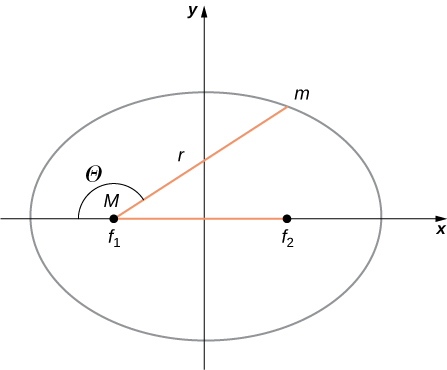
The variables r and are shown in Figure 13.18 in the case of an ellipse. The constants and e are determined by the total energy and angular momentum of the satellite at a given point. The constant e is called the eccentricity. The values of and e determine which of the four conic sections represents the path of the satellite.
英語のヒント
変数rとを、楕円の場合について図13.18に示す。定数とeは、ある点での衛星の全エネルギーと角運動量によって決まる。定数eを離心率という。とeの値によって、四つの円錐曲線のうちどれが衛星の経路を表すかが決まる。
OpenStax / Rice University, University Physics Volume 1, CC BY 4.0. Source-book artwork retained. · CC BY 4.0 · Source出典

Figure 13.18図 13.18
As before, the distance between the planet and the Sun is r, and the angle measured from the x-axis, which is along the major axis of the ellipse, is .
英語のヒント
これまでと同様に、惑星と太陽の距離はrである。楕円の長軸に沿うx軸から測った角はである。
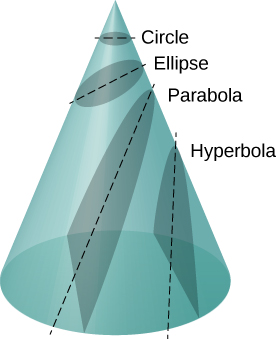
One of the real triumphs of Newton’s law of universal gravitation, with the force proportional to the inverse of the distance squared, is that when it is combined with his second law, the solution for the path of any satellite is a conic section. Every path taken by m is one of the four conic sections: a circle or an ellipse for bound or closed orbits, or a parabola or hyperbola for unbounded or open orbits. These conic sections are shown in Figure 13.19.
英語のヒント
力が距離の2乗に反比例するニュートンの万有引力の法則の大きな成果の一つは、運動の第2法則と組み合わせると、どの衛星の経路の解も円錐曲線になることである。mの取る経路は必ず四つの円錐曲線の一つであり、束縛された閉じた軌道なら円または楕円、非束縛の開いた軌道なら放物線または双曲線になる。図13.19にこれらの円錐曲線を示す。
OpenStax / Rice University, University Physics Volume 1, CC BY 4.0. Source-book artwork retained. · CC BY 4.0 · Source出典

Figure 13.19図 13.19
All motion caused by an inverse square force is one of the four conic sections and is determined by the energy and direction of the moving body.
英語のヒント
逆2乗の力による運動はすべて、四つの円錐曲線の一つを描く。その種類は、運動する物体のエネルギーと向きで決まる。
If the total energy is negative, then , and Equation 13.10 represents a bound or closed orbit of either an ellipse or a circle, where . [You can see from Equation 13.10 that for , , and hence the radius is constant.] For ellipses, the eccentricity is related to how oblong the ellipse appears. A circle has zero eccentricity, whereas a very long, drawn-out ellipse has an eccentricity near one.
英語のヒント
If the total energy is exactly zero, then and the path is a parabola. Recall that a satellite with zero total energy has exactly the escape velocity. (The parabola is formed only by slicing the cone parallel to the tangent line along the surface.) Finally, if the total energy is positive, then and the path is a hyperbola. These last two paths represent unbounded orbits, where m passes by M once and only once. This situation has been observed for several comets that approach the Sun and then travel away, never to return.
英語のヒント
全エネルギーがちょうどゼロならとなり、経路は放物線になる。全エネルギーがゼロの衛星は、ちょうど脱出速度を持つことを思い出そう。(放物線は、円錐の表面に沿う接線に平行に切ったときにだけ生じる。)最後に、全エネルギーが正ならとなり、経路は双曲線になる。後の二つは非束縛軌道であり、mはMのそばを一度だけ通過する。このような状況は、太陽に近づいた後、遠くへ去って二度と戻らないいくつかの彗星で観測されている。
We have confined ourselves to the case in which the smaller mass (planet) orbits a much larger, and hence stationary, mass (Sun), but Equation 13.10 also applies to any two gravitationally interacting masses. Each mass traces out the exact same-shaped conic section as the other. That shape is determined by the total energy and angular momentum of the system, with the center of mass of the system located at the focus. The ratio of the dimensions of the two paths is the inverse of the ratio of their masses.
英語のヒント
これまでは、小さい質量(惑星)が、はるかに大きく、したがって静止しているとみなせる質量(太陽)のまわりを回る場合に話を限ってきた。しかし、円錐曲線の式は、重力で相互作用する任意の二つの質量にも適用できる。各質量は、相手とまったく同じ形の円錐曲線を描く。その形は系の全エネルギーと角運動量によって決まり、系の重心が焦点にある。二つの経路の大きさの比は、質量比の逆数となる。