第13章万有引力
13.1 Newton's Law of Universal Gravitation13.1 ニュートンの万有引力の法則
Learning Objectives学習目標
Learning Objectives学習目標
By the end of this section, you will be able to:
英語のヒント
この節を終えると、次のことができるようになる。
- List the significant milestones in the history of gravitation
英語のヒント
重力研究の歴史における重要な画期を挙げる。 - Calculate the gravitational force between two point masses
英語のヒント
二つの質点の間に働く重力を計算する。 - Estimate the gravitational force between collections of mass
英語のヒント
質量を持つ物体の集まりどうしの間に働く重力を見積もる。
We first review the history of the study of gravitation, with emphasis on those phenomena that for thousands of years have inspired philosophers and scientists to search for an explanation. Then we examine the simplest form of Newton’s law of universal gravitation and how to apply it.
英語のヒント
まず、重力研究の歴史を振り返る。とくに、何千年もの間、哲学者や科学者を説明の探究へと駆り立ててきた現象に注目する。続いて、ニュートンの万有引力の法則の最も単純な形と、その適用方法を調べる。
The History of Gravitation重力研究の歴史
The earliest philosophers wondered why objects naturally tend to fall toward the ground. Aristotle (384–322 BCE) believed that it was the nature of rocks to seek Earth and the nature of fire to seek the Heavens. Brahmagupta (598~665 CE) postulated that Earth was a sphere and that objects possessed a natural affinity for it, falling toward the center from wherever they were located.
英語のヒント
初期の哲学者たちは、なぜ物体が自然に地面へ落ちようとするのか疑問に思った。アリストテレス(紀元前384〜322年)は、岩が地球を目指し、火が天を目指すのは、それぞれの本性だと考えた。ブラーマグプタ(598〜665年頃)は、地球は球体であり、物体には地球への自然な親和性があるため、どこにあっても地球の中心へ向かって落下すると仮定した。
The motions of the Sun, our Moon, and the planets have been studied for thousands of years as well. These motions were described with amazing accuracy by Ptolemy (90–168 CE), whose method of epicycles described the paths of the planets as circles within circles. However, there is little evidence that anyone connected the motion of astronomical bodies with the motion of objects falling to Earth—until the seventeenth century.
英語のヒント
太陽、月、惑星の運動も、何千年もの間研究されてきた。プトレマイオス(90〜168年)は、惑星の軌道を円の中の円として表す周転円の方法を用い、これらの運動を驚くほど正確に記述した。しかし、天体の運動と地球へ落下する物体の運動を結び付けた人がいたという証拠は、17世紀まではほとんどない。
The idea of heliocentrism, in which the Sun is at the center of the solar system, dates at least as far back as Aristarchus of Samos in the third century BCE, but attracted little attention, and Ptolemy’s geocentric (Earth-centered) model held sway in Europe until the sixteenth century. Nicolaus Copernicus (1473–1543) is generally credited as being the first to produce a mathematical model of a heliocentric system and to challenge Ptolemy’s geocentric system. This idea was supported by the incredibly precise naked-eye measurements of planetary motions by Tycho Brahe and their analysis by Johannes Kepler and Galileo Galilei. Kepler showed that the motion of each planet is an ellipse (the first of his three laws, discussed in Kepler’s Laws of Planetary Motion), and Robert Hooke (the same Hooke who formulated Hooke’s law for springs) intuitively suggested that these motions are due to the planets being attracted to the Sun. However, it was Isaac Newton who connected the acceleration of objects near Earth’s surface with the centripetal acceleration of the Moon in its orbit about Earth.
英語のヒント
太陽が太陽系の中心にあるとする地動説の考えは、少なくとも紀元前3世紀のサモスのアリスタルコスまでさかのぼる。しかし、ほとんど注目を集めず、ヨーロッパでは16世紀までプトレマイオスの地球中心の天動説が優勢だった。ニコラウス・コペルニクス(1473〜1543年)は一般に、地動説の数学的モデルを初めて作り、プトレマイオスの天動説に異議を唱えた人物とされる。この考えは、ティコ・ブラーエによる驚くほど精密な肉眼での惑星運動の測定と、ヨハネス・ケプラーおよびガリレオ・ガリレイによるその分析によって裏付けられた。ケプラーは、各惑星の軌道が楕円であることを示した。これは三つの法則の第1法則であり、「ケプラーの惑星運動の法則」で扱う。ロバート・フック(ばねについてのフックの法則を定式化した人物)は、これらの運動が惑星の太陽への引力によって生じると直観的に示唆した。しかし、地表付近の物体の加速度と、地球を回る月の軌道上の向心加速度を結び付けたのは、アイザック・ニュートンだった。
Other prominent scientists and mathematicians of the time, particularly those outside of England, were reluctant to accept Newton's principles. It took the work of another prominent philosopher, writer, and scientist, Émilie du Châtelet, to establish the Newtonian gravitation as the accurate and overarching law. Du Châtelet, who had earlier laid the foundation for the understanding of conservation of energy as well as the principle that light had no mass, translated and augmented Newton's key work. She also utilized calculus to explain gravity, which helped lead to its acceptance.
英語のヒント
当時のほかの著名な科学者や数学者、とくにイングランドの外にいた人々は、ニュートンの原理をなかなか受け入れなかった。ニュートンの重力を正確で包括的な法則として確立するには、もう一人の著名な哲学者、著述家、科学者であるエミリー・デュ・シャトレの仕事が必要だった。デュ・シャトレは、それ以前にエネルギー保存の理解の基礎や、光には質量がないという原理の基礎を築いており、ニュートンの主要な著作を翻訳して内容を増補した。さらに、微積分を用いて重力を説明し、その受容を促した。
Finally, in Einstein’s Theory of Gravity, we look at the theory of general relativity proposed by Albert Einstein in 1916. His theory comes from a vastly different perspective, in which gravity is a manifestation of mass warping space and time. The consequences of his theory gave rise to many remarkable predictions, essentially all of which have been confirmed over the many decades following the publication of the theory (including the 2015 measurement of gravitational waves from the merger of two black holes).
英語のヒント
最後に「アインシュタインの重力理論」で、アルベルト・アインシュタインが1916年に提案した一般相対性理論を扱う。これは大きく異なる見方に基づく理論であり、重力を、質量が空間と時間をゆがめることの現れとして捉える。この理論からは多くの驚くべき予測が導かれた。そのほぼすべてが、理論の発表後何十年もの間に確かめられている。2015年に行われた、二つのブラックホールの合体による重力波の測定もその一つである。
Newton’s Law of Universal Gravitationニュートンの万有引力の法則
Newton noted that objects at Earth’s surface (hence at a distance of from the center of Earth) have an acceleration of g, but the Moon, at a distance of about , has a centripetal acceleration about times smaller than g. He could explain this by postulating that a force exists between any two objects, whose magnitude is given by the product of the two masses divided by the square of the distance between them. We now know that this inverse square law is ubiquitous in nature, a function of geometry for point sources. The strength of any source at a distance r is spread over the surface of a sphere centered about the mass. The surface area of that sphere is proportional to . In later chapters, we see this same form in the electromagnetic force.
英語のヒント
ニュートンは、地表にある物体(したがって地球の中心からの距離がの物体)の加速度がgであるのに対し、約の距離にある月の向心加速度はgの約分の1であることに着目した。あらゆる二つの物体の間に力が存在し、その大きさは二つの質量の積を物体間の距離の2乗で割った値に比例すると仮定すれば、このことを説明できた。現在では、この逆2乗則は自然界の至るところにあり、点状の源についての幾何学的性質から生じることが分かっている。源の強さは、距離rでは、その質量を中心とする球の表面全体に広がる。この球の表面積はに比例する。後の章では、電磁気力にも同じ形が現れることを見る。
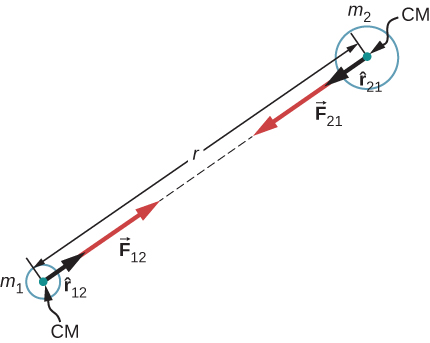
As shown in Figure 13.2, the vector points from object 1 toward object 2, and hence represents an attractive force between the objects. The equal but opposite force is the force on object 2 exerted by object 1.
英語のヒント
図13.2に示すように、ベクトルは物体1から物体2へ向くため、物体間の引力を表している。これと大きさが等しく向きが反対の力は、物体1が物体2に及ぼす力である。
OpenStax / Rice University, University Physics Volume 1, CC BY 4.0. Source-book artwork retained. · CC BY 4.0 · Source出典

Figure 13.2図 13.2
Gravitational force acts along a line joining the centers of mass of two objects.
英語のヒント
重力は、二つの物体の重心を結ぶ直線に沿って作用する。
These equal but opposite forces reflect Newton’s third law, which we discussed earlier. Note that strictly speaking, Equation 13.1 applies to point masses—all the mass is located at one point. But it applies equally to any spherically symmetric objects, where r is the distance between the centers of mass of those objects. In many cases, it works reasonably well for nonsymmetrical objects, if their separation is large compared to their size, and we take r to be the distance between the center of mass of each body.
英語のヒント
大きさが等しく向きが反対のこれらの力は、前に学んだニュートンの第3法則を反映している。厳密には、式13.1は質点、すなわち質量のすべてが1点に集中しているものに適用される。しかし、この式は球対称な物体にも同じように適用できる。その場合、rは物体の重心間の距離である。非対称な物体でも、物体間の距離が大きさに比べて十分に大きく、rをそれぞれの物体の重心間の距離とすれば、多くの場合にかなりよい近似として使える。