第13章万有引力
13.6 Tidal Forces13.6 潮汐力
Learning Objectives学習目標
Learning Objectives学習目標
By the end of this section, you will be able to:
英語のヒント
この節を終えると、次のことができるようになる。
- Explain the origins of Earth’s ocean tides
英語のヒント
地球の海の潮汐が生じる原因を説明する。 - Describe how neap and leap tides differ
英語のヒント
小潮と大潮の違いを説明する。 - Describe how tidal forces affect binary systems
英語のヒント
潮汐力が連星系に与える影響を説明する。
The origin of Earth’s ocean tides has been a subject of continuous investigation for over 2000 years. But the work of Newton is considered to be the beginning of the true understanding of the phenomenon. Ocean tides are the result of gravitational tidal forces. These same tidal forces are present in any astronomical body. They are responsible for the internal heat that creates the volcanic activity on Io, one of Jupiter’s moons, and the breakup of stars that get too close to black holes.
英語のヒント
地球の海に潮汐が生じる原因は、2000年以上にわたって研究され続けてきた。しかし、この現象の本当の理解はニュートンの研究から始まったと考えられている。海の潮汐は、重力による潮汐力の結果である。同じ潮汐力は、どの天体にも存在する。木星の衛星イオで火山活動を生じさせる内部の熱も、ブラックホールに近づきすぎた恒星がばらばらになる現象も、この力によって生じる。
Lunar Tides月による潮汐
If you live on an ocean shore almost anywhere in the world, you can observe the rising and falling of the sea level about twice per day. This is caused by a combination of Earth’s rotation about its axis and the gravitational attraction of both the Moon and the Sun.
英語のヒント
世界のほとんどどの海岸に住んでいても、1日に約2回、海面が上がったり下がったりする様子を観察できる。これは、地軸の周りの地球の自転と、月および太陽の重力による引力が組み合わさって生じる。
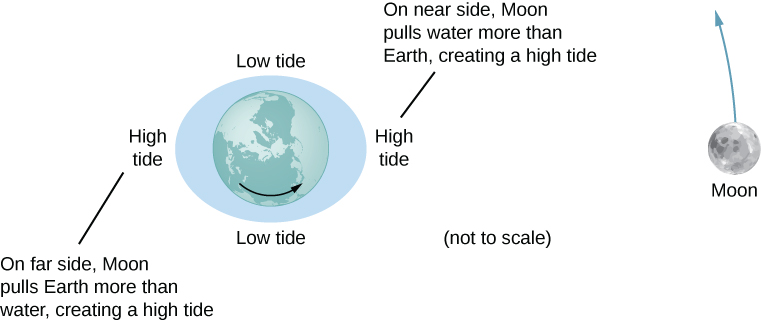
Let’s consider the effect of the Moon first. In Figure 13.23, we are looking “down” onto Earth’s North Pole. One side of Earth is closer to the Moon than the other side, by a distance equal to Earth’s diameter. Hence, the gravitational force is greater on the near side than on the far side. The magnitude at the center of Earth is between these values. This is why a tidal bulge appears on both sides of Earth.
英語のヒント
まず月の影響を考えよう。図13.23では、地球の北極を上から見下ろしている。地球の一方の側は、反対側よりも地球の直径だけ月に近い。したがって、月に近い側での重力は、遠い側での重力より大きい。地球の中心での大きさは、この二つの値の間にある。このため、地球の両側に潮汐による膨らみが現れる。
OpenStax / Rice University, University Physics Volume 1, CC BY 4.0. Source-book artwork retained. · CC BY 4.0 · Source出典

Figure 13.23図 13.23
The tidal force stretches Earth along the line between Earth and the Moon. It is the difference between the gravitational force from the far side to the near side, along with the orbit of Earth and the Moon around each other, that creates the tidal bulge on both sides of the planet. Tidal variations of the oceans are on the order of few meters; hence, this diagram is greatly exaggerated.
英語のヒント
潮汐力は、地球と月を結ぶ直線に沿って地球を引き伸ばす。地球の両側に潮汐による膨らみを生むのは、遠い側と近い側での重力の差と、地球と月が互いの周りを回る運動である。海面の潮汐変動は数m程度なので、この図は大きく誇張されている。
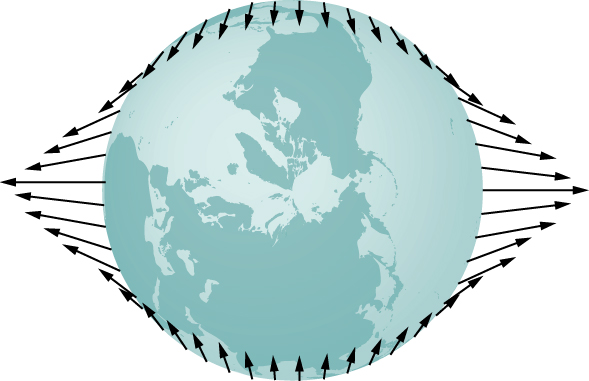
The net force on Earth causes it to orbit about the Earth-Moon center of mass, located about 1600 km below Earth’s surface along the line between Earth and the Moon. The tidal force can be viewed as the difference between the force at the center of Earth and that at any other location. In Figure 13.24, this difference is shown at sea level, where we observe the ocean tides. (Note that the change in sea level caused by these tidal forces is measured from the baseline sea level. We saw earlier that Earth bulges many kilometers at the equator due to its rotation. This defines the baseline sea level and here we consider only the much smaller tidal bulge measured from that baseline sea level.)
英語のヒント
地球に働く合力によって、地球は地球・月系の重心の周りを回る。この重心は地球と月を結ぶ直線上にあり、地表から約1600 km下に位置する。潮汐力は、地球の中心に働く力と、それ以外の場所に働く力の差とみなせる。図13.24では、海の潮汐を観察する海面でのこの差を示している。(この潮汐力が生む海面の変化は、基準となる海面から測ることに注意しよう。地球は自転によって、赤道で何kmも膨らむことをすでに見た。この形状が基準の海面を定める。ここで扱うのは、その基準の海面から測った、はるかに小さな潮汐の膨らみだけである。)
OpenStax / Rice University, University Physics Volume 1, CC BY 4.0. Source-book artwork retained. · CC BY 4.0 · Source出典

Figure 13.24図 13.24
The tidal force is the difference between the gravitational force at the center and that elsewhere. In this figure, the tidal forces are shown at the ocean surface. These forces would diminish to zero as you approach Earth’s center.
英語のヒント
潮汐力は、中心の重力とほかの場所の重力との差である。この図では、海面での潮汐力を示す。地球の中心へ近づくにつれて、これらの力はゼロへ減少する。
Why does the rise and fall of the tides occur twice per day? Look again at Figure 13.23. If Earth were not rotating and the Moon was fixed, then the bulges would remain in the same location on Earth. Relative to the Moon, the bulges stay fixed—along the line connecting Earth and the Moon. But Earth rotates (in the direction shown by the blue arrow) approximately every 24 hours. In 6 hours, the near and far locations of Earth move to where the low tides are occurring, and 6 hours later, those locations are back to the high-tide position. Since the Moon also orbits Earth approximately every 28 days, and in the same direction as Earth rotates, the time between high (and low) tides is actually about 12.5 hours. The actual timing of the tides is complicated by numerous factors, the most important of which is another astronomical body—the Sun.
英語のヒント
なぜ潮の満ち引きは1日に2回起こるのか。図13.23をもう一度見よう。地球が自転せず、月が静止していれば、膨らみは地球上の同じ位置にとどまる。月に対しては、膨らみは地球と月を結ぶ直線上に固定されている。しかし地球は、青い矢印の向きに約24時間で1回自転する。6時間後には、地球の近い側と遠い側の場所は、干潮が生じる位置へ移る。さらに6時間後には、それらの場所は満潮の位置へ戻る。月も約28日で地球を公転し、その向きは地球の自転と同じなので、満潮から次の満潮まで(または干潮から次の干潮まで)の時間は、実際には約12.5時間となる。実際の潮汐の時刻は多くの要因によって複雑になる。そのうち最も重要なのは、もう一つの天体、太陽である。
The Effect of the Sun on Tides太陽が潮汐に及ぼす影響
In addition to the Moon’s tidal forces on Earth’s oceans, the Sun exerts a tidal force as well. The gravitational attraction of the Sun on any object on Earth is nearly 200 times that of the Moon. However, as we show later in an example, the tidal effect of the Sun is less than that of the Moon, but a significant effect nevertheless. Depending upon the positions of the Moon and Sun relative to Earth, the net tidal effect can be amplified or attenuated.
英語のヒント
地球の海には月の潮汐力に加えて、太陽による潮汐力も働く。地上のどの物体に対しても、太陽の重力による引力は、月の引力の約200倍である。しかし後の例で示すように、太陽の潮汐への効果は月より小さい。それでも、無視できない効果である。地球に対する月と太陽の位置に応じて、合成された潮汐の効果は強められたり弱められたりする。
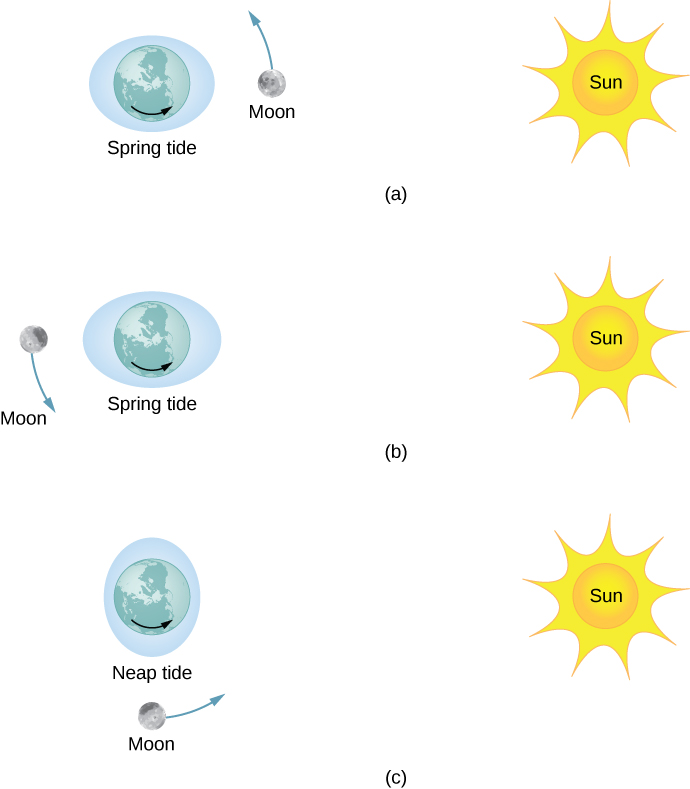
Figure 13.23 illustrates the relative positions of the Sun and the Moon that create the largest tides, called spring tides (or leap tides). During spring tides, Earth, the Moon, and the Sun are aligned and the tidal effects add. (Recall that the tidal forces cause bulges on both sides.) Figure 13.23(c) shows the relative positions for the smallest tides, called neap tides. The extremes of both high and low tides are affected. Spring tides occur during the new or full moon, and neap tides occur at half-moon.
英語のヒント
Additional Resources追加教材
OpenStax / Rice University, University Physics Volume 1, CC BY 4.0. Source-book artwork retained. · CC BY 4.0 · Source出典

Figure 13.25図 13.25
(a and b) The spring tides occur when the Sun and the Moon are aligned, whereas (c) the neap tides occur when the Sun and Moon make a right triangle with Earth. (Figure is not drawn to scale.)
英語のヒント
(a)、(b) 太陽と月が一直線に並ぶと大潮になる。(c) 太陽、月、地球が直角三角形を作ると小潮になる。(図は縮尺どおりではない。)