第13章万有引力
Kepler’s Second Lawケプラーの第2法則
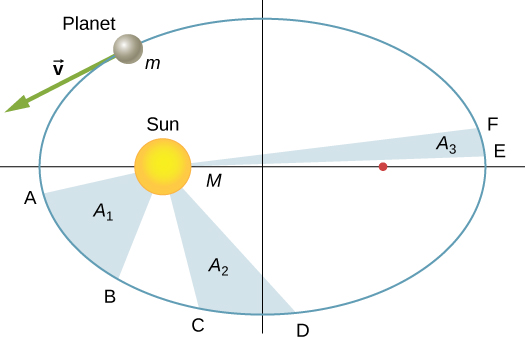
Kepler’s second law states that a planet sweeps out equal areas in equal times, that is, the area divided by time, called the areal velocity, is constant. Consider Figure 13.21. The time it takes a planet to move from position A to B, sweeping out area , is exactly the time taken to move from position C to D, sweeping area , and to move from E to F, sweeping out area . These areas are the same: .
英語のヒント
ケプラーの第2法則は、惑星が等しい時間に等しい面積を掃くという法則である。すなわち、面積を時間で割った面積速度が一定である。図13.21を考えよう。惑星が位置AからBへ動いて面積を掃くのにかかる時間は、CからDへ動いて面積を掃く時間、およびEからFへ動いて面積を掃く時間と、まったく同じである。これらの面積は等しく、である。
OpenStax / Rice University, University Physics Volume 1, CC BY 4.0. Source-book artwork retained. · CC BY 4.0 · Source出典

Figure 13.21図 13.21
The shaded regions shown have equal areas and represent the same time interval.
英語のヒント
陰影を付けた領域は面積が等しく、同じ時間間隔に対応する。
Comparing the areas in the figure and the distance traveled along the ellipse in each case, we can see that in order for the areas to be equal, the planet must speed up as it gets closer to the Sun and slow down as it moves away. This behavior is completely consistent with our conservation equation, Equation 13.5. But we will show that Kepler’s second law is actually a consequence of the conservation of angular momentum, which holds for any system with only radial forces.
英語のヒント
図の各面積と、それぞれの楕円に沿う移動距離を比べると、面積を等しくするには、惑星は太陽へ近づくほど速く、遠ざかるほど遅く動かなければならないことが分かる。この振る舞いは、エネルギー保存の式と完全に一致する。しかし、ケプラーの第2法則は実際には角運動量保存の帰結であり、半径方向の力だけが働くどの系でも成り立つことを、これから示す。
Recall the definition of angular momentum from Angular Momentum, . For the case of orbiting motion, is the angular momentum of the planet about the Sun, is the position vector of the planet measured from the Sun, and is the instantaneous linear momentum at any point in the orbit. Since the planet moves along the ellipse, is always tangent to the ellipse.
英語のヒント
「角運動量」で学んだ定義を思い出そう。軌道運動の場合、は太陽のまわりの惑星の角運動量、は太陽を基準とする惑星の位置ベクトル、は軌道上の任意の点での瞬間の運動量である。惑星は楕円に沿って動くので、は常に楕円の接線方向を向く。
We can resolve the linear momentum into two components: a radial component along the line to the Sun, and a component perpendicular to . The cross product for angular momentum can then be written as
英語のヒント
運動量は、太陽と惑星を結ぶ線に沿う半径方向の成分と、に垂直な成分の二つへ分解できる。すると、角運動量を与える外積は次のように書ける。
.
。
The first term on the right is zero because is parallel to , and in the second term is perpendicular to , so the magnitude of the cross product reduces to . Note that the angular momentum does not depend upon . Since the gravitational force is only in the radial direction, it can change only and not ; hence, the angular momentum must remain constant.
英語のヒント
右辺の第1項は、とが平行なのでゼロである。第2項ではとが垂直なので、外積の大きさはへ簡単になる。角運動量がに依存しないことに注意しよう。重力は半径方向にしか働かないため、だけを変え、は変えられない。したがって、角運動量は一定に保たれなければならない。
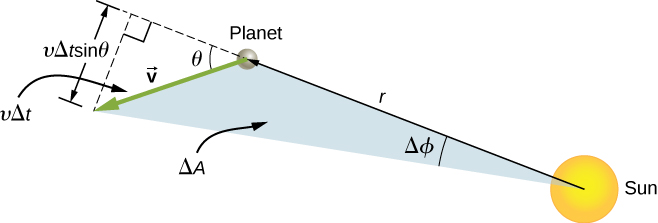
Now consider Figure 13.22. A small triangular area is swept out in time . The velocity is along the path and it makes an angle with the radial direction. Hence, the perpendicular velocity is given by . The planet moves a distance projected along the direction perpendicular to r. Since the area of a triangle is one-half the base (r) times the height , for a small displacement, the area is given by . Substituting for , multiplying by m in the numerator and denominator, and rearranging, we obtain
英語のヒント
図13.22を考えよう。短い時間の間に、小さな三角形の面積を掃く。速度は経路に沿い、半径方向と角をなす。したがって、垂直方向の速度はである。惑星の移動をrに垂直な方向へ射影した距離はとなる。三角形の面積は底辺(r)と高さの積の半分なので、変位が小さければ、面積はで与えられる。を代入し、分子と分母にmを掛けて整理すると、次の式が得られる。
OpenStax / Rice University, University Physics Volume 1, CC BY 4.0. Source-book artwork retained. · CC BY 4.0 · Source出典

Figure 13.22図 13.22
The element of area swept out in time as the planet moves through angle . The angle between the radial direction and is .
英語のヒント
惑星が角だけ動く時間の間に掃く微小面積。半径方向とのなす角はである。
The areal velocity is simply the rate of change of area with time, so we have
英語のヒント
面積速度は、単に時間に対する面積の変化率なので、次のようになる。
Since the angular momentum is constant, the areal velocity must also be constant. This is exactly Kepler’s second law. As with Kepler’s first law, Newton showed it was a natural consequence of his law of gravitation.
英語のヒント
角運動量が一定なので、面積速度も一定でなければならない。これはまさにケプラーの第2法則である。ニュートンは第1法則と同じように、この法則も万有引力の法則から自然に導かれることを示した。
Additional Resources追加教材
Kepler’s Third Lawケプラーの第3法則
Kepler’s third law states that the square of the period is proportional to the cube of the semi-major axis of the orbit. In Satellite Orbits and Energy, we derived Kepler’s third law for the special case of a circular orbit. Equation 13.8 gives us the period of a circular orbit of radius r about Earth:
英語のヒント
ケプラーの第3法則によれば、周期の2乗は軌道の半長軸の3乗に比例する。「衛星の軌道とエネルギー」では、円軌道という特別な場合について、この法則を導いた。円軌道の周期の式は、地球を回る半径rの円軌道の周期を次のように与える。
For an ellipse, recall that the semi-major axis is one-half the sum of the perihelion and the aphelion. For a circular orbit, the semi-major axis (a) is the same as the radius for the orbit. In fact, Equation 13.8 gives us Kepler’s third law if we simply replace r with a and square both sides.
英語のヒント
楕円の半長軸は、近日点距離と遠日点距離の和の半分であったことを思い出そう。円軌道では、半長軸aは軌道半径と同じになる。実際、円軌道の周期の式でrをaへ置き換え、両辺を2乗すれば、ケプラーの第3法則が得られる。
We have changed the mass of Earth to the more general M, since this equation applies to satellites orbiting any large mass.
英語のヒント
地球の質量を、より一般的なMに変えた。この式は、どの大きな質量を回る衛星にも適用できるためである。
Example 13.13例題 13.13
Orbit of Halley’s Cometハレー彗星の軌道
Determine the semi-major axis of the orbit of Halley’s comet, given that it arrives at perihelion every 75.3 years. If the perihelion is 0.586 AU, what is the aphelion?
英語のヒント
ハレー彗星は75.3年ごとに近日点へ到達する。その軌道の半長軸を求めよ。近日点距離が0.586 AUなら、遠日点距離はいくらか。
Strategy方針
We are given the period, so we can rearrange Equation 13.11, solving for the semi-major axis. Since we know the value for the perihelion, we can use the definition of the semi-major axis, given earlier in this section, to find the aphelion. We note that 1 Astronomical Unit (AU) is the average radius of Earth’s orbit and is defined to be .
英語のヒント
周期が与えられているので、ケプラーの第3法則の式を変形し、半長軸について解ける。近日点距離も分かっているため、この節で先に示した半長軸の定義から遠日点距離を求められる。1天文単位(AU)は地球の軌道の平均半径であり、と定義されていることに注意しよう。
Solution解答
Rearranging Equation 13.11 and inserting the values of the period of Halley’s comet and the mass of the Sun, we have
英語のヒント
ケプラーの第3法則の式を変形し、ハレー彗星の周期と太陽の質量を代入すると、次のようになる。
This yields a value of or 17.8 AU for the semi-major axis.
英語のヒント
これにより、半長軸は、すなわち17.8 AUとなる。
The semi-major axis is one-half the sum of the aphelion and perihelion, so we have
英語のヒント
半長軸は遠日点距離と近日点距離の和の半分なので、次の関係が成り立つ。
Substituting for the values, we found for the semi-major axis and the value given for the perihelion, we find the value of the aphelion to be 35.0 AU.
英語のヒント
求めた半長軸の値と、与えられた近日点距離を代入すると、遠日点距離は35.0 AUと求まる。
Significance考察
Edmond Halley, a contemporary of Newton, first suspected that three comets, reported in 1531, 1607, and 1682, were actually the same comet. Before Tycho Brahe made measurements of comets, it was believed that they were one-time events, perhaps disturbances in the atmosphere, and that they were not affected by the Sun. Halley used Newton’s new mechanics to predict his namesake comet’s return in 1758.
英語のヒント
ニュートンと同時代のエドモンド・ハレーは、1531年、1607年、1682年に報告された三つの彗星が、実は同じ彗星ではないかと初めて考えた。ティコ・ブラーエが彗星を測定する以前には、彗星はおそらく大気中の乱れなど、一度限りの出来事であり、太陽の影響を受けないと考えられていた。ハレーはニュートンの新しい力学を用い、後に自分の名で呼ばれる彗星が1758年に戻ると予測した。