第13章万有引力
Summaryまとめ
- All orbital motion follows the path of a conic section. Bound or closed orbits are either a circle or an ellipse; unbounded or open orbits are either a parabola or a hyperbola.
英語のヒント
すべての軌道運動は円錐曲線を描く。束縛された閉じた軌道は円または楕円であり、非束縛の開いた軌道は放物線または双曲線である。 - The areal velocity of any orbit is constant, a reflection of the conservation of angular momentum.
英語のヒント
どの軌道でも面積速度は一定であり、これは角運動量保存を反映している。 - The square of the period of an elliptical orbit is proportional to the cube of the semi-major axis of that orbit.
英語のヒント
楕円軌道の周期の2乗は、その軌道の半長軸の3乗に比例する。
Conceptual Questions概念に関する問題
Exercises 42–43練習問題 42–43
Exercise 42問題 42
Are Kepler’s laws purely descriptive, or do they contain causal information?
英語のヒント
ケプラーの法則は純粋に現象を記述するものか、それとも原因に関する情報も含んでいるか。
Exercise 43問題 43
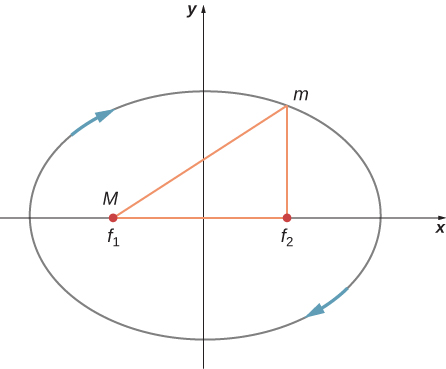
In the diagram below for a satellite in an elliptical orbit about a much larger mass, indicate where its speed is the greatest and where it is the least. What conservation law dictates this behavior? Indicate the directions of the force, acceleration, and velocity at these points. Draw vectors for these same three quantities at the two points where the y-axis intersects (along the semi-minor axis) and from this determine whether the speed is increasing decreasing, or at a max/min.
英語のヒント
下の図は、はるかに大きな質量のまわりを楕円軌道で回る衛星を示す。速さが最大になる位置と最小になる位置を示せ。この振る舞いを決める保存則は何か。それらの点での力、加速度、速度の向きを示せ。y軸と交わる二つの点(半短軸に沿う位置)でも、この三つの量のベクトルを描き、そこから速さが増加中か減少中か、それとも最大または最小なのかを判断せよ。

Solution解き方
The speed is greatest where the satellite is closest to the large mass and least where farther away—at the periapsis and apoapsis, respectively. It is conservation of angular momentum that governs this relationship. But it can also be gleaned from conservation of energy, the kinetic energy must be greatest where the gravitational potential energy is the least (most negative). The force, and hence acceleration, is always directed towards M in the diagram, and the velocity is always tangent to the path at all points. The acceleration vector has a tangential component along the direction of the velocity at the upper location on the y-axis; hence, the satellite is speeding up. Just the opposite is true at the lower position.
英語のヒント
衛星の速さは大きな質量に最も近い近点で最大になり、最も遠い遠点で最小になる。この関係を支配するのは角運動量保存である。エネルギー保存から読み取ることもでき、重力の位置エネルギーが最小(最も大きな負の値)となる位置で、運動エネルギーは最大になる。力と、したがって加速度は常に図のMへ向き、速度はどの点でも軌道の接線方向である。y軸上の上側の位置では、加速度ベクトルに速度の向きと同じ接線方向成分があるので、速さが増す。下側の位置では、ちょうど逆になる。
Problems問題
Exercises 44–50練習問題 44–50
Exercise 44問題 44
Calculate the mass of the Sun based on data for average Earth’s orbit and compare the value obtained with the Sun’s commonly listed value of .
英語のヒント
地球の平均的な軌道のデータから太陽の質量を計算し、一般に示されている太陽質量と比較せよ。
Solution解き方
; The values are the same within 0.05%.
英語のヒント
。値は0.05%以内で一致する。
Exercise 45問題 45
Io orbits Jupiter with an average radius of 421,700 km and a period of 1.769 days. Based upon these data, what is the mass of Jupiter?
英語のヒント
イオは、平均半径421,700 km、周期1.769日の軌道で木星を公転する。このデータから、木星の質量はいくらと求まるか。
Exercise 46問題 46
The “mean” orbital radius listed for astronomical objects orbiting the Sun is typically not an integrated average but is calculated such that it gives the correct period when applied to the equation for circular orbits. Given that, what is the mean orbital radius in terms of aphelion and perihelion?
英語のヒント
太陽を公転する天体について示される「平均」軌道半径は、通常、積分による平均ではなく、円軌道の式に適用したときに正しい周期を与えるように計算されている。このことから、平均軌道半径は近日点距離と遠日点距離でどう表されるか。
Solution解き方
Compare Equation 13.8 and Equation 13.11 to see that they differ only in that the circular radius, r, is replaced by the semi-major axis, a. Therefore, the mean radius is one-half the sum of the aphelion and perihelion, the same as the semi-major axis.
英語のヒント
円軌道の周期の式とケプラーの第3法則の式を比べると、違いは円軌道の半径rが半長軸aに置き換わっていることだけだと分かる。したがって、平均半径は遠日点距離と近日点距離の和の半分で、半長軸と同じである。
Exercise 47問題 47
The perihelion of Halley’s comet is 0.586 AU and the aphelion is 17.8 AU. Given that its speed at perihelion is 55 km/s, what is the speed at aphelion ()? (Hint: You may use either conservation of energy or angular momentum, but the latter is much easier.)
英語のヒント
ハレー彗星の近日点距離は0.586 AU、遠日点距離は17.8 AUである。近日点の速さが55 km/sなら、遠日点の速さはいくらか()。(ヒント:エネルギー保存と角運動量保存のどちらを使ってもよいが、後者の方がはるかに簡単である。)
Exercise 48問題 48
The perihelion of the comet Lagerkvist is 2.61 AU and it has a period of 7.36 years. Show that the aphelion for this comet is 4.95 AU.
英語のヒント
ラーゲルクヴィスト彗星の近日点距離は2.61 AU、周期は7.36年である。遠日点距離が4.95 AUとなることを示せ。
Solution解き方
The semi-major axis, 3.78 AU is found from the equation for the period. This is one-half the sum of the aphelion and perihelion, giving an aphelion distance of 4.95 AU.
英語のヒント
周期の式から、半長軸は3.78 AUと求まる。これは遠日点距離と近日点距離の和の半分なので、遠日点距離は4.95 AUとなる。
Exercise 49問題 49
What is the ratio of the speed at perihelion to that at aphelion for the comet Lagerkvist in the previous problem?
英語のヒント
前問のラーゲルクヴィスト彗星について、遠日点の速さに対する近日点の速さの比はいくらか。
Exercise 50問題 50
Eros has an elliptical orbit about the Sun, with a perihelion distance of 1.13 AU and aphelion distance of 1.78 AU. What is the period of its orbit?
英語のヒント
エロスは、近日点距離1.13 AU、遠日点距離1.78 AUの楕円軌道で太陽を公転する。その周期はいくらか。
Solution解き方
1.75 years
1.75年
aphelion
遠日点
farthest point from the Sun of an orbiting body; the corresponding term for the Moon’s farthest point from Earth is the apogee
英語のヒント
公転する天体が太陽から最も遠くなる点。月が地球から最も遠くなる点に対応する用語は、遠地点である。
Kepler’s first law
ケプラーの第1法則
law stating that every planet moves along an ellipse, with the Sun located at a focus of the ellipse
英語のヒント
すべての惑星が、太陽を一つの焦点とする楕円上を動くという法則。
Kepler’s second law
ケプラーの第2法則
law stating that a planet sweeps out equal areas in equal times, meaning it has a constant areal velocity
英語のヒント
惑星が等しい時間に等しい面積を掃くという法則。すなわち、面積速度が一定である。
Kepler’s third law
ケプラーの第3法則
law stating that the square of the period is proportional to the cube of the semi-major axis of the orbit
英語のヒント
周期の2乗が軌道の半長軸の3乗に比例するという法則。
perihelion
近日点
point of closest approach to the Sun of an orbiting body; the corresponding term for the Moon’s closest approach to Earth is the perigee
英語のヒント
公転する天体が太陽に最も近づく点。月が地球に最も近づく点に対応する用語は、近地点である。