第13章万有引力
A Geometric Theory of Gravity重力の幾何学的理論
Euclidian geometry assumes a “flat” space in which, among the most commonly known attributes, a straight line is the shortest distance between two points, the sum of the angles of all triangles must be 180 degrees, and parallel lines never intersect. Non-Euclidean geometry was not seriously investigated until the nineteenth century, so it is not surprising that Euclidean space is inherently assumed in all of Newton’s laws.
英語のヒント
ユークリッド幾何学は「平坦な」空間を仮定する。そのよく知られた性質には、2点間の最短距離は直線であること、すべての三角形の内角の和は180度であること、平行線は決して交わらないことがある。非ユークリッド幾何学が本格的に研究されたのは19世紀になってからなので、ニュートンのすべての法則でユークリッド空間が暗黙に仮定されているのも不思議ではない。
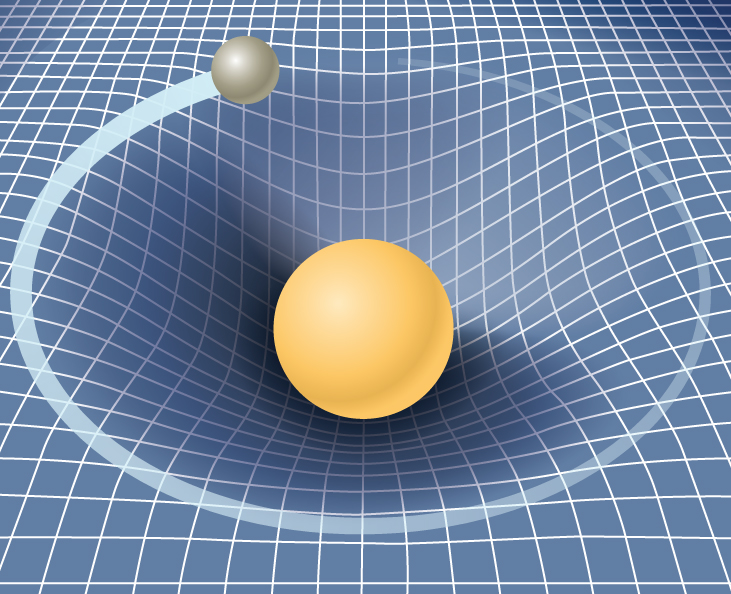
The general theory of relativity challenges this long-held assumption. Only empty space is flat. The presence of mass—or energy, since relativity does not distinguish between the two—distorts or curves space and time, or space-time, around it. The motion of any other mass is simply a response to this curved space-time. Figure 13.30 is a two-dimensional representation of a smaller mass orbiting in response to the distorted space created by the presence of a larger mass. In a more precise but confusing picture, we would also see space distorted by the orbiting mass, and both masses would be in motion in response to the total distortion of space. Note that the figure is a representation to help visualize the concept. These are distortions in our three-dimensional space and time. We do not see them as we would a dimple on a ball. We see the distortion only by careful measurements of the motion of objects and light as they move through space.
英語のヒント
一般相対性理論は、長く保たれてきたこの仮定を問い直す。平坦なのは、何もない空間だけである。質量、あるいはエネルギーが存在すると、その周囲の空間と時間、すなわち時空がゆがみ、曲がる。相対性理論では質量とエネルギーを区別しないため、両者を挙げている。ほかの質量の運動は、この曲がった時空への応答にすぎない。図13.30は、大きな質量の存在によってゆがんだ空間に応じて、小さな質量が公転する様子を2次元で示したものである。より正確だが複雑な図にすれば、公転する質量自身も空間をゆがめ、二つの質量はいずれも、空間全体のゆがみに応じて動く様子が見えるはずである。この図は、概念を思い描くための表現であることに注意しよう。実際のゆがみは、私たちの3次元の空間と時間に生じる。ボールのくぼみを見るように、ゆがみを目で見ることはできない。空間を進む物体や光の運動を注意深く測定することでのみ、そのゆがみを捉えられる。
OpenStax / Rice University, University Physics Volume 1, CC BY 4.0. Source-book artwork retained. · CC BY 4.0 · Source出典

Figure 13.30図 13.30
A smaller mass orbiting in the distorted space-time of a larger mass. In fact, all mass or energy distorts space-time.
英語のヒント
大きな質量がゆがめた時空の中を、小さな質量が公転する。実際には、あらゆる質量とエネルギーが時空をゆがめる。
For weak gravitational fields, the results of general relativity do not differ significantly from Newton’s law of gravitation. But for intense gravitational fields, the results diverge, and general relativity has been shown to predict the correct results. Even in our Sun’s relatively weak gravitational field at the distance of Mercury’s orbit, we can observe the effect. Starting in the mid-1800s, Mercury’s elliptical orbit has been carefully measured. However, although it is elliptical, its motion is complicated by the fact that the perihelion position of the ellipse slowly advances. Most of the advance is due to the gravitational pull of other planets, but a small portion of that advancement could not be accounted for by Newton’s law. At one time, there was even a search for a “companion” planet that would explain the discrepancy. But general relativity correctly predicts the measurements. Since then, many measurements, such as the deflection of light of distant objects by the Sun, have verified that general relativity correctly predicts the observations.
英語のヒント
弱い重力場では、一般相対性理論の結果はニュートンの万有引力の法則と大きくは違わない。しかし強い重力場では結果が分かれ、一般相対性理論が正しい結果を予測することが示されている。水星の軌道の距離における、比較的弱い太陽の重力場でさえ、その効果を観測できる。19世紀半ばから、水星の楕円軌道は注意深く測定されてきた。水星の軌道は楕円だが、その楕円の近日点の位置がゆっくり進むため、運動は複雑になる。この前進の大半はほかの惑星の重力による引力で説明できるが、一部はニュートンの法則では説明できなかった。かつては、この不一致を説明する「伴走する」惑星が探されたことさえあった。しかし一般相対性理論は、測定結果を正しく予測する。その後、太陽によって遠方天体の光が曲げられることなど、多くの測定によって、一般相対性理論が観測を正しく予測することが確かめられてきた。
We close this discussion with one final comment. We have often referred to distortions of space-time or distortions in both space and time. In both special and general relativity, the dimension of time has equal footing with each spatial dimension (differing in its place in both theories only by an ultimately unimportant scaling factor). Near a very large mass, not only is the nearby space “stretched out,” but time is dilated or “slowed.” We discuss these effects more in the next section.
英語のヒント
最後に一つ述べて、この議論を締めくくる。ここまで、時空のゆがみ、あるいは空間と時間の両方のゆがみに何度も触れてきた。特殊相対性理論でも一般相対性理論でも、時間の次元は空間の各次元と対等な立場にある(両理論における扱いの違いは、最終的には本質的でない尺度の係数だけである)。非常に大きな質量の近くでは、周囲の空間が「引き伸ばされる」だけでなく、時間も引き延ばされ、「遅くなる」。次の節で、これらの効果をさらに詳しく扱う。
Black Holesブラックホール
Einstein’s theory of gravitation is expressed in one deceptively simple-looking tensor equation (tensors are a generalization of scalars and vectors), which expresses how a mass determines the curvature of space-time around it. The solutions to that equation yield one of the most fascinating predictions: the black hole. The prediction is that if an object is sufficiently dense, it will collapse in upon itself and be surrounded by an event horizon from which nothing can escape. The name “black hole,” which was coined by astronomer John Wheeler in 1969, refers to the fact that light cannot escape such an object. Karl Schwarzschild was the first person to note this phenomenon in 1916, but at that time, it was considered mostly to be a mathematical curiosity.
英語のヒント
アインシュタインの重力理論は、見た目には単純な一つのテンソル方程式で表される。テンソルはスカラーとベクトルを一般化したものであり、この方程式は、質量が周囲の時空の曲率をどう決めるかを表す。その解から、特に興味深い予言の一つ、ブラックホールが得られる。物体の密度が十分に高ければ、自分自身の内側へ崩壊し、何も脱出できない事象の地平面に囲まれるという予言である。「ブラックホール」という名称は天文学者ジョン・ホイーラーが1969年に作ったもので、このような物体からは光が脱出できないことを指す。カール・シュワルツシルトは1916年にこの現象へ最初に気づいたが、当時は主に数学上の興味深い対象とみなされていた。
Surprisingly, the idea of a massive body from which light cannot escape dates back to the late 1700s. Independently, John Michell and Pierre-Simon Laplace used Newton’s law of gravitation to show that light leaving the surface of a star with enough mass could not escape. Their work was based on the fact that the speed of light had been measured by Ole Rømer in 1676. He noted discrepancies in the data for the orbital period of the moon Io about Jupiter. Rømer realized that the difference arose from the relative positions of Earth and Jupiter at different times and that he could find the speed of light from that difference. Michell and Laplace both realized that since light had a finite speed, there could be a star massive enough that the escape speed from its surface could exceed that speed. Hence, light always would fall back to the star. Oddly, observers far enough away from the very largest stars would not be able to see them, yet they could see a smaller star from the same distance.
英語のヒント
驚くことに、光が脱出できない大質量天体という考えは、18世紀末までさかのぼる。ジョン・ミッチェルとピエール=シモン・ラプラスは、それぞれ独立にニュートンの万有引力の法則を使い、十分な質量を持つ星の表面を出た光は脱出できないと示した。その研究は、1676年にオーレ・レーマーが光速を測定したことに基づいていた。レーマーは、木星を回る衛星イオの公転周期のデータに食い違いがあることに気づいた。時期によって地球と木星の位置関係が異なるためにこの差が生じ、差から光速を求められると理解したのである。ミッチェルとラプラスはともに、光の速さが有限なら、表面からの脱出速度が光速を超えるほど重い星もあり得ると考えた。その場合、光は常に星へ落ち戻る。奇妙なことに、非常に大きな星から十分に離れた観測者には、その星が見えず、同じ距離にある小さな星のほうは見えることになる。
Recall that in Gravitational Potential Energy and Total Energy, we found that the escape speed, given by Equation 13.6, is independent of the mass of the object escaping. Even though the nature of light was not fully understood at the time, the mass of light, if it had any, was not relevant. Hence, Equation 13.6 should be valid for light. Substituting c, the speed of light, for the escape velocity, we have
英語のヒント
「重力による位置エネルギーと全エネルギー」では、脱出速度の式で与えられる脱出速度は、脱出する物体の質量に依存しないことを示した。当時は光の性質が十分に理解されていなかったが、光に質量があったとしても、その質量は関係しない。したがって、脱出速度の式は光にも成り立つはずである。脱出速度に光速cを代入すると、次のようになる。
Thus, we only need values for R and M such that the escape velocity exceeds c, and then light will not be able to escape. Michell posited that if a star had the density of our Sun and a radius that extended just beyond the orbit of Mars, then light would not be able to escape from its surface. He also conjectured that we would still be able to detect such a star from the gravitational effect it would have on objects around it. This was an insightful conclusion, as this is precisely how we infer the existence of such objects today. While we have yet to, and may never, visit a black hole, the circumstantial evidence for them has become so compelling that few astronomers doubt their existence.
英語のヒント
したがって、脱出速度がcを超えるようなRとMの値さえあれば、光は脱出できなくなる。ミッチェルは、太陽と同じ密度の星が、火星の軌道をわずかに超える半径を持つなら、その表面から光は脱出できないと考えた。また、そのような星も周囲の物体へ及ぼす重力の効果から検出できると推測した。これは洞察に富む結論だった。今日、そのような天体の存在は、まさにこの方法で推定されているからである。私たちはまだブラックホールを訪れておらず、今後も決して訪れないかもしれないが、存在を示す状況証拠は非常に強くなり、それを疑う天文学者はほとんどいない。
Before we examine some of that evidence, we turn our attention back to Schwarzschild’s solution to the tensor equation from general relativity. In that solution arises a critical radius, now called the Schwarzschild radius . For any mass M, if that mass were compressed to the extent that its radius becomes less than the Schwarzschild radius, then the mass will collapse to a singularity, and anything that passes inside that radius cannot escape. Once inside , the arrow of time takes all things to the singularity. (In a broad mathematical sense, a singularity is where the value of a function goes to infinity. In this case, it is a point in space of zero volume with a finite mass. Hence, the mass density and gravitational energy become infinite.) The Schwarzschild radius is given by
英語のヒント
その証拠の一部を見る前に、一般相対性理論のテンソル方程式に対するシュワルツシルトの解へ戻ろう。その解には、現在シュワルツシルト半径と呼ばれる臨界半径が現れる。任意の質量Mを圧縮し、その半径がシュワルツシルト半径より小さくなると、その質量は特異点へ崩壊し、この半径の内側へ入ったものは何も脱出できない。いったんの内側へ入ると、時間の矢はすべてを特異点へ導く。(広い数学的な意味では、特異点は関数の値が無限大となる場所である。ここでは、有限の質量を持ち、体積がゼロである空間内の点を指す。したがって、質量密度と重力エネルギーは無限大になる。)シュワルツシルト半径は次の式で与えられる。
If you look at our escape velocity equation with , you will notice that it gives precisely this result. But that is merely a fortuitous accident caused by several incorrect assumptions. One of these assumptions is the use of the incorrect classical expression for the kinetic energy for light. Just how dense does an object have to be in order to turn into a black hole?
英語のヒント
先ほどの脱出速度の式でとすると、まさにこの結果が得られることに気づくだろう。しかし、これはいくつかの誤った仮定が重なって生じた、単なる偶然の一致である。その仮定の一つは、光の運動エネルギーに、適切でない古典的な式を使ったことだ。物体がブラックホールになるには、いったいどれほどの密度が必要なのだろうか。
Example 13.15例題 13.15
Calculating the Schwarzschild Radiusシュワルツシルト半径の計算
Calculate the Schwarzschild radius for both the Sun and Earth. Compare the density of the nucleus of an atom to the density required to compress Earth’s mass uniformly to its Schwarzschild radius. The density of a nucleus is about .
英語のヒント
太陽と地球のシュワルツシルト半径を計算せよ。地球の質量をそのシュワルツシルト半径まで一様に圧縮するために必要な密度を、原子核の密度と比較せよ。原子核の密度は約である。
Strategy方針
We use Equation 13.12 for this calculation. We need only the masses of Earth and the Sun, which we obtain from the astronomical data given in Appendix D.
英語のヒント
この計算にはシュワルツシルト半径の式を使う。必要なのは地球と太陽の質量だけであり、付録Dの天文データから得られる。
Solution解答
Substituting the mass of the Sun, we have
英語のヒント
太陽の質量を代入すると、次のようになる。
This is a diameter of only about 6 km. If we use the mass of Earth, we get . This is a diameter of less than 2 cm! If we pack Earth’s mass into a sphere with the radius , we get a density of
英語のヒント
これは、わずか約6 kmの直径に相当する。地球の質量を使うと、となる。直径は2 cm未満である。地球の質量を半径の球へ詰め込むと、密度は次のようになる。
Significance考察
A neutron star is the most compact object known—outside of a black hole itself. The neutron star is composed of neutrons, with the density of an atomic nucleus, and, like many black holes, is believed to be the remnant of a supernova—a star that explodes at the end of its lifetime. To create a black hole from Earth, we would have to compress it to a density thirteen orders of magnitude greater than that of a neutron star. This process would require unimaginable force. There is no known mechanism that could cause an Earth-sized object to become a black hole. For the Sun, you should be able to show that it would have to be compressed to a density only about 80 times that of a nucleus. (Note: Once the mass is compressed within its Schwarzschild radius, general relativity dictates that it will collapse to a singularity. These calculations merely show the density we must achieve to initiate that collapse.)
英語のヒント
中性子星は、ブラックホール自体を除けば、知られている中で最もコンパクトな天体である。中性子から成り、原子核と同じ密度を持つ。多くのブラックホールと同様に、寿命の終わりに爆発する星、すなわち超新星の残骸と考えられている。地球からブラックホールを作るには、中性子星の密度より13桁も大きな密度まで圧縮しなければならない。この過程には、想像を絶する力が必要になる。地球ほどの物体をブラックホールにできる仕組みは知られていない。太陽の場合は、原子核の約80倍の密度まで圧縮すればよいことを示せるはずである。(注:質量がシュワルツシルト半径の内側へ圧縮されると、一般相対性理論によれば特異点へ崩壊する。ここでの計算は、その崩壊を始めるために達しなければならない密度を示しているにすぎない。)