第13章万有引力
13.7 Einstein's Theory of Gravity13.7 アインシュタインの重力理論
Learning Objectives学習目標
Learning Objectives学習目標
By the end of this section, you will be able to:
英語のヒント
この節を終えると、次のことができるようになる。
- Describe how the theory of general relativity approaches gravitation
英語のヒント
一般相対性理論が重力をどう捉えるかを説明する。 - Explain the principle of equivalence
英語のヒント
等価原理を説明する。 - Calculate the Schwarzschild radius of an object
英語のヒント
物体のシュワルツシルト半径を計算する。 - Summarize the evidence for black holes
英語のヒント
ブラックホールの証拠をまとめる。
Newton’s law of universal gravitation accurately predicts much of what we see within our solar system. Indeed, only Newton’s laws have been needed to accurately send every space vehicle on its journey. The paths of Earth-crossing asteroids, and most other celestial objects, can be accurately determined solely with Newton’s laws. Nevertheless, many phenomena have shown a discrepancy from what Newton’s laws predict, including the orbit of Mercury and the effect that gravity has on light. In this section, we examine a different way of envisioning gravitation.
英語のヒント
ニュートンの万有引力の法則は、太陽系で見られる現象の多くを正確に予測する。実際、あらゆる宇宙機を正確に航行させるには、ニュートンの法則だけで足りてきた。地球の軌道を横切る小惑星や、ほかの大半の天体の軌道も、ニュートンの法則だけで正確に決められる。しかし、水星の軌道や光に及ぼす重力の効果など、多くの現象ではニュートンの法則の予測との不一致が見られる。この節では、重力を捉える別の方法を調べる。
A Revolution in Perspective見方の革命
In 1905, Albert Einstein published his theory of special relativity. This theory is discussed in great detail in Relativity, so we say only a few words here. In this theory, no motion can exceed the speed of light—it is the speed limit of the Universe. This simple fact has been verified in countless experiments. However, it has incredible consequences—space and time are no longer absolute. Two people moving relative to one another do not agree on the length of objects or the passage of time. Almost all of the mechanics you learned in previous chapters, while remarkably accurate even for speeds of many thousands of miles per second, begin to fail when approaching the speed of light.
英語のヒント
1905年、アルベルト・アインシュタインは特殊相対性理論を発表した。この理論は「相対性理論」で詳しく扱うので、ここでは簡単に述べるだけにする。この理論では、どの運動も光の速さを超えられない。光速は宇宙の速度制限である。この単純な事実は、無数の実験で確かめられている。しかし、その帰結は驚くべきものとなる。空間と時間は、もはや絶対的ではない。互いに相対運動をする二人は、物体の長さや時間の経過について一致しない。これまでの章で学んだ力学のほとんどすべては、毎秒何千マイルもの速さでも驚くほど正確だが、光速へ近づくと成り立たなくなり始める。
This speed limit on the Universe was also a challenge to the inherent assumption in Newton’s law of gravitation that gravity is an action-at-a-distance force. That is, without physical contact, any change in the position of one mass is instantly communicated to all other masses. This assumption does not come from any first principle, as Newton’s theory simply does not address the question. (The same was believed of electromagnetic forces, as well. It is fair to say that most scientists were not completely comfortable with the action-at-a-distance concept.)
英語のヒント
宇宙にこの速度制限があることは、重力を遠隔作用とするニュートンの万有引力の法則に内在する仮定にも問題を投げかけた。つまり、物理的な接触なしに、ある質量の位置の変化が、ほかのすべての質量へ瞬時に伝わるという仮定である。この仮定は、根本原理から導かれたものではない。ニュートンの理論は、そもそもその問題を扱っていない。(電磁力についても同じことが信じられていた。大半の科学者は、遠隔作用という考え方を完全には受け入れがたく感じていたと言ってよい。)
A second assumption also appears in Newton’s law of gravitation Equation 13.1. The masses are assumed to be exactly the same as those used in Newton’s second law, . We made that assumption in many of our derivations in this chapter. Again, there is no underlying principle that this must be, but experimental results are consistent with this assumption. In Einstein’s subsequent theory of general relativity (1916), both of these issues were addressed. His theory was a theory of space-time geometry and how mass (and acceleration) distort and interact with that space-time. It was not a theory of gravitational forces. The mathematics of the general theory is beyond the scope of this text, but we can look at some underlying principles and their consequences.
英語のヒント
もう一つの仮定は、ニュートンの万有引力の法則である式13.1に現れる。そこで使われる質量は、ニュートンの第2法則に使われる質量と、厳密に同じものだと仮定されている。この章の多くの導出でも、その仮定を用いてきた。ここでも、必ずそうでなければならないという根本原理はないが、実験結果はこの仮定と一致する。その後にアインシュタインが発表した一般相対性理論(1916年)では、この二つの問題が扱われた。この理論は、時空の幾何学と、質量(および加速度)が時空をどうゆがめ、時空とどう相互作用するかについての理論であった。重力という力についての理論ではない。一般相対性理論の数学は本書の範囲を超えるが、その根本原理の一部と、それがもたらす結果を見ていくことはできる。
The Principle of Equivalence等価原理
Einstein came to his general theory in part by wondering why someone who was free falling did not feel their weight. Indeed, it is common to speak of astronauts orbiting Earth as being weightless, despite the fact that Earth’s gravity is still quite strong there. In Einstein’s general theory, there is no difference between free fall and being weightless. This is called the principle of equivalence. The equally surprising corollary to this is that there is no difference between a uniform gravitational field and a uniform acceleration in the absence of gravity. Let’s focus on this last statement. Although a perfectly uniform gravitational field is not feasible, we can approximate it very well.
英語のヒント
アインシュタインが一般相対性理論にたどり着いたきっかけの一つは、自由落下する人がなぜ自分の重さを感じないのか、という疑問だった。実際、地球を回る宇宙飛行士は、そこでの地球の重力がまだかなり強いにもかかわらず、無重量状態にあると言われることが多い。アインシュタインの一般相対性理論では、自由落下と無重量状態に違いはない。これを等価原理という。同じほど驚くべき帰結として、一様な重力場と、重力がないところでの一様な加速度は区別できない。最後の主張に注目しよう。完全に一様な重力場は実現できないが、非常によく近似することはできる。
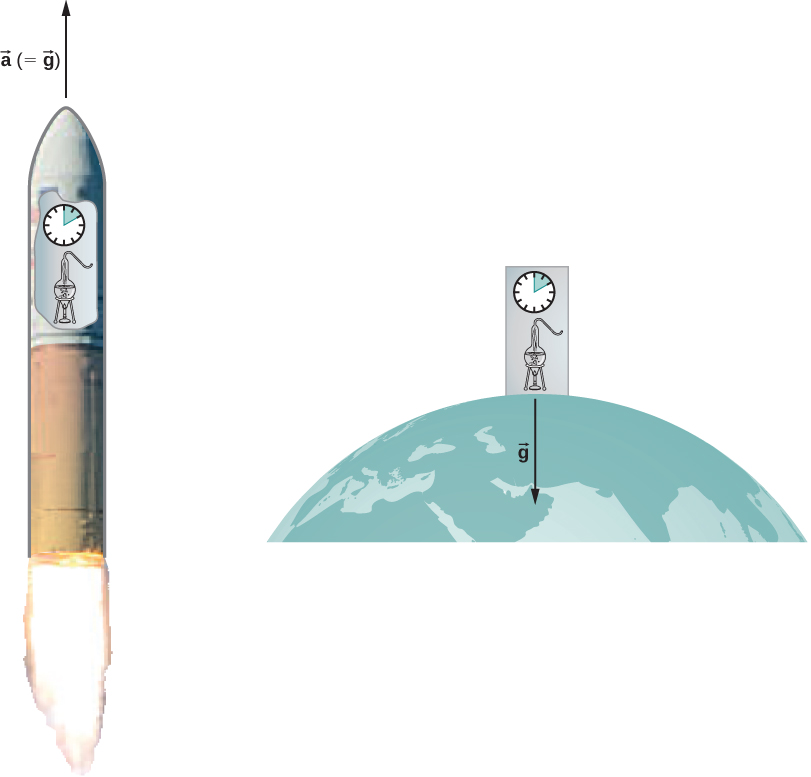
Within a reasonably sized laboratory on Earth, the gravitational field is essentially uniform. The corollary states that any physical experiments performed there have the identical results as those done in a laboratory accelerating at in deep space, well away from all other masses. Figure 13.29 illustrates the concept.
英語のヒント
地球上の適度な大きさの実験室の中では、重力場は実質的に一様である。この帰結によれば、そこで行うあらゆる物理実験は、ほかのすべての質量から遠く離れた宇宙空間で、の加速度で加速する実験室で行う場合と、同じ結果になる。図13.29はこの考え方を示す。
OpenStax / Rice University, University Physics Volume 1, CC BY 4.0. Source-book artwork retained. · CC BY 4.0 · Source出典

Figure 13.29図 13.29
According to the principle of equivalence, the results of all experiments performed in a laboratory in a uniform gravitational field are identical to the results of the same experiments performed in a uniformly accelerating laboratory.
英語のヒント
等価原理によれば、一様な重力場に置かれた実験室で行うすべての実験の結果は、一様に加速する実験室で行う同じ実験の結果と等しい。
How can these two apparently fundamentally different situations be the same? The answer is that gravitation is not a force between two objects but is the result of each object responding to the effect that the other has on the space-time surrounding it. A uniform gravitational field and a uniform acceleration have exactly the same effect on space-time.
英語のヒント
一見、根本的に異なるこの二つの状況が、どうして同じになるのだろうか。答えは、重力が二つの物体の間の力ではなく、それぞれの物体が、相手の物体によって周囲の時空に生じた効果に応じて動く結果だということである。一様な重力場と一様な加速度は、時空にまったく同じ効果を及ぼす。