第13章万有引力
13.2 Gravitation Near Earth's Surface13.2 地表付近の重力
Learning Objectives学習目標
Learning Objectives学習目標
By the end of this section, you will be able to:
英語のヒント
この節を終えると、次のことができるようになる。
- Explain the connection between the constants and
英語のヒント
定数との関係を説明する。 - Determine the mass of an astronomical body from free-fall acceleration at its surface
英語のヒント
天体表面の自由落下の加速度から、その天体の質量を求める。 - Describe how the value of varies due to location and Earth’s rotation
英語のヒント
場所や地球の自転によっての値がどう変わるかを説明する。
In this section, we observe how Newton’s law of gravitation applies at the surface of a planet and how it connects with what we learned earlier about free fall. We also examine the gravitational effects within spherical bodies.
英語のヒント
この節では、ニュートンの万有引力の法則が惑星表面でどう適用され、前に学んだ自由落下とどう結び付くかを調べる。また、球形の物体の内部での重力の効果も調べる。
Weight重さ
Recall that the acceleration of a free-falling object near Earth’s surface is approximately . The force causing this acceleration is called the weight of the object, and from Newton’s second law, it has the value mg. This weight is present regardless of whether the object is in free fall. We now know that this force is the gravitational force between the object and Earth. If we substitute mg for the magnitude of in Newton’s law of universal gravitation, m for , and for , we obtain the scalar equation
英語のヒント
地表付近を自由落下する物体の加速度が、約であることを思い出そう。この加速度を生じさせる力を物体の重さといい、ニュートンの第2法則によればその値はmgである。この重さは、物体が自由落下しているかどうかにかかわらず存在する。現在では、この力が物体と地球の間の重力であることが分かっている。ニュートンの万有引力の法則で、の大きさをmgに、をmに、をに置き換えると、次のスカラーの式が得られる。
where r is the distance between the centers of mass of the object and Earth. The mass m of the object cancels, leaving
英語のヒント
ここでrは物体と地球の重心間の距離である。物体の質量mは約分で消え、次の式が残る。
The average radius of Earth is about 6370 km. Hence, for objects within a few kilometers of Earth’s surface, we can take (Figure 13.8). This explains why all masses free fall with the same acceleration. We have ignored the fact that Earth also accelerates toward the falling object, but that is acceptable as long as the mass of Earth is much larger than that of the object.
英語のヒント
地球の平均半径は約6370 kmである。したがって、地表から数km以内にある物体なら、としてよい(図13.8)。これによって、すべての質量が同じ加速度で自由落下することを説明できる。地球も落下する物体へ向かって加速するという事実を無視しているが、地球の質量が物体の質量よりはるかに大きい限り、この扱いは許される。
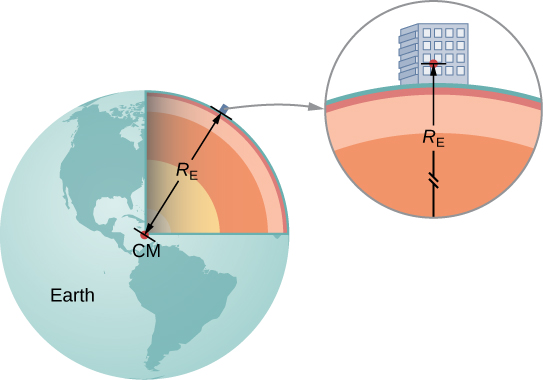
OpenStax / Rice University, University Physics Volume 1, CC BY 4.0. Source-book artwork retained. · CC BY 4.0 · Source出典

Figure 13.8図 13.8
We can take the distance between the centers of mass of Earth and an object on its surface to be the radius of Earth, provided that its size is much less than the radius of Earth.
英語のヒント
地表の物体の大きさが地球の半径よりはるかに小さいなら、地球と物体の重心間の距離を地球の半径としてよい。
Example 13.3例題 13.3
Masses of Earth and Moon地球と月の質量
Have you ever wondered how we know the mass of Earth? We certainly can’t place it on a scale. The values of g and the radius of Earth were measured with reasonable accuracy centuries ago.
英語のヒント
地球の質量がどうして分かるのか、不思議に思ったことはないだろうか。地球をはかりに載せることは、もちろんできない。gと地球の半径は、何世紀も前にかなりの正確さで測定されていた。
- Use the standard values of g, , and Equation 13.2 to find the mass of Earth.
英語のヒント
gとの標準値、および式13.2を用いて地球の質量を求めよ。 - Estimate the value of g on the Moon. Use the fact that the Moon has a radius of about 1700 km (a value of this accuracy was determined many centuries ago) and assume it has the same average density as Earth, .
英語のヒント
月面のgの値を見積もれ。月の半径が約1700 kmであること(この程度の正確さの値は何世紀も前に求められていた)を利用し、月の平均密度は地球と同じであると仮定せよ。
Strategy方針
With the known values of g and , we can use Equation 13.2 to find . For the Moon, we use the assumption of equal average density to determine the mass from a ratio of the volumes of Earth and the Moon.
英語のヒント
gとの既知の値を使い、式13.2からを求められる。月については、平均密度が等しいという仮定を使い、地球と月の体積比から質量を求める。
Solution解答
-
- The volume of a sphere is proportional to the radius cubed, so a simple ratio gives us
英語のヒント
球の体積は半径の3乗に比例するため、単純な比を取ると次のようになる。
Significance考察
As soon as Cavendish determined the value of G in 1798, the mass of Earth could be calculated. (In fact, that was the ultimate purpose of Cavendish’s experiment in the first place.) The value we calculated for g of the Moon is incorrect. The average density of the Moon is actually only and at the surface. Newton attempted to measure the mass of the Moon by comparing the effect of the Sun on Earth’s ocean tides compared to that of the Moon. His value was a factor of two too small. The most accurate values for g and the mass of the Moon come from tracking the motion of spacecraft that have orbited the Moon. But the mass of the Moon can actually be determined accurately without going to the Moon. Earth and the Moon orbit about a common center of mass, and careful astronomical measurements can determine that location. The ratio of the Moon’s mass to Earth’s is the ratio of [the distance from the common center of mass to the Moon’s center] to [the distance from the common center of mass to Earth’s center].
英語のヒント
キャヴェンディッシュが1798年にGの値を求めると、すぐに地球の質量を計算できるようになった。実際、そもそもそれが彼の実験の最終的な目的だった。ここで計算した月のgの値は正しくない。月の平均密度は実際にはしかなく、表面ではである。ニュートンは、地球の海の潮汐に太陽が及ぼす影響と、月が及ぼす影響を比較して月の質量を測ろうとした。彼の値は正しい値の半分だった。月のgと質量の最も正確な値は、月を周回した宇宙機の運動を追跡することで得られる。しかし実際には、月まで行かなくても月の質量を正確に求められる。地球と月は共通の重心のまわりを公転しており、慎重な天文測定によってその位置を求められる。月の質量と地球の質量の比は、[共通の重心から月の中心までの距離]と[共通の重心から地球の中心までの距離]の比である。
Later in this chapter, we will see that the mass of other astronomical bodies also can be determined by the period of small satellites orbiting them. But until Cavendish determined the value of G, the masses of all these bodies were unknown.
英語のヒント
この章の後半では、ほかの天体の質量も、それらのまわりを公転する小さな衛星の周期から求められることを見る。しかし、キャヴェンディッシュがGの値を求めるまでは、これらの天体の質量はすべて不明だった。
Example 13.4例題 13.4
Gravity above Earth’s Surface地表上空の重力
What is the value of g 400 km above Earth’s surface, where the International Space Station is in orbit?
英語のヒント
国際宇宙ステーションが周回する、地表から400 km上空でのgの値はいくらか。
Strategy方針
Using the value of and noting the radius is , we use Equation 13.2 to find g.
英語のヒント
の値を用い、半径がであることに注意して、式13.2からgを求める。
Significance考察
We often see video of astronauts in space stations, apparently weightless. But clearly, the force of gravity is acting on them. Comparing the value of g we just calculated to that on Earth , we see that the astronauts in the International Space Station still have 88% of their weight. They only appear to be weightless because they are in free fall. We will come back to this in Satellite Orbits and Energy.
英語のヒント
宇宙ステーション内の宇宙飛行士が、重さを失ったように見える映像をよく目にする。しかし、彼らに重力が作用していることは明らかである。いま計算したgを地表の値と比べると、国際宇宙ステーション内の宇宙飛行士にも、地表での88%の重さがあると分かる。無重量に見えるのは、自由落下しているためにすぎない。この点は「衛星の軌道とエネルギー」で再び扱う。