第13章万有引力
The event horizon事象の地平面
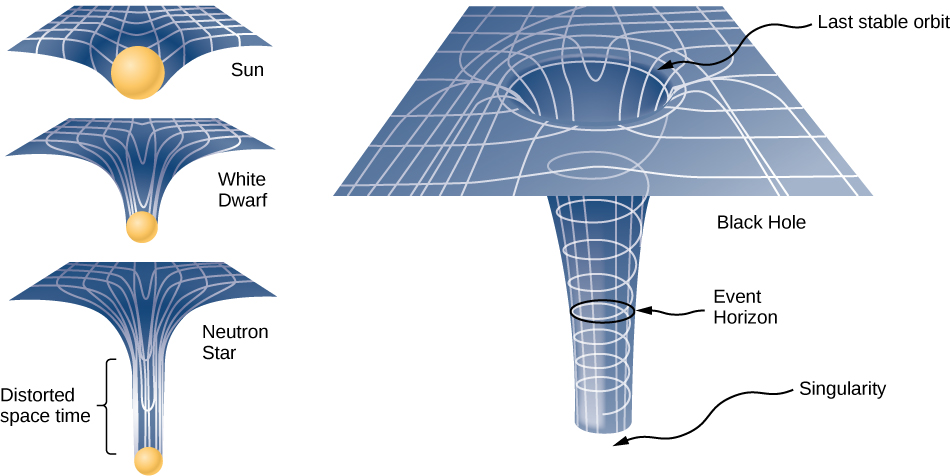
The Schwarzschild radius is also called the event horizon of a black hole. We noted that both space and time are stretched near massive objects, such as black holes. Figure 13.31 illustrates that effect on space. The distortion caused by our Sun is actually quite small, and the diagram is exaggerated for clarity. Consider the neutron star, described in Example 13.15. Although the distortion of space-time at the surface of a neutron star is very high, the radius is still larger than its Schwarzschild radius. Objects could still escape from its surface.
英語のヒント
However, if a neutron star gains additional mass, it would eventually collapse, shrinking beyond the Schwarzschild radius. Once that happens, the entire mass would be pulled, inevitably, to a singularity. In the diagram, space is stretched to infinity. Time is also stretched to infinity. As objects fall toward the event horizon, we see them approaching ever more slowly, but never reaching the event horizon. As outside observers, we never see objects pass through the event horizon—effectively, time is stretched to a stop.
英語のヒント
しかし、中性子星がさらに質量を得ると、やがて崩壊し、シュワルツシルト半径よりも小さくなる。そうなると、その質量全体は必然的に特異点へ引き込まれる。図では、空間は無限に引き伸ばされている。時間も無限に引き伸ばされる。物体が事象の地平面へ落ちていくと、外からは接近する速さがますます遅くなり、決して事象の地平面へ到達しないように見える。外部の観測者には、物体が事象の地平面を通過するところは決して見えない。実質的に、時間は引き伸ばされて止まる。
Additional Resources追加教材
(credit: modification of work by NASA) NASA imagery used for educational publication; no NASA endorsement is implied. · NASA media use permission; OpenStax additions CC BY 4.0 · Source出典

Figure 13.31図 13.31
The space distortion becomes more noticeable around increasingly larger masses. Once the mass density reaches a critical level, a black hole forms and the fabric of space-time is torn. The curvature of space is greatest at the surface of each of the first three objects shown and is finite. The curvature then decreases (not shown) to zero as you move to the center of the object. But the black hole is different. The curvature becomes infinite: The surface has collapsed to a singularity, and the cone extends to infinity. (Note: These diagrams are not to any scale.) (credit: modification of work by NASA)
英語のヒント
質量が大きくなるほど、その周囲の空間のゆがみは目立つ。質量密度が臨界値に達するとブラックホールができ、時空が裂ける。最初の三つの天体では、空間の曲率は表面で最大となるが、有限である。内部では、天体の中心へ近づくにつれて曲率はゼロまで減少する(図示していない)。しかしブラックホールは異なる。曲率は無限大になる。表面は特異点へ崩壊し、円錐は無限に伸びる。(注:これらの図は縮尺に従っていない。)(クレジット:NASAの作品を改変)
Observational evidence of neutron stars and black holes中性子星とブラックホールの観測的証拠
The first validated neutron star was discovered by Jocelyn Bell Burnell in 1967. Burnell observed a regular radio pulse from an distant object, a phenomenon not previously observed. After further analysis and the discovery of a second pulsar (as the objects would later be called), the researchers and scientific community recognized that the pulses were caused by rapidly rotating neutron stars. At about the same time, a number of other astronomers, including Iosof Shklovsky, observed radio sources that would be proven to be neutron stars. These discoveries renewed interest in black holes. Evidence for black holes is based upon several types of observations, such as radiation analysis of X-ray binaries, gravitational lensing of the light from distant galaxies, and the motion of visible objects around invisible partners. We will focus on these later observations as they relate to what we have learned in this chapter. Although light cannot escape from a black hole for us to see, we can nevertheless see the gravitational effect of the black hole on surrounding masses.
英語のヒント
最初に確証が得られた中性子星は、1967年にジョスリン・ベル・バーネルが発見した。バーネルは遠方の天体から規則的な電波パルスを観測した。これは、それまで観測されたことのない現象だった。さらに解析が進み、二つ目のパルサー(この種の天体は後にそう呼ばれる)が発見されると、研究者や科学界は、パルスが高速で自転する中性子星から生じていると認めた。ほぼ同時期に、ヨシフ・シュクロフスキーらほかの天文学者も、後に中性子星と証明される電波源を観測した。これらの発見により、ブラックホールへの関心が再び高まった。ブラックホールの証拠は、X線連星の放射の解析、遠方銀河の光の重力レンズ効果、見えない相手の周囲を回る可視天体の運動など、複数種の観測に基づいている。ここでは、この章で学んだ内容と関係する後者の観測に注目する。光はブラックホールから脱出できないため直接見ることはできないが、周囲の質量に及ぼすブラックホールの重力の効果は見ることができる。
The closest, and perhaps most dramatic, evidence for a black hole is at the center of our Milky Way galaxy. The UCLA Galactic Group, using data obtained by the W. M. Keck telescopes, has determined the orbits of several stars near the center of our galaxy. Some of that data is shown in Figure 13.32. The orbits of two stars are highlighted. From measurements of the periods and sizes of their orbits, it is estimated that they are orbiting a mass of approximately 4 million solar masses. Note that the mass must reside in the region created by the intersection of the ellipses of the stars. The region in which that mass must reside would fit inside the orbit of Mercury—yet nothing is seen there in the visible spectrum. In 2020, UCLA astrophysicist Andrea Ghez and Plank Institute's (Germany) Reinhardt Genzel shared the Nobel prize for the discovery of the supermassive object. They shared the prize with Richard Penrose, whose mathematical models proved that black holes can actually form and align with Einstein's theory. Since their work, the world has actually seen a black hole, thanks to the Event Horizon Telescope. The global network of observatories combined massive amounts of data in order to produce remarkable images of two black holes: first at the center of galaxy Messier 87, and second at the center of the Milky Way, Saggitarious A.
英語のヒント
最も近く、ひょっとすると最も劇的なブラックホールの証拠は、私たちの天の川銀河の中心にある。UCLA銀河中心グループは、W・M・ケック望遠鏡のデータから、銀河中心近くの複数の恒星の軌道を求めた。そのデータの一部を図13.32に示す。二つの恒星の軌道を強調してある。軌道の周期と大きさの測定から、これらの恒星は太陽質量の約400万倍の質量を回っていると推定される。その質量は、恒星の楕円軌道が交わる領域に存在しなければならない。その領域は水星の軌道の内側に収まるほど小さいが、可視光では何も見えない。2020年、UCLAの天体物理学者アンドレア・ゲズと、ドイツのプランク研究所のラインハルト・ゲンツェルは、この超大質量天体の発見によってノーベル賞を共同受賞した。数学モデルによって、ブラックホールが実際に形成され、アインシュタインの理論と整合することを証明したリチャード・ペンローズも、ともに受賞した。その研究以後、イベント・ホライズン・テレスコープによって、世界は実際にブラックホールの姿を目にした。世界各地の天文台のネットワークが膨大なデータを統合し、二つのブラックホールの驚くべき画像を作り出した。最初は銀河M87の中心、二つ目は天の川銀河の中心にある、いて座Aである。
Image omitted because its reuse rights could not be verified.権利の確認ができないため画像を割愛。
Figure 13.32図 13.32
Paths of stars orbiting about a mass at the center of our Milky Way galaxy. From their motion, it is estimated that a black hole of about 4 million solar masses resides at the center. (credit: modification of work by UCLA Galactic Center Group – W.M. Keck Observatory Laser Team)
英語のヒント
天の川銀河の中心にある質量の周りを回る恒星の軌道。恒星の運動から、中心には太陽質量の約400万倍のブラックホールがあると推定される。(クレジット:UCLA Galactic Center Group – W.M. Keck Observatory Laser Teamの作品を改変)
The physics of stellar creation and evolution is well established. The ultimate source of energy that makes stars shine is the self-gravitational energy that triggers fusion. The general behavior is that the more massive a star, the brighter it shines and the shorter it lives. The logical inference is that a mass that is 4 million times the mass of our Sun, confined to a very small region, and that cannot be seen, has no viable interpretation other than a black hole. Extragalactic observations strongly suggest that black holes are common at the center of galaxies.
英語のヒント
恒星の誕生と進化の物理は、よく確立されている。星を輝かせる究極のエネルギー源は、核融合を引き起こす自己重力エネルギーである。一般に、星は重いほど明るく輝き、寿命は短い。太陽質量の400万倍の質量が、ごく小さな領域に閉じ込められ、しかも見えないなら、ブラックホール以外に成り立つ解釈はないというのが論理的な推論である。銀河系外の観測も、銀河の中心にはブラックホールが普通に存在することを強く示唆している。