第13章万有引力
Energy in Circular Orbits円軌道のエネルギー
In Gravitational Potential Energy and Total Energy, we argued that objects are gravitationally bound if their total energy is negative. The argument was based on the simple case where the velocity was directly away or toward the planet. We now examine the total energy for a circular orbit and show that indeed, the total energy is negative. As we did earlier, we start with Newton’s second law applied to a circular orbit,
英語のヒント
「重力による位置エネルギーと全エネルギー」では、全エネルギーが負であれば物体は重力で束縛されると論じた。その議論は、速度の向きが惑星からまっすぐ遠ざかるか、まっすぐ近づくかという単純な場合に基づいていた。ここでは円軌道の全エネルギーを調べ、実際に負であることを示す。先ほどと同じように、円軌道にニュートンの第2法則を適用することから始める。
In the last step, we multiplied by r on each side. The right side is just twice the kinetic energy, so we have
英語のヒント
最後の段階では、両辺にrを掛けた。右辺は運動エネルギーのちょうど2倍なので、次のようになる。
The total energy is the sum of the kinetic and potential energies, so our final result is
英語のヒント
全エネルギーは運動エネルギーと位置エネルギーの和なので、最終結果は次のようになる。
We can see that the total energy is negative, with the same magnitude as the kinetic energy. For circular orbits, the magnitude of the kinetic energy is exactly one-half the magnitude of the potential energy. Remarkably, this result applies to any two masses in circular orbits about their common center of mass, at a distance r from each other. The proof of this is left as an exercise. We will see in the next section that a very similar expression applies in the case of elliptical orbits.
英語のヒント
全エネルギーは負であり、その大きさは運動エネルギーに等しい。円軌道では、運動エネルギーの大きさは位置エネルギーの大きさのちょうど半分である。注目すべきことに、この結果は、互いに距離rだけ離れ、共通の重心のまわりを円軌道で公転する任意の二つの質量に成り立つ。証明は練習問題として残しておく。次の節では、楕円軌道にも非常によく似た式が成り立つことを見る。
Example 13.12例題 13.12
Energy Required to Orbit軌道へ入れるために必要なエネルギー
In Example 13.8, we calculated the energy required to simply lift the 9000-kg Soyuz vehicle from Earth’s surface to the height of the ISS, 400 km above the surface. In other words, we found its change in potential energy. We now ask, what total energy change in the Soyuz vehicle is required to take it from Earth’s surface and put it in orbit with the ISS for a rendezvous (Figure 13.16)? How much of that total energy is kinetic energy?
英語のヒント
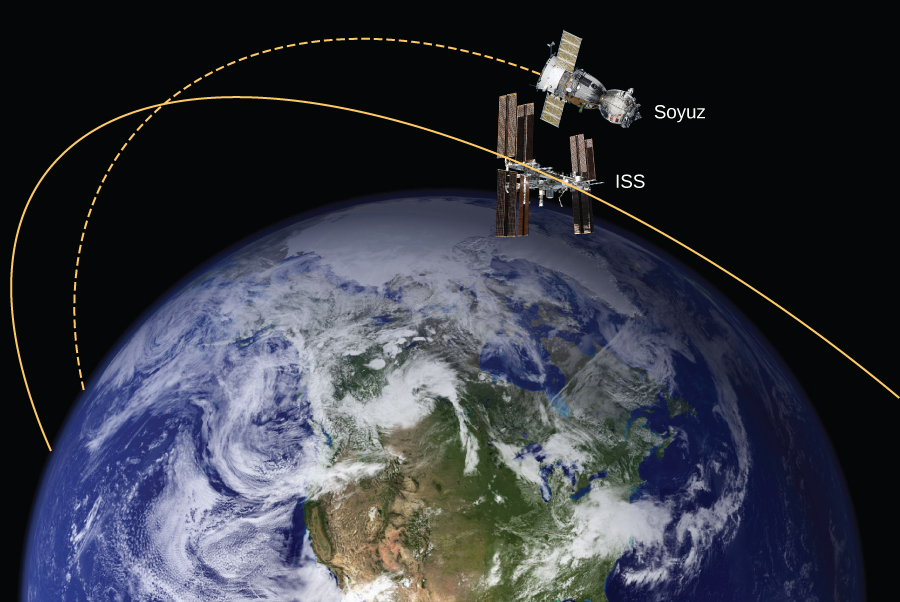
(credit: modification of works by NASA) NASA imagery used for educational publication; no NASA endorsement is implied. · NASA media use permission; OpenStax additions CC BY 4.0 · Source出典

Figure 13.16図 13.16
The Soyuz in a rendezvous with the ISS. Note that this diagram is not to scale; the Soyuz is very small compared to the ISS and its orbit is much closer to Earth. (credit: modification of works by NASA)
英語のヒント
ISSとランデブーするソユーズ。この図は縮尺どおりではない。ソユーズはISSよりはるかに小さく、その軌道は地球にもっと近い。(出典:NASAの作品を改変)
Strategy方針
The energy required is the difference in the Soyuz’s total energy in orbit and that at Earth’s surface. We can use Equation 13.9 to find the total energy of the Soyuz at the ISS orbit. But the total energy at the surface is simply the potential energy, since it starts from rest. [Note that we do not use Equation 13.9 at the surface, since we are not in orbit at the surface.] The kinetic energy can then be found from the difference in the total energy change and the change in potential energy found in Example 13.8. Alternatively, we can use Equation 13.7 to find and calculate the kinetic energy directly from that. The total energy required is then the kinetic energy plus the change in potential energy found in Example 13.8.
英語のヒント
必要なエネルギーは、軌道上と地表でのソユーズの全エネルギーの差である。円軌道の全エネルギーの式を使えば、ISSの軌道上でのソユーズの全エネルギーを求められる。一方、地表では静止から出発するため、全エネルギーは位置エネルギーだけである。地表では軌道を回っていないので、円軌道の全エネルギーの式を地表に適用してはいけない。次に、全エネルギーの変化から、例題13.8で求めた位置エネルギーの変化を引けば、運動エネルギーが求まる。別の方法として、軌道の速さの式からを求め、運動エネルギーを直接計算してもよい。その場合、必要な全エネルギーは、この運動エネルギーと例題13.8の位置エネルギーの変化の和となる。
Solution解答
From Equation 13.9, the total energy of the Soyuz in the same orbit as the ISS is
英語のヒント
円軌道の全エネルギーの式より、ISSと同じ軌道にあるソユーズの全エネルギーは次のようになる。
The total energy at Earth’s surface is
英語のヒント
地表での全エネルギーは次のとおりである。
The change in energy is . To get the kinetic energy, we subtract the change in potential energy from Example 13.6, . That gives us . As stated earlier, the kinetic energy of a circular orbit is always one-half the magnitude of the potential energy, and the same as the magnitude of the total energy. Our result confirms this.
英語のヒント
エネルギーの変化はである。運動エネルギーを求めるには、例題13.6の位置エネルギーの変化を引く。その結果、となる。先に述べたように、円軌道の運動エネルギーは常に、位置エネルギーの大きさの半分であり、全エネルギーの大きさに等しい。この結果は、その関係を確かめている。
The second approach is to use Equation 13.7 to find the orbital speed of the Soyuz, which we did for the ISS in Example 13.9.
英語のヒント
So the kinetic energy of the Soyuz in orbit is
英語のヒント
したがって、軌道上のソユーズの運動エネルギーは次のようになる。
the same as in the previous method. The total energy is just
英語のヒント
これは前の方法と同じ値である。全エネルギーは単に次のようになる。
Significance考察
The kinetic energy of the Soyuz is nearly eight times the change in its potential energy, or 90% of the total energy needed for the rendezvous with the ISS. And it is important to remember that this energy represents only the energy that must be given to the Soyuz. With our present rocket technology, the mass of the propulsion system (the rocket fuel, its container and combustion system) far exceeds that of the payload, and a tremendous amount of kinetic energy must be given to that mass. So the actual cost in energy is many times that of the change in energy of the payload itself.
英語のヒント
ソユーズの運動エネルギーは位置エネルギーの変化のほぼ8倍であり、ISSとのランデブーに必要な全エネルギーの約90%を占める。ここでのエネルギーは、ソユーズに与えなければならないエネルギーだけを表していることを忘れてはならない。現在のロケット技術では、推進系(ロケット燃料、容器、燃焼系)の質量は積載物の質量をはるかに超え、その質量にも膨大な運動エネルギーを与えなければならない。したがって、実際に消費するエネルギーは、積載物そのもののエネルギー変化の何倍にもなる。