第13章万有引力
Other Tidal Effectsその他の潮汐効果
Tidal forces exist between any two bodies. The effect stretches the bodies along the line between their centers. Although the tidal effect on Earth’s seas is observable on a daily basis, long-term consequences cannot be observed so easily. One consequence is the dissipation of rotational energy due to friction during flexure of the bodies themselves. Earth’s rotation rate is slowing down as the tidal forces transfer rotational energy into heat. The other effect, related to this dissipation and conservation of angular momentum, is called “locking” or tidal synchronization. It has already happened to most moons in our solar system, including Earth’s Moon. The Moon keeps one face toward Earth—its rotation rate has locked into the orbital rate about Earth. The same process is happening to Earth, and eventually it will keep one face toward the Moon. If that does happen, we would no longer see tides, as the tidal bulge would remain in the same place on Earth, and half the planet would never see the Moon. However, this locking will take many billions of years, perhaps not before our Sun expires.
英語のヒント
潮汐力はどの二つの物体の間にも存在する。その効果は、中心どうしを結ぶ直線に沿って物体を引き伸ばす。地球の海への潮汐効果は毎日観察できるが、長期的な結果はそれほど簡単には観察できない。その一つは、物体自体がたわむ際の摩擦による回転エネルギーの散逸である。潮汐力が回転エネルギーを熱へ変えるため、地球の自転の速さは低下している。この散逸と角運動量保存に関係するもう一つの効果は、「固定」または潮汐同期と呼ばれる。太陽系の衛星の大半では、地球の月も含めて、すでにこの現象が起きている。月は地球へ同じ面を向け続ける。月の自転の速さが、地球の周りを公転する速さに同期しているのである。地球でも同じ過程が進んでおり、いずれ月へ同じ面を向け続けるようになる。そうなれば、潮汐による膨らみは地球上の同じ場所にとどまり、潮の満ち引きは見られなくなる。また、地球の半分からは月が一度も見えなくなる。しかし、この固定には何十億年もかかり、太陽が寿命を迎えるまでには起こらないかもしれない。
One of the more dramatic example of tidal effects is found on Io, one of Jupiter’s moons. In 1979, the Voyager spacecraft sent back dramatic images of volcanic activity on Io. It is the only other astronomical body in our solar system on which we have found such activity. Figure 13.27 shows a more recent picture of Io taken by the New Horizons spacecraft on its way to Pluto, while using a gravity assist from Jupiter.
英語のヒント
潮汐効果の特に劇的な例は、木星の衛星イオに見られる。1979年、探査機ボイジャーは、イオの火山活動の劇的な画像を送ってきた。イオは、太陽系でこのような活動が発見された、地球以外で唯一の天体である。図13.27は、探査機ニュー・ホライズンズが冥王星へ向かう途中、木星の重力アシストを利用していたときに撮影した、より新しいイオの画像である。
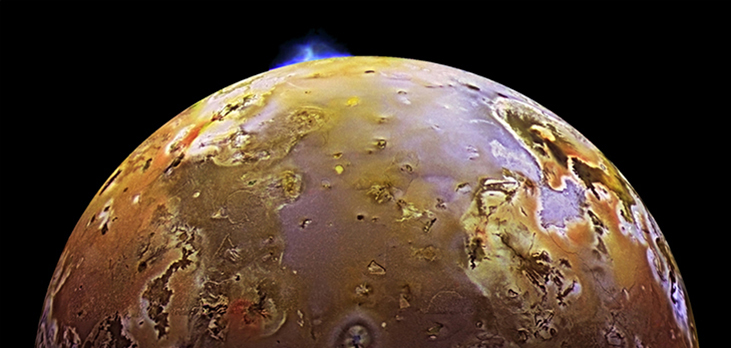
NASA/JPL/University of Arizona, Color Mosaic and Active Volcanic Plumes on Io (PIA01081). Modified in OpenStax University Physics Volume 1. Courtesy NASA/JPL-Caltech; no endorsement is implied. · NASA/JPL image use permission; OpenStax additions CC BY 4.0 · Source出典

Figure 13.27図 13.27
Dramatic evidence of tidal forces can be seen on Io. The eruption seen in blue is due to the internal heat created by the tidal forces exerted on Io by Jupiter. (credit: modification of work by NASA/JPL/University of Arizona)
英語のヒント
イオでは潮汐力の劇的な証拠が見られる。青く見える噴火は、木星がイオに及ぼす潮汐力によって生じた内部の熱によるものである。(クレジット:NASA/JPL/University of Arizonaの作品を改変)
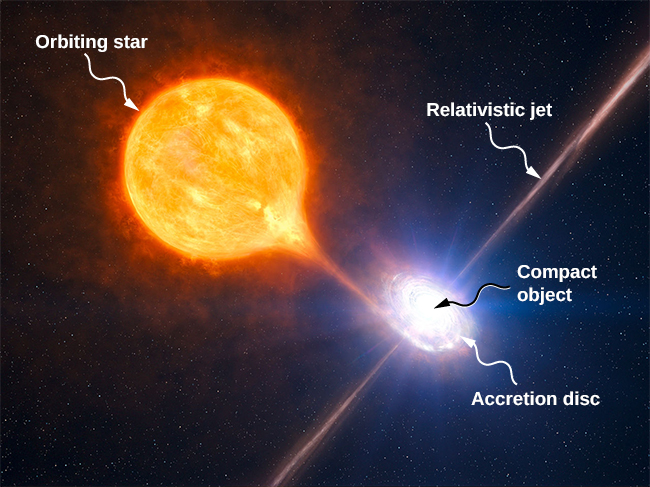
For some stars, the effect of tidal forces can be catastrophic. The tidal forces in very close binary systems can be strong enough to rip matter from one star to the other, once the tidal forces exceed the cohesive self-gravitational forces that hold the stars together. This effect can be seen in normal stars that orbit nearby compact stars, such as neutron stars or black holes. Figure 13.28 shows an artist’s rendition of this process. As matter falls into the compact star, it forms an accretion disc that becomes super-heated and radiates in the X-ray spectrum.
英語のヒント
恒星によっては、潮汐力の効果が破壊的になる。非常に接近した連星系では、星を一つに保つ自身の重力による凝集力を潮汐力が上回ると、一方の星から他方へ物質を引きはがすほど強くなることがある。この効果は、中性子星やブラックホールなどのコンパクト天体の近くを回る普通の恒星で見られる。図13.28は、この過程の想像図である。物質はコンパクト天体へ落ち込む際に降着円盤を作り、それは極端に高温となってX線を放射する。
ESO/L. Calçada/M. Kornmesser. Modified in OpenStax University Physics Volume 1. · CC BY 4.0 · Source出典

Figure 13.28図 13.28
Tidal forces from a compact object can tear matter away from an orbiting star. In addition to the accretion disc orbiting the compact object, material is often ejected along relativistic jets as shown. (credit: modification of work by ESO/L. Calçada/M. Kornmesser)
英語のヒント
コンパクト天体の潮汐力は、公転する恒星から物質を引きはがすことがある。コンパクト天体を回る降着円盤に加えて、図のように相対論的ジェットに沿って物質が噴き出すことも多い。(クレジット:ESO/L. Calçada/M. Kornmesserの作品を改変)
The energy output of these binary systems can exceed the typical output of thousands of stars. Another example might be a quasar. Quasars are very distant and immensely bright objects, often exceeding the energy output of entire galaxies. It is the general consensus among astronomers that they are, in fact, massive black holes producing radiant energy as matter that has been tidally ripped from nearby stars falls into them.
英語のヒント
こうした連星系の放出エネルギーは、典型的な恒星数千個分を超えることがある。別の例としてクエーサーが考えられる。クエーサーは非常に遠くにある極めて明るい天体で、銀河全体の放出エネルギーを上回ることも多い。実際には、近くの恒星から潮汐力で引きはがした物質が落ち込むことで放射エネルギーを生み出す、巨大なブラックホールであるというのが、天文学者の間の一般的な見解である。
Summaryまとめ
- Earth’s tides are caused by the difference in gravitational forces from the Moon and the Sun on the different sides of Earth.
英語のヒント
地球の潮汐は、地球の異なる側に月と太陽が及ぼす重力の差によって生じる。 - Spring or neap (high) tides occur when Earth, the Moon, and the Sun are aligned, and neap or (low) tides occur when they form a right triangle.
英語のヒント
地球、月、太陽が一直線に並ぶと、大きな潮汐である大潮が生じ、三者が直角三角形を作ると、小さな潮汐である小潮が生じる。 - Tidal forces can create internal heating, changes in orbital motion, and even destruction of orbiting bodies.
英語のヒント
潮汐力は、内部の加熱や軌道運動の変化を生み、公転する物体を破壊することさえある。
Conceptual Questions概念に関する問題
Exercises 51練習問題 51
Exercise 51問題 51
As an object falls into a black hole, tidal forces increase. Will these tidal forces always tear the object apart as it approaches the Schwarzschild radius? How does the mass of the black hole and size of the object affect your answer?
英語のヒント
物体がブラックホールへ落ち込むにつれて、潮汐力は増加する。物体がシュワルツシルト半径へ近づくとき、この潮汐力は必ず物体を引き裂くだろうか。ブラックホールの質量と物体の大きさは、答えにどう影響するか。
Problems問題
Exercises 52–54練習問題 52–54
Exercise 52問題 52
(a) What is the difference between the forces on a 1.0-kg mass on the near side of Io and far side due to Jupiter? Io has a mean radius of 1821 km and a mean orbital radius about Jupiter of 421,700 km. (b) Compare this difference to that calculated for the difference for Earth due to the Moon calculated in Example 13.14. Tidal forces are the cause of Io’s volcanic activity.
英語のヒント
(a) 木星が、イオの木星に近い側と遠い側にある1.0 kgの物体へ及ぼす力の差はいくらか。イオの平均半径は1821 km、木星を回る平均軌道半径は421,700 kmである。(b) この差を、例13.14で求めた月による地球の両側での力の差と比較せよ。イオの火山活動の原因は潮汐力である。
Exercise 53問題 53
If the Sun were to collapse into a black hole, the point of no return for an investigator would be approximately 3 km from the center singularity. Would the investigator be able to survive visiting even 300 km from the center? Answer this by finding the difference in the gravitational attraction the black holes exerts on a 1.0-kg mass at the head and at the feet of the investigator.
英語のヒント
太陽が崩壊してブラックホールになったとすると、探査者が引き返せなくなる地点は、中心の特異点から約3 kmとなる。探査者は、中心から300 kmの地点を訪れるだけでも生き延びられるだろうか。探査者の頭と足にある1.0 kgの物体にブラックホールが及ぼす重力の差を求め、答えよ。
Solution解き方
19,800 N; this is clearly not survivable
英語のヒント
19,800 N。明らかに生き延びることはできない。
Exercise 54問題 54
Consider Figure 13.24 in Tidal Forces. This diagram represents the tidal forces for spring tides. Sketch a similar diagram for neap tides. (Hint: For simplicity, imagine that the Sun and the Moon contribute equally. Your diagram would be the vector sum of two force fields (as in Figure 13.24), reduced by a factor of two, and superimposed at right angles.)
英語のヒント
neap tide
小潮
low tide created when the Moon and the Sun form a right triangle with Earth
英語のヒント
月、太陽、地球が直角三角形を作るときに生じる、小さな潮汐。
spring tide
大潮
high tide created when the Moon, the Sun, and Earth are along one line
英語のヒント
月、太陽、地球が一直線に並ぶときに生じる、大きな潮汐。
tidal force
潮汐力
difference between the gravitational force at the center of a body and that at any other location on the body; the tidal force stretches the body
英語のヒント
物体の中心での重力と、物体上のほかの場所での重力との差。潮汐力は物体を引き伸ばす。