第13章万有引力
13.4 Satellite Orbits and Energy13.4 衛星の軌道とエネルギー
Learning Objectives学習目標
Learning Objectives学習目標
By the end of this section, you will be able to:
英語のヒント
この節を終えると、次のことができるようになる。
- Describe the mechanism for circular orbits
英語のヒント
円軌道が生じる仕組みを説明する。 - Find the orbital periods and speeds of satellites
英語のヒント
衛星の軌道周期と速さを求める。 - Determine whether objects are gravitationally bound
英語のヒント
物体が重力で束縛されているかどうかを判断する。
The Moon orbits Earth. In turn, Earth and the other planets orbit the Sun. The space directly above our atmosphere is filled with artificial satellites in orbit. We examine the simplest of these orbits, the circular orbit, to understand the relationship between the speed and period of planets and satellites in relation to their positions and the bodies that they orbit.
英語のヒント
月は地球を公転する。その地球やほかの惑星は、さらに太陽を公転している。大気圏のすぐ上の空間は、軌道を回る人工衛星で満たされている。これらの軌道のうち最も単純な円軌道を調べ、惑星や衛星の速さと周期が、その位置や、公転の中心となる天体とどのように関係するかを理解する。
Circular Orbits円軌道
As noted at the beginning of this chapter, Nicolaus Copernicus first suggested that Earth and all other planets orbit the Sun in circles. He further noted that orbital periods increased with distance from the Sun. Later analysis by Kepler showed that these orbits are actually ellipses, but the orbits of most planets in the solar system are nearly circular. Earth’s orbital distance from the Sun varies a mere 2%. The exception is the eccentric orbit of Mercury, whose orbital distance varies nearly 40%.
英語のヒント
この章の冒頭で述べたように、ニコラウス・コペルニクスは最初に、地球とほかのすべての惑星が円を描いて太陽を公転すると提案した。さらに、太陽からの距離が増すほど公転周期が長くなることに着目した。後のケプラーの分析により、軌道は実際には楕円だと分かったが、太陽系のほとんどの惑星の軌道は円に近い。地球の軌道の太陽からの距離は、わずか2%しか変化しない。例外は離心率の大きい水星の軌道で、距離はほぼ40%変化する。
Determining the orbital speed and orbital period of a satellite is much easier for circular orbits, so we make that assumption in the derivation that follows. As we described in the previous section, an object with negative total energy is gravitationally bound and therefore is in orbit. Our computation for the special case of circular orbits will confirm this. We focus on objects orbiting Earth, but our results can be generalized for other cases.
英語のヒント
衛星の軌道の速さと周期を求めることは、円軌道ならはるかに簡単なので、以下の導出では円軌道を仮定する。前の節で説明したように、全エネルギーが負の物体は重力で束縛され、したがって軌道を回っている。円軌道という特別な場合について計算し、このことを確認する。地球を回る物体に注目するが、結果はほかの場合にも一般化できる。
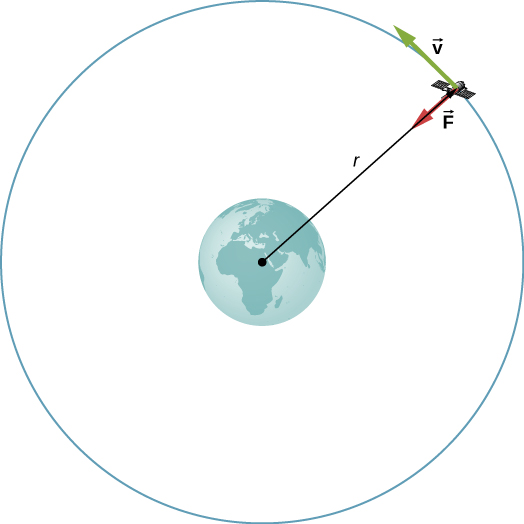
Consider a satellite of mass m in a circular orbit about Earth at distance r from the center of Earth (Figure 13.13). It has centripetal acceleration directed toward the center of Earth. Earth’s gravity is the only force acting, so Newton’s second law gives
英語のヒント
地球の中心から距離rの円軌道を回る、質量mの衛星を考える(図13.13)。衛星には地球の中心へ向かう向心加速度がある。働く力は地球の重力だけなので、ニュートンの第2法則から次の式が得られる。
OpenStax / Rice University, University Physics Volume 1, CC BY 4.0. Source-book artwork retained. · CC BY 4.0 · Source出典

Figure 13.13図 13.13
A satellite of mass m orbiting at radius r from the center of Earth. The gravitational force supplies the centripetal acceleration.
英語のヒント
地球の中心から半径rの軌道を回る質量mの衛星。重力が向心加速度を生み出す。
We solve for the speed of the orbit, noting that m cancels, to get the orbital speed
英語のヒント
mが約分で消えることに注意して速さについて解くと、軌道の速さは次のようになる。
Consistent with what we saw in Equation 13.2 and Equation 13.6, m does not appear in Equation 13.7. The value of g, the escape velocity, and orbital velocity depend only upon the distance from the center of the planet, and not upon the mass of the object being acted upon. Notice the similarity in the equations for and . The escape velocity is exactly times greater, about 40%, than the orbital velocity. This comparison was noted in Example 13.7, and it is true for a satellite at any radius.
英語のヒント
To find the period of a circular orbit, we note that the satellite travels the circumference of the orbit in one period T. Using the definition of speed, we have . We substitute this into Equation 13.7 and rearrange to get
英語のヒント
円軌道の周期を求めるには、衛星が1周期Tの間に軌道の円周を進むことに着目する。速さの定義からである。これを軌道の速さの式へ代入し、変形すると次のようになる。
We see in the next section that this represents Kepler’s third law for the case of circular orbits. It also confirms Copernicus’s observation that the period of a planet increases with increasing distance from the Sun. We need only replace with in Equation 13.8.
英語のヒント
次の節で見るように、これは円軌道の場合のケプラーの第3法則を表している。また、太陽からの距離が増すほど惑星の周期が長くなるという、コペルニクスの観察も確かめられる。周期の式でをに置き換えるだけでよい。
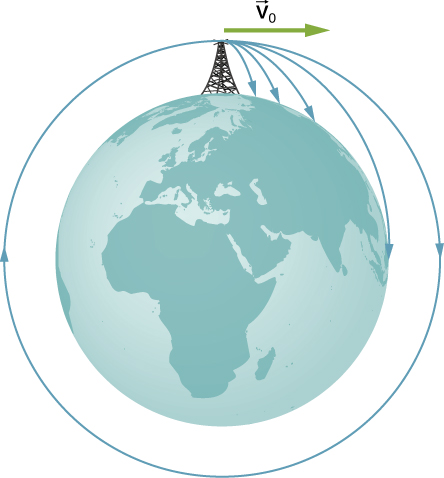
We conclude this section by returning to our earlier discussion about astronauts in orbit appearing to be weightless, as if they were free-falling towards Earth. In fact, they are in free fall. Consider the trajectories shown in Figure 13.14. (This figure is based on a drawing by Newton in his Principia and also appeared earlier in Motion in Two and Three Dimensions.) All the trajectories shown that hit the surface of Earth have less than orbital velocity. The astronauts would accelerate toward Earth along the noncircular paths shown and feel weightless. (Astronauts actually train for life in orbit by riding in airplanes that free fall for 30 seconds at a time.) But with the correct orbital velocity, Earth’s surface curves away from them at exactly the same rate as they fall toward Earth. Of course, staying the same distance from the surface is the point of a circular orbit.
英語のヒント
この節の最後に、軌道上の宇宙飛行士が、地球へ自由落下しているかのように無重量に見えるという先の議論へ戻ろう。実際、彼らは自由落下している。図13.14の軌跡を考える。この図はニュートンの『プリンキピア』の図に基づき、「2次元と3次元の運動」にもすでに登場した。図のうち地表に衝突する軌跡は、すべて軌道の速度より小さい速度の場合である。宇宙飛行士は、図の円形でない軌跡に沿って地球へ向かって加速し、無重量を感じる。実際に宇宙飛行士は、1回に30秒間自由落下する飛行機に乗って、軌道上の生活の訓練を行う。しかし、適切な軌道の速度を持てば、地表は、宇宙飛行士が地球へ落下するのとまったく同じ割合で下方へ曲がって遠ざかっていく。もちろん、地表からの距離を一定に保つことこそ、円軌道の要点である。
OpenStax / Rice University, University Physics Volume 1, CC BY 4.0. Source-book artwork retained. · CC BY 4.0 · Source出典

Figure 13.14図 13.14
A circular orbit is the result of choosing a tangential velocity such that Earth’s surface curves away at the same rate as the object falls toward Earth.
英語のヒント
物体が地球へ落下するのと同じ割合で、地表が曲がって遠ざかるような接線方向の速度を選ぶと、円軌道が生じる。
We can summarize our discussion of orbiting satellites in the following Problem-Solving Strategy.
英語のヒント
軌道を回る衛星についての議論を、次の問題を解く方針にまとめられる。
Example 13.9例題 13.9
The International Space Station国際宇宙ステーション
Determine the orbital speed and period for the International Space Station (ISS).
英語のヒント
国際宇宙ステーション(ISS)の軌道の速さと周期を求めよ。
Strategy方針
Since the ISS orbits above Earth’s surface, the radius at which it orbits is . We use Equation 13.7 and Equation 13.8 to find the orbital speed and period, respectively.
英語のヒント
Solution解答
which is about 17,000 mph. Using Equation 13.8, the period is
英語のヒント
これは約17,000 mphである。周期の式を使うと、周期は次のようになる。
which is just over 90 minutes.
英語のヒント
これは90分を少し超える。
Significance考察
The ISS is considered to be in low Earth orbit (LEO). Nearly all satellites are in LEO, including most weather satellites. GPS satellites, at about 20,000 km, are considered medium Earth orbit. The higher the orbit, the more energy is required to put it there and the more energy is needed to reach it for repairs. Of particular interest are the satellites in geosynchronous orbit. All fixed satellite dishes on the ground pointing toward the sky, such as TV reception dishes, are pointed toward geosynchronous satellites. These satellites are placed at the exact distance, and just above the equator, such that their period of orbit is 1 day. They remain in a fixed position relative to Earth’s surface.
英語のヒント
ISSは地球低軌道(LEO)にあるとされる。ほとんどの気象衛星を含め、人工衛星のほぼすべてはLEOにある。約20,000 km上空のGPS衛星は、地球中軌道にあるとされる。軌道が高いほど、そこへ衛星を入れるのにも、修理のために到達するのにも、多くのエネルギーが必要になる。とくに関心があるのは、対地同期軌道の衛星である。テレビ受信用など、地上で空の一定方向へ固定して向けた衛星アンテナは、すべて対地同期衛星へ向いている。これらの衛星は、赤道の真上で、公転周期が1日となるちょうどの距離に配置される。そのため、地表に対して一定の位置にとどまる。
Example 13.10例題 13.10
Determining the Mass of Earth地球の質量を求める
Determine the mass of Earth from the orbit of the Moon.
英語のヒント
月の軌道から地球の質量を求めよ。
Strategy方針
We use Equation 13.8, solve for , and substitute for the period and radius of the orbit. The radius and period of the Moon’s orbit was measured with reasonable accuracy thousands of years ago. From the astronomical data in Appendix D, the period of the Moon is 27.3 days , and the average distance between the centers of Earth and the Moon is 384,000 km.
英語のヒント
Solution解答
Solving for ,
英語のヒント
について解くと、次のようになる。
Significance考察
Compare this to the value of that we obtained in Example 13.5, using the value of g at the surface of Earth. Although these values are very close (~0.8%), both calculations use average values. The value of g varies from the equator to the poles by approximately 0.5%. But the Moon has an elliptical orbit in which the value of r varies just over 10%. (The apparent size of the full Moon actually varies by about this amount, but it is difficult to notice through casual observation as the time from one extreme to the other is many months.)
英語のヒント
この値を、例題13.5で地表のgを使って求めたと比較しよう。両者は非常に近い(差は約0.8%)が、どちらの計算も平均値を使っている。gは赤道から極までに約0.5%変わる。一方、月の軌道は楕円で、rの値は10%を少し超えて変化する。満月の見かけの大きさも実際にこの程度変化するが、一方の極値からもう一方までに何か月もかかるため、何気なく観察するだけでは気付きにくい。
Example 13.11例題 13.11
Galactic Speed and Period銀河の速さと周期
Let’s revisit Example 13.2. Assume that the Milky Way and Andromeda galaxies are in a circular orbit about each other. What would be the velocity of each and how long would their orbital period be? Assume the mass of each is 8 × 10¹¹ solar masses and their centers are separated by 2.5 million light years.
英語のヒント
例題13.2をもう一度考えよう。天の川銀河とアンドロメダ銀河が、互いのまわりを円軌道で公転していると仮定する。それぞれの速度と公転周期はいくらになるか。各銀河の質量を8 × 10¹¹太陽質量、中心間の距離を250万光年とする。
Strategy方針
We cannot use Equation 13.7 and Equation 13.8 directly because they were derived assuming that the object of mass m orbited about the center of a much larger planet of mass M. We determined the gravitational force in Example 13.2 using Newton’s law of universal gravitation. We can use Newton’s second law, applied to the centripetal acceleration of either galaxy, to determine their tangential speed. From that result we can determine the period of the orbit.
英語のヒント
Solution解答
and that the acceleration of each galaxy is
英語のヒント
また、各銀河の加速度は次のように求まった。
Since the galaxies are in a circular orbit, they have centripetal acceleration. If we ignore the effect of other galaxies, then, as we learned in Linear Momentum and Collisions and Fixed-Axis Rotation, the centers of mass of the two galaxies remain fixed. Hence, the galaxies must orbit about this common center of mass. For equal masses, the center of mass is exactly half way between them. So the radius of the orbit, , is not the same as the distance between the galaxies, but one-half that value, or 1.25 million light-years. These two different values are shown in Figure 13.15.
英語のヒント
銀河は円軌道にあるので向心加速度を持つ。ほかの銀河の影響を無視すれば、「運動量と衝突」および「固定軸のまわりの回転」で学んだように、二つの銀河の重心は固定されたままである。したがって、両者はこの共通の重心のまわりを公転しなければならない。質量が等しければ、重心は両者のちょうど中間にある。軌道半径は銀河間距離とは異なり、その半分の125万光年となる。図13.15に、この二つの異なる距離を示す。
Image omitted because its reuse rights could not be verified.権利の確認ができないため画像を割愛。
Figure 13.15図 13.15
The distance between two galaxies, which determines the gravitational force between them, is r, and is different from , which is the radius of orbit for each. For equal masses, . (credit: modification of work by Marc Van Norden)
英語のヒント
両銀河の間の重力を決める距離rは、各銀河の軌道半径とは異なる。質量が等しい場合には、である。(出典:Marc Van Nordenの作品を改変)
Using the expression for centripetal acceleration, we have
英語のヒント
向心加速度の式を用いると、次のようになる。
Solving for the orbit velocity, we have . Finally, we can determine the period of the orbit directly from , to find that the period is , about 5 × 10¹⁰ years.
英語のヒント
軌道の速度について解くと、となる。最後に、から周期を直接求めると、、すなわち約5 × 10¹⁰年となる。
Significance考察
The orbital speed of 47 km/s might seem high at first. But this speed is comparable to the escape speed from the Sun, which we calculated in an earlier example. To give even more perspective, this period is nearly four times longer than the time that the Universe has been in existence.
英語のヒント
軌道の速さ47 km/sは、初めは大きく思えるかもしれない。しかし、この速さは、先の例題で求めた太陽からの脱出の速さと同程度である。さらに規模をつかむためにいうと、この周期は、宇宙が存在してきた時間のほぼ4倍である。
In fact, the present relative motion of these two galaxies is such that they are expected to collide in about 4 × 10⁹ years. Although the density of stars in each galaxy makes a direct collision of any two stars unlikely, such a collision will have a dramatic effect on the shape of the galaxies. Examples of such collisions are well known in astronomy.
英語のヒント
実際には、二つの銀河の現在の相対運動から、約4 × 10⁹年後に衝突すると予想される。各銀河の恒星密度から考えて、二つの恒星が直接衝突する可能性は低いが、銀河どうしの衝突は銀河の形に劇的な影響を与える。このような衝突の例は、天文学でよく知られている。