第13章万有引力
The Magnitude of the Tides潮汐の大きさ
With accurate data for the positions of the Moon and the Sun, the time of maximum and minimum tides at most locations on our planet can be predicted accurately.
英語のヒント
月と太陽の位置について正確なデータがあれば、地球上のほとんどの場所で、潮位が最大・最小になる時刻を正確に予測できる。
Additional Resources追加教材
The magnitude of the tides, however, is far more complicated. The relative angles of Earth and the Moon determine spring and neap tides, but the magnitudes of these tides are affected by the distances from Earth as well. Tidal forces are greater when the distances are smaller. Both the Moon’s orbit about Earth and Earth’s orbit about the Sun are elliptical, so a spring tide is exceptionally large if it occurs when the Moon is at perigee and Earth is at perihelion. Conversely, it is relatively small if it occurs when the Moon is at apogee and Earth is at aphelion.
英語のヒント
しかし、潮汐の大きさははるかに複雑である。地球と月の相対的な角度が大潮と小潮を決めるが、潮汐の大きさは地球からの距離にも影響される。距離が小さいほど、潮汐力は大きい。月の地球周回軌道も地球の太陽周回軌道も楕円なので、月が近地点にあり、地球が近日点にあるときに大潮が起これば、特に大きくなる。逆に、月が遠地点にあり、地球が遠日点にあるときの大潮は、比較的小さくなる。
The greatest causes of tide variation are the topography of the local shoreline and the bathymetry (the profile of the depth) of the ocean floor. The range of tides due to these effects is astounding. Although ocean tides are much smaller than a meter in many places around the globe, the tides at the Bay of Fundy (Figure 13.26), on the east coast of Canada, can be as much as 16.3 meters.
英語のヒント
潮汐の変動を引き起こす最大の要因は、付近の海岸線の地形と、海底の水深の分布である。これらによる潮位差の幅には驚かされる。地球上の多くの場所では潮位差が1 mよりはるかに小さいのに対し、カナダ東岸のファンディ湾(図13.26)では16.3 mにもなることがある。
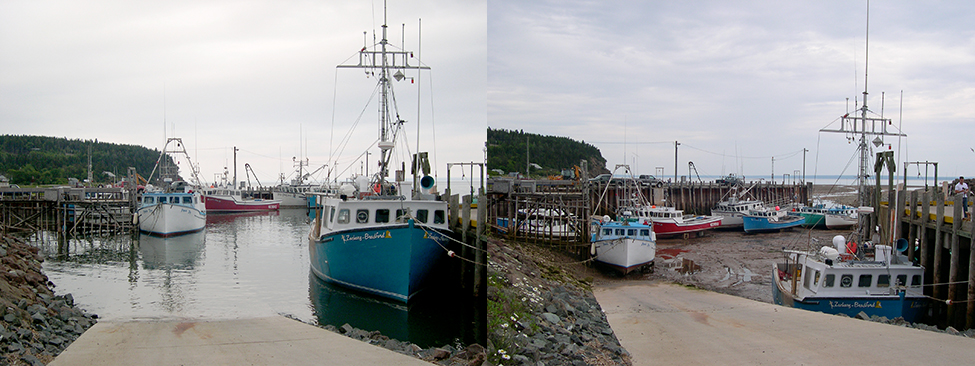
Dylan Kereluk, Bay of Fundy - Tide In and Bay of Fundy - Tide Out, CC BY 2.0. Modified in OpenStax University Physics Volume 1. · CC BY 2.0 components; OpenStax composition CC BY 4.0 · Source出典

Figure 13.26図 13.26
Boats in the Bay of Fundy at high and low tides. The twice-daily change in sea level creates a real challenge to the safe mooring of boats. (credit: modification of works by Dylan Kereluk)
英語のヒント
ファンディ湾の満潮時と干潮時の船。1日に2回の海面の変化は、船を安全に係留するうえで大きな課題となる。(クレジット:Dylan Kerelukの作品を改変)
Example 13.14例題 13.14
Comparing Tidal Forces潮汐力の比較
Compare the Moon’s gravitational force on a 1.0-kg mass located on the near side and another on the far side of Earth. Repeat for the Sun and then compare the results to confirm that the Moon’s tidal forces are about twice that of the Sun.
英語のヒント
地球の月に近い側と遠い側に置いた、質量1.0 kgの二つの物体に働く月の重力を比較せよ。太陽についても同様に求め、結果を比較して、月の潮汐力が太陽の潮汐力の約2倍であることを確かめよ。
Strategy方針
We use Newton’s law of gravitation given by Equation 13.1. We need the masses of the Moon and the Sun and their distances from Earth, as well as the radius of Earth. We use the astronomical data from Appendix D.
英語のヒント
Solution解答
Substituting the mass of the Moon and mean distance from Earth to the Moon, we have
英語のヒント
月の質量と、地球から月までの平均距離を代入すると、次のようになる。
In the denominator, we use the minus sign for the near side and the plus sign for the far side. The results are
英語のヒント
分母では、近い側に負号、遠い側に正号を使う。結果は次のとおりである。
The Moon’s gravitational force is nearly 7% higher at the near side of Earth than at the far side, but both forces are much less than that of Earth itself on the 1.0-kg mass. Nevertheless, this small difference creates the tides. We now repeat the problem, but substitute the mass of the Sun and the mean distance between the Earth and Sun. The results are
英語のヒント
月の重力は地球の近い側で遠い側より約7%大きいが、どちらの力も、1.0 kgの物体に地球自身が及ぼす力よりはるかに小さい。それでも、この小さな差が潮汐を生む。今度は太陽の質量と地球・太陽間の平均距離に置き換え、同じ計算を繰り返す。結果は次のようになる。
We have to keep six significant digits since we wish to compare the difference between them to the difference for the Moon. (Although we can’t justify the absolute value to this accuracy, since all values in the calculation are the same except the distances, the accuracy in the difference is still valid to three digits.) The difference between the near and far forces on a 1.0-kg mass due to the Moon is
英語のヒント
二つの値の差を月について求めた差と比較したいので、有効数字を6桁残す必要がある。(絶対値をこの精度まで正しいとする根拠はない。しかし計算に使う値は距離以外すべて同じなので、差の精度はなお3桁まで有効である。)1.0 kgの物体に月が及ぼす力の、近い側と遠い側での差は、次のようになる。
whereas the difference for the Sun is
英語のヒント
これに対し、太陽についての差は次のようになる。
Note that a more proper approach is to write the difference in the two forces with the difference between the near and far distances explicitly expressed. With just a bit of algebra we can show that
英語のヒント
より適切なのは、近い側と遠い側の距離の差を明示して、二つの力の差を書き表す方法である。少し代数計算を行うだけで、次のことを示せる。
where and are the same to three significant digits, but their difference , equal to the diameter of Earth, is also known to three significant digits. The results of the calculation are the same. This approach would be necessary if the number of significant digits needed exceeds that available on your calculator or computer.
英語のヒント
ここで、とは有効数字3桁では同じ値だが、その差も地球の直径に等しく、有効数字3桁まで分かっている。計算結果は同じである。必要な有効数字の桁数が電卓やコンピューターで扱える桁数を超える場合には、この方法が必要になる。
Significance考察
Note that the forces exerted by the Sun are nearly 200 times greater than the forces exerted by the Moon. But the difference in those forces for the Sun is half that for the Moon. This is the nature of tidal forces. The Moon has a greater tidal effect because the fractional change in distance from the near side to the far side is so much greater for the Moon than it is for the Sun.
英語のヒント
太陽が及ぼす力は、月が及ぼす力の約200倍であることに注意しよう。しかし、太陽の力の両側での差は、月の場合の半分である。これが潮汐力の性質である。近い側から遠い側への距離の変化が元の距離に占める割合は、月のほうが太陽よりはるかに大きい。このため、月の潮汐への効果のほうが大きい。