第13章万有引力
Results Away from the Equator赤道以外での結果
At the pole, and , just as is the case without rotation. At any other latitude , the situation is more complicated. The centripetal acceleration is directed toward point P in the figure, and the radius becomes . The vector sum of the weight and must point toward point P, hence no longer points away from the center of Earth. (The difference is small and exaggerated in the figure.) A plumb bob will always point along this deviated direction. All buildings are built aligned along this deviated direction, not along a radius through the center of Earth. For the tallest buildings, this represents a deviation of a few feet at the top.
英語のヒント
極ではかつとなり、自転がない場合と同じになる。それ以外の緯度では、状況はもっと複雑である。向心加速度は図の点Pへ向かい、回転半径はとなる。重力とのベクトル和は点Pへ向かわなければならないので、はもはや地球の中心からまっすぐ外向きには向かない。(この違いは小さく、図では誇張してある。)下げ振りは常に、このずれた方向に沿って向く。建物はすべて、地球の中心を通る半径方向ではなく、このずれた方向に沿って建てられる。最も高い建物では、最上部で数フィートのずれとなる。
It is also worth noting that Earth is not a perfect sphere. The interior is partially liquid, and this enhances Earth bulging at the equator due to its rotation. The radius of Earth is about 30 km greater at the equator compared to the poles. It is left as an exercise to compare the strength of gravity at the poles to that at the equator using Equation 13.2. The difference is comparable to the difference due to rotation and is in the same direction. Apparently, you really can lose “weight” by moving to the tropics.
英語のヒント
地球が完全な球ではない点にも注意が必要である。内部の一部は液体であり、このことが自転による赤道部分の膨らみを強める。地球の半径は、極より赤道で約30 km大きい。式13.2を用いて極と赤道の重力の強さを比較することは、練習問題として残しておく。その差は自転による差と同程度で、向きも同じである。どうやら熱帯へ移れば、本当に「体重」を減らせるようだ。
Gravity Away from the Surface表面から離れた場所の重力
Earlier we stated without proof that the law of gravitation applies to spherically symmetrical objects, where the mass of each body acts as if it were at the center of the body. Since Equation 13.2 is derived from Equation 13.1, it is also valid for symmetrical mass distributions, but both equations are valid only for values of . As we saw in Example 13.4, at 400 km above Earth’s surface, where the International Space Station orbits, the value of g is . (We will see later that this is also the centripetal acceleration of the ISS.)
英語のヒント
For , Equation 13.1 and Equation 13.2 are not valid. However, we can determine g for these cases using a principle that comes from Gauss’s law, which is a powerful mathematical tool that we study in more detail later in the course. A consequence of Gauss’s law, applied to gravitation, is that only the mass within r contributes to the gravitational force. Also, that mass, just as before, can be considered to be located at the center. The gravitational effect of the mass outside r has zero net effect.
英語のヒント
Two very interesting special cases occur. For a spherical planet with constant density, the mass within r is the density times the volume within r. This mass can be considered located at the center. Replacing with only the mass within r, , and with r, Equation 13.2 becomes
英語のヒント
非常に興味深い特別な場合が二つある。密度が一定の球形の惑星では、rより内側の質量は密度と内側の体積の積であり、その質量が中心にあるものと考えられる。をrより内側の質量だけ、すなわちに、をrに置き換えると、式13.2は次のようになる。
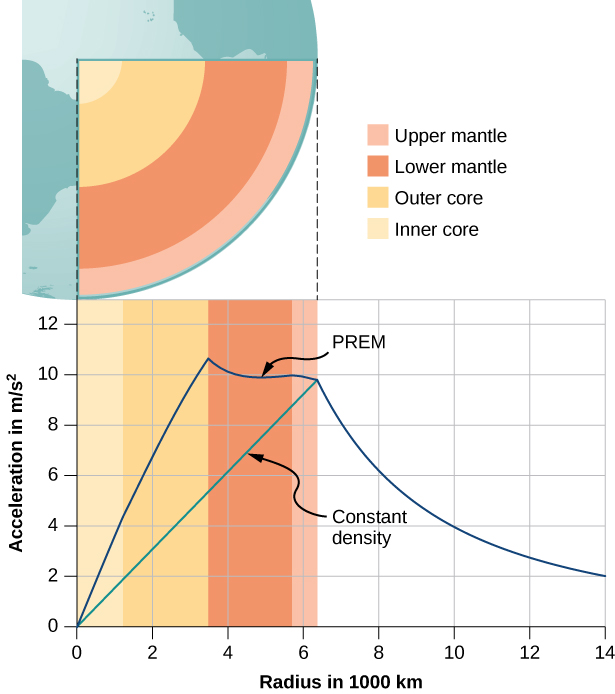
The value of g, and hence your weight, decreases linearly as you descend down a hole to the center of the spherical planet. At the center, you are weightless, as the mass of the planet pulls equally in all directions. Actually, Earth’s density is not constant, nor is Earth solid throughout. Figure 13.11 shows the profile of g if Earth had constant density and the more likely profile based upon estimates of density derived from seismic data.
英語のヒント
球形の惑星の中心へ続く穴を下っていくと、g、したがって体重は直線的に減少する。中心では惑星の質量がすべての方向へ等しく引くので、無重量になる。実際の地球の密度は一定ではなく、内部全体が固体でもない。図13.11には、地球の密度が一定だった場合のgの分布と、地震データから推定した密度に基づく、より実際に近いと考えられる分布を示す。
OpenStax / Rice University, University Physics Volume 1, CC BY 4.0. Source-book artwork retained. · CC BY 4.0 · Source出典

Figure 13.11図 13.11
For , the value of g for the case of constant density is the straight green line. The blue line from the PREM (Preliminary Reference Earth Model) is probably closer to the actual profile for g.
英語のヒント
では、密度が一定の場合のgの値は、緑色の直線で示される。PREM(暫定的標準地球モデル)による青い線の方が、gの実際の分布に近いと考えられる。
The second interesting case concerns living on a spherical shell planet. This scenario has been proposed in many science fiction stories. Ignoring significant engineering issues, the shell could be constructed with a desired radius and total mass, such that g at the surface is the same as Earth’s. Can you guess what happens once you descend in an elevator to the inside of the shell, where there is no mass between you and the center? What benefits would this provide for traveling great distances from one point on the sphere to another? And finally, what effect would there be if the planet was spinning?
英語のヒント
もう一つの興味深い場合は、球殻状の惑星に暮らすことである。この設定は、多くのSF作品で提案されてきた。重大な工学上の問題を無視すれば、表面のgが地球と同じになるよう、望みの半径と総質量で球殻を作れる。エレベーターで球殻の内側へ降り、自分と中心との間に質量がない場所に入ると、何が起こると思うか。球上のある点から別の点へ長距離を移動する際、これにはどのような利点があるだろうか。最後に、その惑星が回転していたら、どのような影響があるだろうか。