第13章万有引力
The Gravitational Field重力場
Equation 13.2 is a scalar equation, giving the magnitude of the gravitational acceleration as a function of the distance from the center of the mass that causes the acceleration. But we could have retained the vector form for the force of gravity in Equation 13.1, and written the acceleration in vector form as
英語のヒント
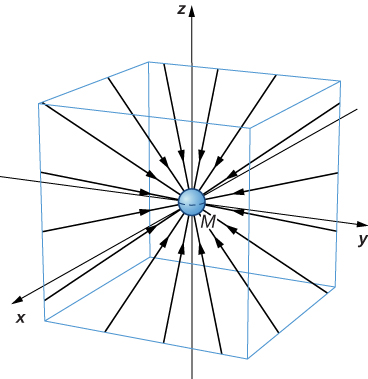
We identify the vector field represented by as the gravitational field caused by mass . We can picture the field as shown Figure 13.9. The lines are directed radially inward and are symmetrically distributed about the mass.
英語のヒント
で表されるベクトル場を、質量が作る重力場と呼ぶ。この場は図13.9のように描ける。線は半径方向の内向きに向かい、質量のまわりに対称に分布する。
OpenStax / Rice University, University Physics Volume 1, CC BY 4.0. Source-book artwork retained. · CC BY 4.0 · Source出典

Figure 13.9図 13.9
Field line representation of the gravitational field created by Earth.
英語のヒント
地球が作る重力場を力線で表した図。
The direction of is parallel to the field lines at any point. The strength of at any point is inversely proportional to the line spacing. Another way to state this is that the magnitude of the field in any region is proportional to the number of lines that pass through a unit surface area, effectively a density of lines. Since the lines are equally spaced in all directions, the number of lines per unit surface area at a distance r from the mass is the total number of lines divided by the surface area of a sphere of radius r, which is proportional to . Hence, this picture perfectly represents the inverse square law, in addition to indicating the direction of the field. In the field picture, we say that a mass m interacts with the gravitational field of mass M. We will use the concept of fields to great advantage in the later chapters on electromagnetism.
英語のヒント
の向きは、どの点でも力線と平行である。各点でのの強さは、線の間隔に反比例する。言い換えると、ある領域の場の大きさは、単位表面積を通る線の数、つまり実質的には線の密度に比例する。線はすべての方向に等間隔で分布する。そのため、質量から距離rの位置で単位表面積を通る線の数は、線の総数を半径rの球の表面積で割った値となり、に比例する。したがって、この描き方は場の向きだけでなく、逆2乗則も正確に表している。場による描像では、質量mは質量Mの重力場と相互作用すると述べる。後の電磁気学の章では、場の概念を大いに活用する。
Apparent Weight: Accounting for Earth’s Rotation見かけの重さ:地球の自転を考慮する
As we saw in Applications of Newton’s Laws, objects moving at constant speed in a circle have a centripetal acceleration directed toward the center of the circle, which means that there must be a net force directed toward the center of that circle. Since all objects on the surface of Earth move through a circle every 24 hours, there must be a net centripetal force on each object directed toward the center of that circle.
英語のヒント
「ニュートンの法則の応用」で見たように、一定の速さで円運動する物体には、円の中心へ向かう向心加速度がある。これは、円の中心へ向かう合力が存在しなければならないことを意味する。地表のすべての物体は24時間ごとに円を1周するので、それぞれの物体には、その円の中心へ向かう正味の向心力が働かなければならない。
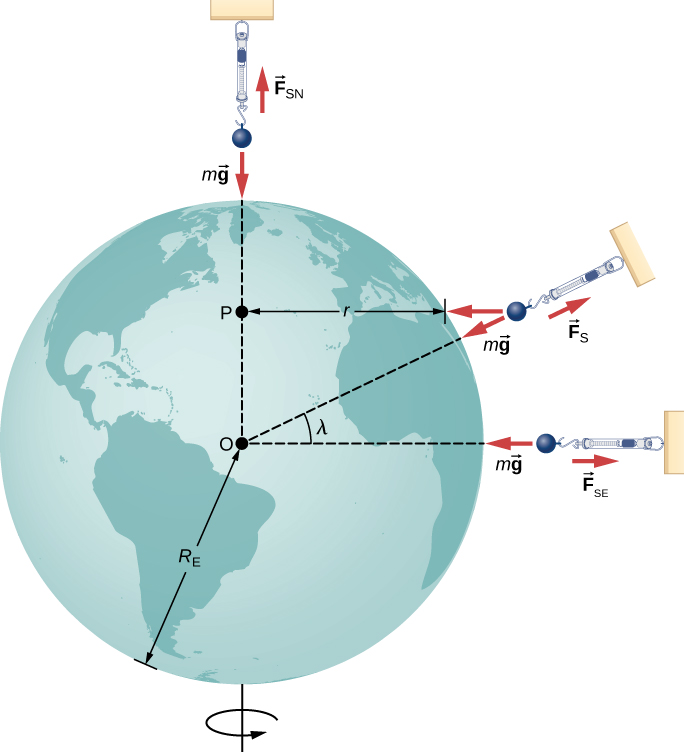
Let’s first consider an object of mass m located at the equator, suspended from a scale (Figure 13.10). The scale exerts an upward force away from Earth’s center. This is the reading on the scale, and hence it is the apparent weight of the object. The weight (mg) points toward Earth’s center. If Earth were not rotating, the acceleration would be zero and, consequently, the net force would be zero, resulting in . This would be the true reading of the weight.
英語のヒント
まず、赤道上ではかりにつり下げられた質量mの物体を考えよう(図13.10)。はかりは地球の中心から離れる上向きの力を及ぼす。これがはかりの示す値であり、物体の見かけの重さとなる。重力(mg)は地球の中心へ向かう。地球が自転していなければ加速度はゼロであり、したがって合力もゼロとなって、となる。このとき、はかりは真の重さを示す。
OpenStax / Rice University, University Physics Volume 1, CC BY 4.0. Source-book artwork retained. · CC BY 4.0 · Source出典

Figure 13.10図 13.10
For a person standing at the equator, the centripetal acceleration is in the same direction as the force of gravity. At latitude , the angle the between and the force of gravity is and the magnitude of decreases with .
英語のヒント
赤道に立つ人の向心加速度は、重力と同じ向きである。緯度では、と重力のなす角がとなり、の大きさはに従って減少する。
With rotation, the sum of these forces must provide the centripetal acceleration, . Using Newton’s second law, we have
英語のヒント
自転があると、これらの力の和は向心加速度を生み出さなければならない。ニュートンの第2法則を用いると、次のようになる。
Note that points in the same direction as the weight; hence, it is negative. The tangential speed v is the speed at the equator and r is . We can calculate the speed simply by noting that objects on the equator travel the circumference of Earth in 24 hours. Instead, let’s use the alternative expression for from Motion in Two and Three Dimensions. Recall that the tangential speed is related to the angular speed by . Hence, we have . By rearranging Equation 13.3 and substituting , the apparent weight at the equator is
英語のヒント
は重力と同じ向きであるため、負になることに注意しよう。接線方向の速さvは赤道上の速さで、rはである。赤道上の物体が24時間で地球の円周を1周することを利用すれば、速さは簡単に計算できる。ここでは代わりに、「2次元と3次元の運動」で扱ったの別の表し方を用いよう。接線方向の速さは角速度とで結び付いていた。したがってとなる。式13.3を変形し、を代入すると、赤道上の見かけの重さは次のようになる。
The angular speed of Earth everywhere is
英語のヒント
地球の角速度は、どの場所でも次の値である。
Substituting for the values or and , we have . This is only 0.34% of the value of gravity, so it is clearly a small correction.
英語のヒント
との値を代入すると、となる。これは重力加速度の値のわずか0.34%なので、補正は明らかに小さい。
Example 13.5例題 13.5
Zero Apparent Weight見かけの重さがゼロになる場合
How fast would Earth need to spin for those at the equator to have zero apparent weight? How long would the length of the day be?
英語のヒント
赤道上にいる人の見かけの重さがゼロになるには、地球はどれほどの速さで自転する必要があるか。そのとき、1日の長さはどれほどになるか。
Strategy方針
Using Equation 13.3, we can set the apparent weight () to zero and determine the centripetal acceleration required. From that, we can find the speed at the equator. The length of day is the time required for one complete rotation.
英語のヒント
式13.3を用いて、見かけの重さ()をゼロと置き、必要な向心加速度を求める。そこから赤道上の速さを求められる。1日の長さは、1回転するのに必要な時間である。
Solution解答
From Equation 13.2, we have , so setting , we get . Using the expression for , substituting for Earth’s radius and the standard value of gravity, we get
英語のヒント
式13.2よりである。と置くと、を得る。の式を用い、地球の半径と重力加速度の標準値を代入すると、次のようになる。
The period T is the time for one complete rotation. Therefore, the tangential speed is the circumference divided by T, so we have
英語のヒント
周期Tは1回転するのにかかる時間である。したがって、接線方向の速さは円周をTで割った値であり、次の式が成り立つ。
This is about 84 minutes.
英語のヒント
これは約84分である。
Significance考察
We will see later in this chapter that this speed and length of day would also be the orbital speed and period of a satellite in orbit at Earth’s surface. While such an orbit would not be possible near Earth’s surface due to air resistance, it certainly is possible only a few hundred miles above Earth.
英語のヒント
この速さと1日の長さが、地表すれすれの軌道を回る衛星の軌道の速さと周期にも等しいことを、この章の後半で見る。空気抵抗のため地表付近ではそのような軌道は実現できないが、地球の数百マイル上空であれば確かに可能である。