第13章万有引力
Orbital Transfers軌道間の移行
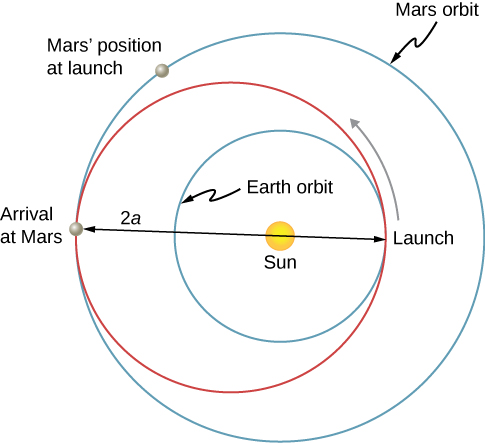
People have imagined traveling to the other planets of our solar system since they were discovered. But how can we best do this? The most efficient method was discovered in 1925 by Walter Hohmann, inspired by a popular science fiction novel of that time. The method is now called a Hohmann transfer. For the case of traveling between two circular orbits, the transfer is along a “transfer” ellipse that perfectly intercepts those orbits at the aphelion and perihelion of the ellipse. Figure 13.20 shows the case for a trip from Earth’s orbit to that of Mars. As before, the Sun is at the focus of the ellipse.
英語のヒント
太陽系のほかの惑星が発見されて以来、人々はそこへ旅することを思い描いてきた。では、どうすれば最もうまく行けるだろうか。最も効率的な方法は、1925年、当時人気のあったSF小説に着想を得たヴァルター・ホーマンによって発見された。この方法を現在ではホーマン遷移という。二つの円軌道の間を移動する場合、遠日点と近日点でそれぞれの円軌道にちょうど接する「遷移」楕円に沿って移動する。図13.20は地球の軌道から火星の軌道へ行く場合である。これまでと同様、太陽は楕円の焦点にある。
For any ellipse, the semi-major axis is defined as one-half the sum of the perihelion and the aphelion. In Figure 13.18, the semi-major axis is the distance from the origin to either side of the ellipse along the x-axis, or just one-half the longest axis (called the major axis). Hence, to travel from one circular orbit of radius to another circular orbit of radius , the aphelion of the transfer ellipse will be equal to the value of the larger orbit, while the perihelion will be the smaller orbit. The semi-major axis, denoted a, is therefore given by .
英語のヒント
どの楕円でも、半長軸は近日点距離と遠日点距離の和の半分として定義される。図13.18では、原点からx軸に沿って楕円の左右どちらかの端までの距離、すなわち最も長い軸(長軸)の長さの半分である。したがって、半径の円軌道から半径の円軌道へ移動する場合、遷移楕円の遠日点距離は大きい方の軌道半径に、近日点距離は小さい方の軌道半径に等しい。半長軸をaとすると、で与えられる。
OpenStax / Rice University, University Physics Volume 1, CC BY 4.0. Source-book artwork retained. · CC BY 4.0 · Source出典

Figure 13.20図 13.20
The transfer ellipse has its perihelion at Earth’s orbit and aphelion at Mars’ orbit.
英語のヒント
遷移楕円の近日点は地球の軌道上に、遠日点は火星の軌道上にある。
Let’s take the case of traveling from Earth to Mars. For the moment, we ignore the planets and assume we are alone in Earth’s orbit and wish to move to Mars’ orbit. From Equation 13.9, the expression for total energy, we can see that the total energy for a spacecraft in the larger orbit (Mars) is greater (less negative) than that for the smaller orbit (Earth). To move onto the transfer ellipse from Earth’s orbit, we will need to increase our kinetic energy, that is, we need a velocity boost. The most efficient method is a very quick acceleration along the circular orbital path, which is also along the path of the ellipse at that point. (In fact, the acceleration should be instantaneous, such that the circular and elliptical orbits are congruent during the acceleration. In practice, the finite acceleration is short enough that the difference is not a significant consideration.) Once you have arrived at Mars orbit, you will need another velocity boost to move into that orbit, or you will stay on the elliptical orbit and simply fall back to perihelion where you started. For the return trip, you simply reverse the process with a retro-boost at each transfer point.
英語のヒント
地球から火星へ行く場合を考えよう。ひとまず惑星そのものを無視し、地球の軌道上に単独でいて、火星の軌道へ移りたいとする。全エネルギーの式から、大きい軌道(火星)にある宇宙機の全エネルギーは、小さい軌道(地球)の場合より大きい、すなわち負の大きさが小さいと分かる。地球の軌道から遷移楕円へ入るには、運動エネルギーを増やす必要がある。つまり、速度を増加させる必要がある。最も効率がよいのは、円軌道に沿ってごく短時間で加速する方法である。その方向は、その点での楕円軌道の方向でもある。理想的には、加速中に円軌道と楕円軌道が一致するよう、瞬間的に加速すべきである。実際には有限の時間がかかるが、その時間は十分に短く、差を重要な問題として扱う必要はない。火星の軌道へ到着したら、そこへ乗り移るためにもう一度速度を増加させる必要がある。そうしなければ楕円軌道にとどまり、出発した近日点へ落ち戻るだけである。帰りは各遷移点で逆向きの噴射を行い、単に過程を逆にする。
To make the move onto the transfer ellipse and then off again, we need to know each circular orbit velocity and the transfer orbit velocities at perihelion and aphelion. The velocity boost required is simply the difference between the circular orbit velocity and the elliptical orbit velocity at each point. We can find the circular orbital velocities from Equation 13.7. To determine the velocities for the ellipse, we state without proof (as it is beyond the scope of this course) that total energy for an elliptical orbit is
英語のヒント
遷移楕円へ入り、そこから再び出るためには、二つの円軌道の速度と、遷移軌道の近日点および遠日点での速度を知る必要がある。必要な速度の増分は、それぞれの点での円軌道の速度と楕円軌道の速度の差にすぎない。円軌道の速度は軌道の速さの式から求められる。楕円での速度を求めるため、証明はこの課程の範囲を超えるので省略するが、楕円軌道の全エネルギーが次式になることを述べておく。
where is the mass of the Sun and a is the semi-major axis. Remarkably, this is the same as Equation 13.9 for circular orbits, but with the value of the semi-major axis replacing the orbital radius. Since we know the potential energy from Equation 13.4, we can find the kinetic energy and hence the velocity needed for each point on the ellipse. We leave it as a challenge problem to find those transfer velocities for an Earth-to-Mars trip.
英語のヒント
ここでは太陽の質量、aは半長軸である。注目すべきことに、これは円軌道の全エネルギーの式で、軌道半径を半長軸に置き換えたものと同じである。位置エネルギーの式から位置エネルギーは分かるため、楕円上の各点で必要な運動エネルギー、したがって速度を求められる。地球から火星への旅の遷移速度を求めることは、発展問題として残しておく。
We end this discussion by pointing out a few important details. First, we have not accounted for the gravitational potential energy due to Earth and Mars, or the mechanics of landing on Mars. In practice, that must be part of the calculations. Second, timing is everything. You do not want to arrive at the orbit of Mars to find out it isn’t there. We must leave Earth at precisely the correct time such that Mars will be at the aphelion of our transfer ellipse just as we arrive. That opportunity comes about every 2 years. And returning requires correct timing as well. The total trip would take just under 3 years! There are other options that provide for a faster transit, including a gravity assist flyby of Venus. But these other options come with an additional cost in energy and danger to the astronauts.
英語のヒント
最後に、重要な細部をいくつか挙げる。第1に、ここでは地球と火星による重力の位置エネルギーや、火星に着陸するための力学を考慮していない。実際の計算には、それらも含めなければならない。第2に、タイミングが決定的に重要である。火星の軌道へ到着して、そこに火星がいないと分かるのでは困る。私たちが到着する瞬間に、遷移楕円の遠日点に火星が来るよう、地球を正確な時刻に出発しなければならない。この機会は約2年ごとに訪れる。帰還にも正しいタイミングが必要で、往復全体には3年弱かかる。金星の重力アシストを伴う接近通過など、もっと速く移動する方法もある。しかし、そうした選択肢には追加のエネルギーが必要であり、宇宙飛行士への危険も増える。