第13章万有引力
13.3 Gravitational Potential Energy and Total Energy13.3 重力による位置エネルギーと全エネルギー
Learning Objectives学習目標
Learning Objectives学習目標
By the end of this section, you will be able to:
英語のヒント
この節を終えると、次のことができるようになる。
- Determine changes in gravitational potential energy over great distances
英語のヒント
大きな距離にわたる重力による位置エネルギーの変化を求める。 - Apply conservation of energy to determine escape velocity
英語のヒント
エネルギー保存を適用して脱出速度を求める。 - Determine whether astronomical bodies are gravitationally bound
英語のヒント
天体が重力で束縛されているかどうかを判断する。
We studied gravitational potential energy in Potential Energy and Conservation of Energy, where the value of g remained constant. We now develop an expression that works over distances such that g is not constant. This is necessary to correctly calculate the energy needed to place satellites in orbit or to send them on missions in space.
英語のヒント
「位置エネルギーとエネルギー保存」では、gが一定の場合の重力による位置エネルギーを学んだ。ここでは、gが一定でなくなるほど広い距離にわたって使える式を導く。これは、衛星を軌道に乗せたり、宇宙での任務へ送り出したりするのに必要なエネルギーを、正しく計算するために必要である。
Gravitational Potential Energy beyond Earth地球から遠い場所の重力による位置エネルギー
We defined work and potential energy in Work and Kinetic Energy and Potential Energy and Conservation of Energy. The usefulness of those definitions is the ease with which we can solve many problems using conservation of energy. Potential energy is particularly useful for forces that change with position, as the gravitational force does over large distances. In Potential Energy and Conservation of Energy, we showed that the change in gravitational potential energy near Earth’s surface is . This works very well if g does not change significantly between and . We return to the definition of work and potential energy to derive an expression that is correct over larger distances.
英語のヒント
「仕事と運動エネルギー」および「位置エネルギーとエネルギー保存」で、仕事と位置エネルギーを定義した。これらの定義が便利なのは、エネルギー保存を用いて多くの問題を容易に解けることである。位置エネルギーは、広い距離にわたる重力のように、位置によって変わる力に対してとくに役立つ。「位置エネルギーとエネルギー保存」では、地表付近の重力による位置エネルギーの変化がであることを示した。との間でgがあまり変化しなければ、この式は非常によく成り立つ。より広い距離にわたって正しい式を導くために、仕事と位置エネルギーの定義に戻ろう。
Recall that work (W) is the integral of the dot product between force and distance. Essentially, it is the product of the component of a force along a displacement times that displacement. We define as the negative of the work done by the force we associate with the potential energy. For clarity, we derive an expression for moving a mass m from distance from the center of Earth to distance . However, the result can easily be generalized to any two objects changing their separation from one value to another.
英語のヒント
仕事(W)は、力と距離の内積を積分したものであることを思い出そう。要するに、変位に沿う力の成分と、その変位との積である。位置エネルギーに対応させる力がした仕事に負号を付けたものとして、を定義する。明確にするため、質量mを地球の中心からの距離の位置から距離の位置へ動かす場合の式を導く。ただし、得られる結果は、任意の二物体の間隔が一つの値から別の値へ変わる場合へ容易に一般化できる。
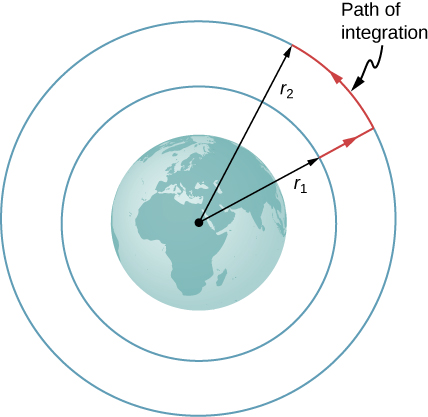
Consider Figure 13.12, in which we take m from a distance from Earth’s center to a distance that is from the center. Gravity is a conservative force (its magnitude and direction are functions of location only), so we can take any path we wish, and the result for the calculation of work is the same. We take the path shown, as it greatly simplifies the integration. We first move radially outward from distance to distance , and then move along the arc of a circle until we reach the final position. During the radial portion, is opposite to the direction we travel along , so Along the arc, is perpendicular to , so . No work is done as we move along the arc. Using the expression for the gravitational force and noting the values for along the two segments of our path, we have
英語のヒント
図13.12を考えよう。質量mを、地球の中心からの距離の位置から、距離の位置へ移動させる。重力は保存力であり、その大きさと向きは位置だけで決まる。そのため、どの経路を取っても仕事の計算結果は同じになる。ここでは積分を大幅に簡単にするため、図の経路を取る。まず距離から距離まで半径方向の外向きに動き、次に円弧に沿って最終位置まで移動する。半径方向の部分では、は移動方向と逆向きなので、となる。円弧に沿う部分ではとが垂直なので、となる。円弧に沿って動く間には仕事はされない。重力の式を用い、経路の二つの部分におけるの値に注意すると、次のようになる。
Since , we can adopt a simple expression for :
英語のヒント
なので、には次の単純な式を採用できる。
OpenStax / Rice University, University Physics Volume 1, CC BY 4.0. Source-book artwork retained. · CC BY 4.0 · Source出典

Figure 13.12図 13.12
The work integral, which determines the change in potential energy, can be evaluated along the path shown in red.
英語のヒント
位置エネルギーの変化を決める仕事の積分は、赤で示した経路に沿って計算できる。
Note two important items with this definition. First, . The potential energy is zero when the two masses are infinitely far apart. Only the difference in U is important, so the choice of is merely one of convenience. (Recall that in earlier gravity problems, you were free to take at the top or bottom of a building, or anywhere.) Second, note that U becomes increasingly more negative as the masses get closer. That is consistent with what you learned about potential energy in Potential Energy and Conservation of Energy. As the two masses are separated, positive work must be done against the force of gravity, and hence, U increases (becomes less negative). All masses naturally fall together under the influence of gravity, falling from a higher to a lower potential energy.
英語のヒント
この定義について、重要な点を二つ挙げる。第1に、である。二つの質量が無限に遠く離れたとき、位置エネルギーはゼロになる。重要なのはUの差だけなので、という選択は単に便利さのためである。以前の重力の問題では、建物の上端でも下端でも、ほかのどこでもとしてよかったことを思い出そう。第2に、質量どうしが近づくほど、Uはより大きな負の値になる。これは「位置エネルギーとエネルギー保存」で学んだことと一致する。二つの質量を引き離すときには、重力に逆らって正の仕事をしなければならず、そのためUは増加する(負の大きさが小さくなる)。すべての質量は、重力の作用によって自然に近づく方向へ落下し、高い位置エネルギーから低い位置エネルギーへ移る。
Example 13.6例題 13.6
Lifting a Payload積載機体を持ち上げる
How much energy is required to lift the 9000-kg Soyuz vehicle from Earth’s surface to the height of the ISS, 400 km above the surface?
英語のヒント
質量9000 kgのソユーズの機体を、地表からISSの高度である400 km上空まで持ち上げるには、どれだけのエネルギーが必要か。
Strategy方針
Use Equation 13.2 to find the change in potential energy of the payload. That amount of work or energy must be supplied to lift the payload.
英語のヒント
式13.2を用いて積載機体の位置エネルギーの変化を求める。機体を持ち上げるには、その量の仕事またはエネルギーを供給しなければならない。
Solution解答
Paying attention to the fact that we start at Earth’s surface and end at 400 km above the surface, the change in U is
英語のヒント
出発点が地表であり、終点が地表の400 km上空であることに注意すると、Uの変化は次のようになる。
We insert the values
英語のヒント
次の値を代入する。
and convert 400 km into . We find . It is positive, indicating an increase in potential energy, as we would expect.
英語のヒント
また、400 kmをに換算する。計算するととなる。予想どおり正の値であり、位置エネルギーの増加を示している。
Significance考察
For perspective, consider that the average US household energy use in 2013 was 909 kWh per month. That is energy of
英語のヒント
規模をつかむため、2013年の米国の平均的な家庭のエネルギー使用量が月909 kWhだったことを考えよう。これは次のエネルギーに相当する。
So our result is an energy expenditure equivalent to 10 months. But this is just the energy needed to raise the payload 400 km. If we want the Soyuz to be in orbit so it can rendezvous with the ISS and not just fall back to Earth, it needs a lot of kinetic energy. As we see in the next section, that kinetic energy is about five times that of . In addition, far more energy is expended lifting the propulsion system itself. Space travel is not cheap.
英語のヒント
したがって、得られた結果は家庭の10か月分のエネルギー消費に相当する。しかし、これは積載機体を400 km持ち上げるだけのエネルギーである。ソユーズが単に地球へ落ち戻るのではなく、ISSとランデブーできる軌道に入るには、多くの運動エネルギーが必要になる。次の節で見るように、その運動エネルギーはの約5倍である。さらに、推進系そのものを持ち上げるには、はるかに多くのエネルギーが費やされる。宇宙旅行は安くない。