第14章流体力学
Density密度
Suppose a block of brass and a block of wood have exactly the same mass. If both blocks are dropped in a tank of water, why does the wood float and the brass sink (Figure 14.3)? This occurs because the brass has a greater density than water, whereas the wood has a lower density than water.
英語のヒント
真鍮の塊と木の塊が、まったく同じ質量を持つとしよう。両方を水槽へ落とすと、なぜ木は浮かび、真鍮は沈むのだろうか(図14.3)。これは、真鍮の密度は水より大きく、木の密度は水より小さいためである。
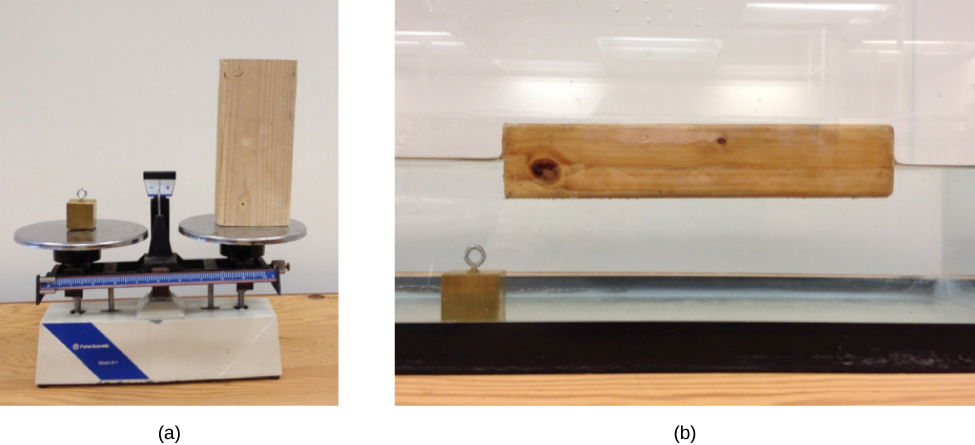
(credit: modification of works by Joseph J. Trout, Stockton University) OpenStax University Physics Volume 1, CC BY 4.0. · CC BY 4.0 · Source出典

Figure 14.3図 14.3
(a) A block of brass and a block of wood both have the same weight and mass, but the block of wood has a much greater volume. (b) When placed in a fish tank filled with water, the cube of brass sinks and the block of wood floats. (The block of wood is the same in both pictures; it was turned on its side to fit on the scale.) (credit: modification of works by Joseph J. Trout, Stockton University)
英語のヒント
(a) 真鍮の塊と木の塊は、重さも質量も同じだが、木のほうが体積ははるかに大きい。(b) 水を満たした水槽に入れると、真鍮の立方体は沈み、木の塊は浮く。(二つの写真の木の塊は同じもので、はかりに載るよう横向きにしてある。)(クレジット:Joseph J. Trout、Stockton Universityの作品を改変)
Density is an important characteristic of substances. It is crucial, for example, in determining whether an object sinks or floats in a fluid.
英語のヒント
密度は物質の重要な特性である。例えば、物体が流体に沈むか浮かぶかを決める際に欠かせない。
The SI unit of density is . Table 14.1 lists some representative values. The cgs unit of density is the gram per cubic centimeter, , where
英語のヒント
密度のSI単位はである。表14.1に代表的な値を示す。cgs単位系では、密度の単位は1立方センチメートルあたりのグラム、で、次の関係がある。
The metric system was originally devised so that water would have a density of , equivalent to . Thus, the basic mass unit, the kilogram, was first devised to be the mass of 1000 mL of water, which has a volume of .
英語のヒント
メートル法はもともと、水の密度が、すなわちとなるように考案された。そのため、質量の基本単位であるキログラムは、最初は体積に当たる1000 mLの水の質量として定められた。
Solids () 固体() |
Liquids () 液体() |
Gases ( 101.3 kPa) 気体(、101.3 kPa) |
|||
|---|---|---|---|---|---|
Substance 物質 |
Substance 物質 |
Substance 物質 |
|||
Aluminum アルミニウム |
Benzene ベンゼン |
Air 空気 |
|||
Bone 骨 |
Blood 血液 |
Carbon dioxide 二酸化炭素 |
|||
Brass 真鍮 |
Ethyl alcohol エチルアルコール |
Carbon monoxide 一酸化炭素 |
|||
Concrete コンクリート |
Gasoline ガソリン |
Helium ヘリウム |
|||
Copper 銅 |
Glycerin グリセリン |
Hydrogen 水素 |
|||
Cork コルク |
Mercury 水銀 |
Methane メタン |
|||
Earth’s crust 地殻 |
Olive oil オリーブ油 |
Nitrogen 窒素 |
|||
Glass ガラス |
Nitrous oxide 亜酸化窒素 |
||||
Gold 金 |
Oxygen 酸素 |
||||
Granite 花崗岩 |
|||||
Iron 鉄 |
|||||
Lead 鉛 |
|||||
Oak オーク材 |
|||||
Pine マツ材 |
|||||
Platinum 白金 |
|||||
Polystyrene ポリスチレン |
|||||
Tungsten タングステン |
|||||
Uranium ウラン |
|||||
As you can see by examining Table 14.1, the density of an object may help identify its composition. The density of gold, for example, is about 2.5 times the density of iron, which is about 2.5 times the density of aluminum. Density also reveals something about the phase of the matter and its substructure. Notice that the densities of liquids and solids are roughly comparable, consistent with the fact that their atoms are in close contact. The densities of gases are much less than those of liquids and solids, because the atoms in gases are separated by large amounts of empty space. The gases are displayed for a standard temperature of and a standard pressure of 101.3 kPa, and there is a strong dependence of the densities on temperature and pressure. The densities of the solids and liquids displayed are given for the standard temperature of and the densities of solids and liquids depend on the temperature. The density of solids and liquids normally increase with decreasing temperature.
英語のヒント
表14.1を見ると分かるように、物体の密度は、その組成の判別に役立つことがある。例えば金の密度は鉄の約2.5倍で、鉄の密度はアルミニウムの約2.5倍である。密度は、物質の相や、その内部構造についても何かを示す。液体と固体の密度はおおよそ同程度であることに注意しよう。これは、原子が互いに密接していることと一致する。気体の密度は液体や固体よりはるかに小さい。気体の原子間には、大きな空の空間があるためである。気体については標準温度、標準圧力101.3 kPaでの値を示してあり、その密度は温度と圧力に強く依存する。固体と液体は標準温度での値で、その密度は温度に依存する。通常、固体と液体の密度は温度が下がると大きくなる。
Table 14.2 shows the density of water in various phases and temperature. The density of water increases with decreasing temperature, reaching a maximum at and then decreases as the temperature falls below . This behavior of the density of water explains why ice forms at the top of a body of water.
英語のヒント
表14.2に、水のさまざまな相と温度における密度を示す。水の密度は温度の低下とともに増加し、で最大となる。その後、温度がを下回ると減少する。この密度の振る舞いによって、水域の上部で氷ができる理由を説明できる。
Substance 物質 |
|
|---|---|
Ice 氷 |
|
Water 水 |
|
Water 水 |
|
Water 水 |
|
Water 水 |
|
Steam 水蒸気 |
|
Sea water 海水 |
The density of a substance is not necessarily constant throughout the volume of a substance. If the density is constant throughout a substance, the substance is said to be a homogeneous substance. A solid iron bar is an example of a homogeneous substance. The density is constant throughout, and the density of any sample of the substance is the same as its average density. If the density of a substance were not constant, the substance is said to be a heterogeneous substance. A chunk of Swiss cheese is an example of a heterogeneous material containing both the solid cheese and gas-filled voids. The density at a specific location within a heterogeneous material is called local density, and is given as a function of location, (Figure 14.4).
英語のヒント
物質の密度は、その体積全体にわたって必ずしも一定ではない。物質全体で密度が一定なら、その物質を均質という。中まで詰まった鉄の棒は、均質な物質の一例である。全体にわたって密度が一定なので、どの部分を取り出しても、その密度は平均密度と同じになる。密度が一定でなければ、その物質を不均質という。スイスチーズの塊は、固体のチーズと気体で満たされた穴を含む、不均質な物質の例である。不均質な物質の特定の場所の密度を局所密度と呼び、位置の関数として与える(図14.4)。
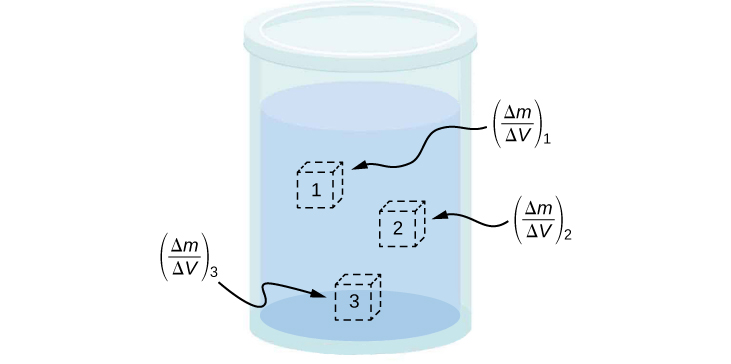
OpenStax / Rice University, University Physics Volume 1, CC BY 4.0. Source-book artwork retained. · CC BY 4.0 · Source出典

Figure 14.4図 14.4
Density may vary throughout a heterogeneous mixture. Local density at a point is obtained from dividing mass by volume in a small volume around a given point.
英語のヒント
不均質な混合物では、密度は場所によって変わり得る。ある点の局所密度は、その点の周囲の小さな体積について、質量を体積で割ることで得られる。
Local density can be obtained by a limiting process, based on the average density in a small volume around the point in question, taking the limit where the size of the volume approaches zero,
英語のヒント
局所密度は、考えている点の周囲の小さな体積の平均密度に基づき、その体積をゼロへ近づける極限操作によって求められる。
where is the density, m is the mass, and V is the volume.
英語のヒント
ここで、は密度、mは質量、Vは体積である。
Since gases are free to expand and contract, the densities of the gases vary considerably with temperature, whereas the densities of liquids vary little with temperature. Therefore, the densities of liquids are often treated as constant, with the density equal to the average density.
英語のヒント
気体は自由に膨張・収縮できるため、その密度は温度によって大きく変わる。一方、液体の密度は温度であまり変わらない。このため、液体の密度は平均密度に等しい一定値として扱うことが多い。
Density is a dimensional property; therefore, when comparing the densities of two substances, the units must be taken into consideration. For this reason, a more convenient, dimensionless quantity called the specific gravity is often used to compare densities. Specific gravity is defined as the ratio of the density of the material to the density of water at and one atmosphere of pressure, which is :
英語のヒント
密度は次元を持つ量なので、二つの物質の密度を比べるときには、単位を考慮しなければならない。このため、密度の比較には、比重という便利な無次元量を使うことが多い。比重は、物質の密度と、温度、圧力1気圧での水の密度との比として定義される。
The comparison uses water because the density of water is , which was originally used to define the kilogram. Specific gravity, being dimensionless, provides a ready comparison among materials without having to worry about the unit of density. For instance, the density of aluminum is 2.7 in (2700 in ), but its specific gravity is 2.7, regardless of the unit of density. Specific gravity is a particularly useful quantity with regard to buoyancy, which we will discuss later in this chapter.
英語のヒント
比較の基準に水を用いるのは、水の密度がであり、もともとキログラムの定義に使われたためである。比重は無次元なので、密度の単位を気にせず、物質どうしをすぐに比較できる。例えばアルミニウムの密度は、なら2.7、なら2700だが、比重は密度の単位に関係なく2.7である。比重は、この章の後で述べる浮力に関して、特に便利な量となる。