第14章流体力学
Flow and Resistance as Causes of Pressure Drops流れと抵抗によって生じる圧力低下
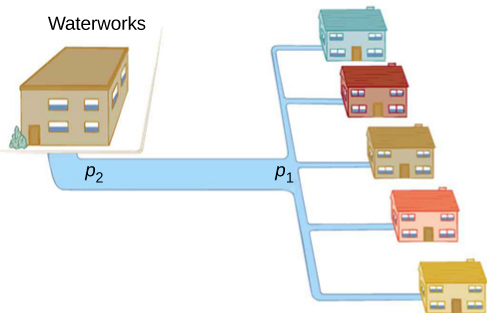
Water pressure in homes is sometimes lower than normal during times of heavy use, such as hot summer days. The drop in pressure occurs in the water main before it reaches individual homes. Let us consider flow through the water main as illustrated in Figure 14.39. We can understand why the pressure to the home drops during times of heavy use by rearranging the equation for flow rate:
英語のヒント
暑い夏の日など、水の使用量が多いときには、家庭の水圧が普段より低くなることがある。圧力は各家庭に届く前に、水道本管で低下する。図14.39のような本管内の流れを考えよう。流量の式を変形すると、使用量が多いときに家庭へ供給される圧力が下がる理由が分かる。
In this case, is the pressure at the water works and R is the resistance of the water main. During times of heavy use, the flow rate Q is large. This means that must also be large. Thus must decrease. It is correct to think of flow and resistance as causing the pressure to drop from to . The equation is valid for both laminar and turbulent flows.
英語のヒント
ここで、は水道施設での圧力、Rは水道本管の抵抗である。使用量が多いときには流量Qが大きい。そのため、も大きくなければならず、は低下する。流れと抵抗によって、圧力がからへ下がると考えてよい。式は、層流にも乱流にも成り立つ。
OpenStax / Rice University, University Physics Volume 1, CC BY 4.0. Source-book artwork retained. · CC BY 4.0 · Source出典

Figure 14.39図 14.39
During times of heavy use, there is a significant pressure drop in a water main, and supplied to users is significantly less than created at the water works. If the flow is very small, then the pressure drop is negligible, and .
英語のヒント
使用量が多いときには水道本管で大きな圧力低下が起こり、利用者へ供給されるは、水道施設で生じるよりかなり小さい。流量が非常に少なければ圧力低下は無視でき、となる。
We can also use to analyze pressure drops occurring in more complex systems in which the tube radius is not the same everywhere. Resistance is much greater in narrow places, such as in an obstructed coronary artery. For a given flow rate Q, the pressure drop is greatest where the tube is most narrow. This is how water faucets control flow. Additionally, R is greatly increased by turbulence, and a constriction that creates turbulence greatly reduces the pressure downstream. Plaque in an artery reduces pressure and hence flow, both by its resistance and by the turbulence it creates.
英語のヒント
は、管の半径が場所によって異なる、より複雑な系の圧力低下の解析にも使える。閉塞した冠動脈のような狭い場所では、抵抗がはるかに大きい。流量Qが与えられたとき、圧力低下は管が最も狭い場所で最大となる。水道の蛇口は、この仕組みで流量を調節する。また、乱流によってRは大きく増加するため、乱流を生む狭窄部は下流の圧力を大きく下げる。動脈のプラークは、それ自体の抵抗と、それが生む乱流の両方によって圧力を下げ、結果として血流も減らす。
Measuring Turbulence乱流を判定する
An indicator called the Reynolds number can reveal whether flow is laminar or turbulent. For flow in a tube of uniform diameter, the Reynolds number is defined as
英語のヒント
レイノルズ数という指標を使うと、流れが層流か乱流かを判定できる。直径が一様な管内の流れでは、レイノルズ数を次のように定義する。
where is the fluid density, v its speed, its viscosity, and r the tube radius. The Reynolds number is a dimensionless quantity. Experiments have revealed that is related to the onset of turbulence. For below about 2000, flow is laminar. For above about 3000, flow is turbulent.
英語のヒント
ここで、は流体の密度、vは速さ、は粘性、rは管の半径である。レイノルズ数は無次元量である。実験によって、が乱流の発生に関係することが分かっている。が約2000より小さいと層流、が約3000より大きいと乱流になる。
For values of between about 2000 and 3000, flow is unstable—that is, it can be laminar, but small obstructions and surface roughness can make it turbulent, and it may oscillate randomly between being laminar and turbulent. In fact, the flow of a fluid with a Reynolds number between 2000 and 3000 is a good example of chaotic behavior. A system is defined to be chaotic when its behavior is so sensitive to some factor that it is extremely difficult to predict. It is difficult, but not impossible, to predict whether flow is turbulent or not when a fluid’s Reynold’s number falls in this range due to extremely sensitive dependence on factors like roughness and obstructions on the nature of the flow. A tiny variation in one factor has an exaggerated (or nonlinear) effect on the flow.
英語のヒント
が約2000から3000の間にあると、流れは不安定となる。層流にもなるが、小さな障害物や表面の粗さによって乱流に変わり、層流と乱流を不規則に行き来することもある。実際、この範囲のレイノルズ数を持つ流れは、カオス的な振る舞いのよい例である。ある要因に極めて敏感で、振る舞いの予測が非常に難しい系を、カオス的と定義する。流体のレイノルズ数がこの範囲に入ると、流れの性質が粗さや障害物などに極めて敏感に依存するため、乱流になるかどうかの予測は、不可能ではないものの難しい。一つの要因のごく小さな変化が、流れに大きく増幅された、すなわち非線形な影響を与える。
Example 14.9例題 14.9
Using Flow Rate: Turbulent Flow or Laminar Flow流量の活用:乱流か層流か
In Example 14.8, we found the volume flow rate of an air conditioning system to be This calculation assumed laminar flow. (a) Was this a good assumption? (b) At what velocity would the flow become turbulent?
英語のヒント
例題14.8では、空調システムの体積流量をと求めた。この計算は層流を仮定していた。(a) この仮定は適切だったか。(b) どの速度になると乱流になるか。
Strategy方針
To determine if the flow of air through the air conditioning system is laminar, we first need to find the velocity, which can be found by
英語のヒント
空調システム内の空気の流れが層流かどうかを判定するには、まず速度を求める必要がある。速度は次の式から得られる。
Then we can calculate the Reynold’s number, using the equation below, and determine if it falls in the range for laminar flow
英語のヒント
次に、以下の式でレイノルズ数を計算し、層流の範囲に入るかどうかを判定できる。
Solution解答
- Using the values given:
英語のヒント
与えられた値を使う。Since the Reynolds number is 1835 < 2000, the flow is laminar and not turbulent. The assumption that the flow was laminar is valid.英語のヒント
レイノルズ数は1835 < 2000なので、流れは乱流ではなく層流である。層流という仮定は妥当だった。 - To find the maximum speed of the air to keep the flow laminar, consider the Reynold’s number.
英語のヒント
層流を維持できる空気の最大の速さを求めるため、レイノルズ数を考える。
Significance考察
When transferring a fluid from one point to another, it desirable to limit turbulence. Turbulence results in wasted energy, as some of the energy intended to move the fluid is dissipated when eddies are formed. In this case, the air conditioning system will become less efficient once the velocity exceeds 0.16 m/s, since this is the point at which turbulence will begin to occur.
英語のヒント
流体をある点から別の点へ送るときは、乱流を抑えることが望ましい。渦ができると、流体を動かすためのエネルギーの一部が散逸するため、乱流はエネルギーの浪費を生む。この場合、速度が0.16 m/sを超えると乱流が発生し始めるので、空調システムの効率が下がる。