第14章流体力学
Problems問題
Exercises 78–85練習問題 78–85
Exercise 78問題 78
Verify that pressure has units of energy per unit volume.
英語のヒント
圧力の単位が、単位体積当たりのエネルギーの単位に一致することを確かめよ。
Solution解き方
Exercise 79問題 79
Suppose you have a wind speed gauge like the pitot tube shown in Figure 14.32. By what factor must wind speed increase to double the value of h in the manometer? Is this independent of the moving fluid and the fluid in the manometer?
英語のヒント
図14.32のピトー管のような風速計があるとする。マノメーターのhを2倍にするには、風速を何倍にする必要があるか。この倍率は、流れている流体とマノメーター内の流体によらず同じか。
Exercise 80問題 80
If the pressure reading of your pitot tube is 15.0 mm Hg at a speed of 200 km/h, what will it be at 700 km/h at the same altitude?
英語のヒント
風速200 km/hでピトー管の圧力の指示値が15.0 mmHgなら、同じ高度で風速700 km/hになったときの指示値はいくらか。
Solution解き方
−135 mm Hg
Exercise 81問題 81
Every few years, winds in Boulder, Colorado, attain sustained speeds of 45.0 m/s (about 100 mph) when the jet stream descends during early spring. Approximately what is the force due to the Bernoulli equation on a roof having an area of ? Typical air density in Boulder is , and the corresponding atmospheric pressure is . (Bernoulli’s principle as stated in the text assumes laminar flow. Using the principle here produces only an approximate result, because there is significant turbulence.)
英語のヒント
コロラド州ボルダーでは数年に一度、春先にジェット気流が下降し、45.0 m/s(約100 mph)の風が持続する。面積の屋根に、ベルヌーイの式によってどの程度の力が働くか。ボルダーの典型的な空気密度は、対応する大気圧はである。(本文に示したベルヌーイの原理は層流を仮定する。ここでは大きな乱流があるため、この原理から得られるのは近似的な結果にとどまる。)
Exercise 82問題 82
What is the pressure drop due to the Bernoulli Effect as water goes into a 3.00-cm-diameter nozzle from a 9.00-cm-diameter fire hose while carrying a flow of 40.0 L/s? (b) To what maximum height above the nozzle can this water rise? (The actual height will be significantly smaller due to air resistance.)
英語のヒント
毎秒40.0 Lの水が、直径9.00 cmの消防ホースから直径3.00 cmのノズルへ流れ込むとき、ベルヌーイ効果による圧力低下はいくらか。(b) この水はノズルより最大でどの高さまで上昇できるか。(実際の高さは、空気抵抗のためかなり低くなる。)
Solution解き方
a. ; b. 163 m
a. ;b. 163 m
Exercise 83問題 83
(a) Using Bernoulli’s equation, show that the measured fluid speed v for a pitot tube, like the one in Figure 14.32(b), is given by , where h is the height of the manometer fluid, is the density of the manometer fluid, is the density of the moving fluid, and g is the acceleration due to gravity. (Note that v is indeed proportional to the square root of h, as stated in the text.) (b) Calculate v for moving air if a mercury manometer’s h is 0.200 m.
英語のヒント
(a) ベルヌーイの式を使い、図14.32(b)のようなピトー管で測る流体の速さvが、で与えられることを示せ。ここでhはマノメーター内の液柱の高さ、はマノメーター内の流体の密度、は流れている流体の密度、gは重力加速度である。(本文で述べたとおり、vが実際にhの平方根に比例することに注意せよ。)(b) 流れる空気を測る水銀マノメーターでhが0.200 mのとき、vを計算せよ。
Exercise 84問題 84
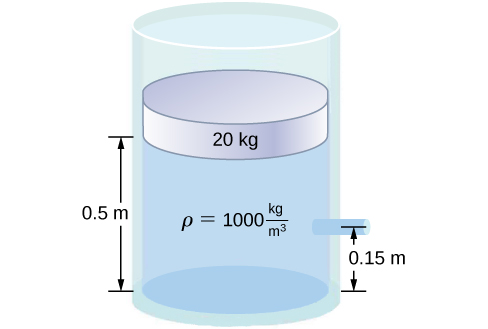
A container of water has a cross-sectional area of . A piston sits on top of the water (see the following figure). There is a spout located 0.15 m from the bottom of the tank, open to the atmosphere, and a stream of water exits the spout. The cross sectional area of the spout is . (a) What is the velocity of the water as it leaves the spout? (b) If the opening of the spout is located 1.5 m above the ground, how far from the spout does the water hit the floor? Ignore all friction and dissipative forces.
英語のヒント
水を入れた容器の断面積はである。水面にはピストンが載っている(次の図)。容器の底から0.15 mの位置に大気へ開いた注ぎ口があり、水が流れ出している。注ぎ口の断面積はである。(a) 注ぎ口を出る水の速度はいくらか。(b) 注ぎ口が地面から1.5 mの高さにあるとき、水は注ぎ口から水平にどれだけ離れた位置で床に当たるか。すべての摩擦力と散逸力を無視せよ。
Solution解き方
a. ;
b.
b.
a. ;b. 、
Exercise 85問題 85
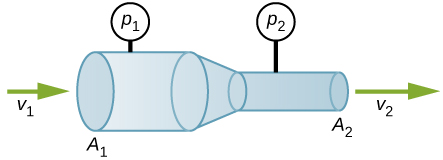
A fluid of a constant density flows through a reduction in a pipe. Find an equation for the change in pressure, in terms of , and the density.
英語のヒント
密度が一定の流体が、細くなる管の中を流れる。と密度を用いて、圧力変化の式を求めよ。


Bernoulli’s equation
ベルヌーイの式
equation resulting from applying conservation of energy to an incompressible frictionless fluid: throughout the fluid
英語のヒント
非圧縮性で摩擦のない流体にエネルギー保存を適用して得られる式。流体全体でとなる。
Bernoulli’s principle
ベルヌーイの原理
Bernoulli’s equation applied at constant depth:
英語のヒント
深さが一定の場合に適用したベルヌーイの式。