第14章流体力学
14.3 Pascal's Principle and Hydraulics14.3 パスカルの原理と液圧装置
Learning Objectives学習目標
Learning Objectives学習目標
By the end of this section, you will be able to:
英語のヒント
この節を終えると、次のことができるようになる。
- State Pascal’s principle
英語のヒント
パスカルの原理を述べる。 - Describe applications of Pascal’s principle
英語のヒント
パスカルの原理の応用を説明する。 - Derive relationships between forces in a hydraulic system
英語のヒント
液圧装置における力どうしの関係を導く。
In 1653, the French philosopher and scientist Blaise Pascal published his Treatise on the Equilibrium of Liquids, in which he discussed principles of static fluids. A static fluid is a fluid that is not in motion. When a fluid is not flowing, we say that the fluid is in static equilibrium. If the fluid is water, we say it is in hydrostatic equilibrium. For a fluid in static equilibrium, the net force on any part of the fluid must be zero; otherwise the fluid will start to flow.
英語のヒント
1653年、フランスの哲学者・科学者ブレーズ・パスカルは『液体の平衡についての論考』を発表し、その中で静止流体の原理を論じた。静止流体とは、動いていない流体である。流体が流れていないとき、静的平衡にあるという。流体が水なら、静水圧平衡にあるという。静的平衡の流体では、そのどの部分に働く合力もゼロでなければならない。そうでなければ、流体は流れ始める。
Pascal’s observations—since proven experimentally—provide the foundation for hydraulics, one of the most important developments in modern mechanical technology. Pascal observed that a change in pressure applied to an enclosed fluid is transmitted undiminished throughout the fluid and to the walls of its container. Because of this, we often know more about pressure than other physical quantities in fluids. Moreover, Pascal’s principle implies that the total pressure in a fluid is the sum of the pressures from different sources. A good example is the fluid at a depth depends on the depth of the fluid and the pressure of the atmosphere.
英語のヒント
パスカルの観察は、その後実験で証明され、現代の機械技術で特に重要な発展の一つである液圧技術の基礎となった。パスカルは、閉じ込めた流体に加えた圧力の変化が、弱まることなく流体全体と容器の壁へ伝わることを見いだした。このため、流体の圧力については、ほかの物理量より多くのことが分かる場合が多い。さらに、パスカルの原理から、流体内の全圧力は異なる源からの圧力の和であることが分かる。ある深さの流体の圧力が、その深さと大気圧に依存することがよい例である。
Pascal’s Principleパスカルの原理
Pascal’s principle (also known as Pascal’s law) states that when a change in pressure is applied to an enclosed fluid, it is transmitted undiminished to all portions of the fluid and to the walls of its container. In an enclosed fluid, since atoms of the fluid are free to move about, they transmit pressure to all parts of the fluid and to the walls of the container. Any change in pressure is transmitted undiminished.
英語のヒント
パスカルの原理(パスカルの法則ともいう)は、閉じ込めた流体に加えた圧力の変化が、弱まることなく流体のすべての部分と容器の壁へ伝わることを述べる。閉じた流体中の原子は自由に動けるため、流体全体と容器の壁へ圧力を伝える。圧力の変化は、そのままの大きさで伝わる。
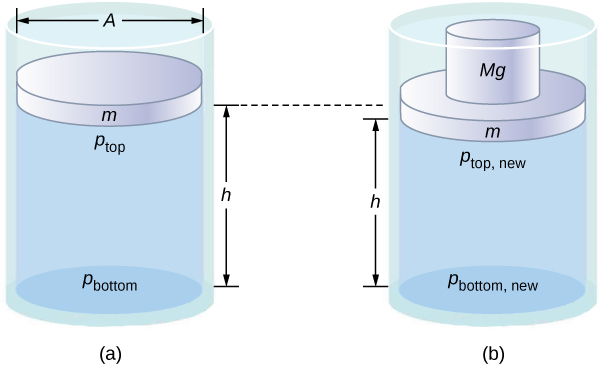
Note that this principle does not say that the pressure is the same at all points of a fluid—which is not true, since the pressure in a fluid near Earth varies with height. Rather, this principle applies to the change in pressure. Suppose you place some water in a cylindrical container of height H and cross-sectional area A that has a movable piston of mass m (Figure 14.15). Adding weight Mg at the top of the piston increases the pressure at the top by Mg/A, since the additional weight also acts over area A of the lid:
英語のヒント
この原理は、流体のどの点でも圧力が同じだと言っているわけではないことに注意しよう。地球付近の流体の圧力は高さによって変わるので、それは正しくない。原理が扱うのは、圧力の変化である。高さH、断面積Aの円筒容器に水を入れ、質量mの動くピストンを置くとする(図14.15)。ピストンの上へ重さMgのおもりを加えると、流体上面の圧力はMg/Aだけ増す。加えた重さも、ふたの面積Aに作用するためである。
OpenStax / Rice University, University Physics Volume 1, CC BY 4.0. Source-book artwork retained. · CC BY 4.0 · Source出典

Figure 14.15図 14.15
Pressure in a fluid changes when the fluid is compressed. (a) The pressure at the top layer of the fluid is different from pressure at the bottom layer. (b) The increase in pressure by adding weight to the piston is the same everywhere, for example, .
英語のヒント
流体を圧縮すると圧力が変わる。(a) 流体の最上層の圧力は、最下層の圧力と異なる。(b) ピストンにおもりを加えて生じる圧力の増加は、どこでも同じである。例えば、となる。
According to Pascal’s principle, the pressure at all points in the water changes by the same amount, Mg/A. Thus, the pressure at the bottom also increases by Mg/A. The pressure at the bottom of the container is equal to the sum of the atmospheric pressure, the pressure due to the fluid, and the pressure supplied by the mass. The change in pressure at the bottom of the container due to the mass is
英語のヒント
パスカルの原理によれば、水中のすべての点の圧力は、同じMg/Aだけ変わる。したがって、底の圧力もMg/Aだけ増加する。容器の底の圧力は、大気圧、流体による圧力、おもりによる圧力の和に等しい。おもりによる底の圧力の変化は、次のようになる。
Since the pressure changes are the same everywhere in the fluid, we no longer need subscripts to designate the pressure change for top or bottom:
英語のヒント
圧力の変化は流体中のどこでも同じなので、上面か下面かを指定する添字は、もはや必要ない。
Additional Resources追加教材
Applications of Pascal’s Principle and Hydraulic Systemsパスカルの原理と液圧装置の応用
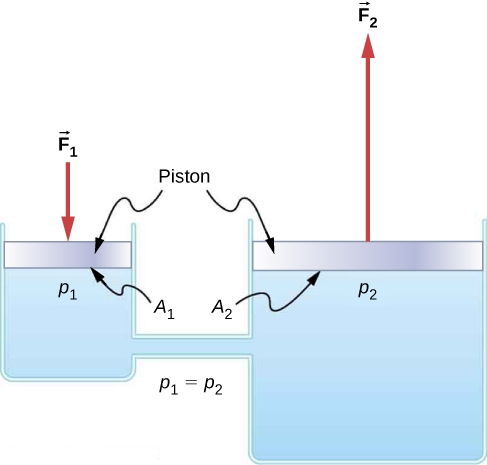
Hydraulic systems are used to operate automotive brakes, hydraulic jacks, and numerous other mechanical systems (Figure 14.16).
英語のヒント
液圧装置は、自動車のブレーキ、油圧ジャッキ、その他多くの機械装置を動かすために使われる(図14.16)。
OpenStax / Rice University, University Physics Volume 1, CC BY 4.0. Source-book artwork retained. · CC BY 4.0 · Source出典

Figure 14.16図 14.16
A typical hydraulic system with two fluid-filled cylinders, capped with pistons and connected by a tube called a hydraulic line. A downward force on the left piston creates a change in pressure that is transmitted undiminished to all parts of the enclosed fluid. This results in an upward force on the right piston that is larger than because the right piston has a larger surface area.
英語のヒント
典型的な液圧装置。流体を満たした二つのシリンダーを、液圧配管と呼ぶ管でつなぎ、それぞれにピストンを付ける。左ピストンへの下向きの力が圧力を変化させ、その変化は閉じた流体全体へ弱まらずに伝わる。このため、右ピストンには上向きの力が生じる。右ピストンは面積が大きいので、この力はより大きい。
We can derive a relationship between the forces in this simple hydraulic system by applying Pascal’s principle. Note first that the two pistons in the system are at the same height, so there is no difference in pressure due to a difference in depth. The pressure due to acting on area is simply
英語のヒント
パスカルの原理を使えば、この単純な液圧装置での力の関係を導ける。まず、二つのピストンは同じ高さにあり、深さの違いによる圧力差はないことに注意しよう。面積に働くによる圧力は、単純に次のようになる。
According to Pascal’s principle, this pressure is transmitted undiminished throughout the fluid and to all walls of the container. Thus, a pressure is felt at the other piston that is equal to . That is, However, since we see that
英語のヒント
パスカルの原理によれば、この圧力は弱まらず、流体全体と容器のすべての壁へ伝わる。したがって、もう一方のピストンには、に等しい圧力が加わる。すなわち、である。一方、なので、次のことが分かる。
This equation relates the ratios of force to area in any hydraulic system, provided that the pistons are at the same vertical height and that friction in the system is negligible.
英語のヒント
この式は、ピストンが同じ鉛直方向の高さにあり、装置の摩擦を無視できるなら、どの液圧装置でも力と面積の比を関係付ける。
Hydraulic systems can increase or decrease the force applied to them. To make the force larger, the pressure is applied to a larger area. For example, if a 100-N force is applied to the left cylinder in Figure 14.16 and the right cylinder has an area five times greater, then the output force is 500 N. Hydraulic systems are analogous to simple levers, but they have the advantage that pressure can be sent through tortuously curved lines to several places at once.
英語のヒント
液圧装置は、加えた力を大きくすることも小さくすることもできる。力を大きくするには、圧力をより広い面積へ加える。例えば図14.16で、左シリンダーに100 Nを加え、右シリンダーの面積が5倍なら、出力は500 Nになる。液圧装置は単純なてこに似ているが、複雑に曲がった配管を通して、複数の場所へ同時に圧力を送れる利点がある。
The hydraulic jack is such a hydraulic system. A hydraulic jack is used to lift heavy loads, such as the ones used by auto mechanics to raise an automobile. It consists of an incompressible fluid in a U-tube fitted with a movable piston on each side. One side of the U-tube is narrower than the other. A small force applied over a small area can balance a much larger force on the other side over a larger area (Figure 14.17).
英語のヒント
油圧ジャッキは、そのような液圧装置の一つである。重い荷物を持ち上げるために使い、自動車整備士が車を上げる装置がその例となる。圧縮できない流体をU字管へ入れ、両側に動くピストンを取り付ける。U字管の一方は、もう一方より細い。小さな面積へ加えた小さな力が、反対側の大きな面積に働く、はるかに大きな力とつり合う(図14.17)。
Image omitted because its reuse rights could not be verified.権利の確認ができないため画像を割愛。
Figure 14.17図 14.17
(a) A hydraulic jack operates by applying forces to an incompressible fluid in a U-tube, using a movable piston on each side of the tube. (b) Hydraulic jacks are commonly used by car mechanics to lift vehicles so that repairs and maintenance can be performed. (credit b: modification of work by Jane Whitney)
英語のヒント
(a) 油圧ジャッキは、U字管の両側にある可動ピストンを使い、圧縮できない流体へ力を加えて動作する。(b) 自動車整備士は、修理や整備ができるよう車を持ち上げるために、油圧ジャッキをよく使う。((b)のクレジット:Jane Whitneyの作品を改変)
From Pascal’s principle, it can be shown that the force needed to lift the car is less than the weight of the car:
英語のヒント
パスカルの原理から、車を持ち上げるのに必要な力は、車の重さより小さいことを示せる。
where is the force applied to lift the car, is the cross-sectional area of the smaller piston, is the cross sectional area of the larger piston, and is the weight of the car.
英語のヒント
ここで、は車を持ち上げるために加える力、は小ピストンの断面積、は大ピストンの断面積、は車の重さである。
Example 14.3例題 14.3
Calculating Force on Wheel Cylinders: Pascal Puts on the Brakesホイールシリンダーの力の計算:パスカルがブレーキをかける
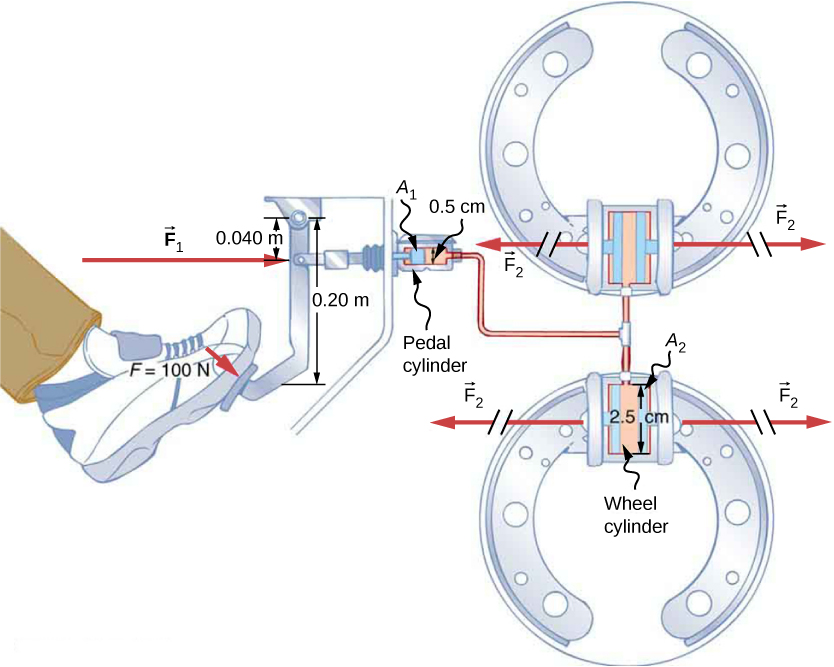
Consider the automobile hydraulic system shown in Figure 14.18. Suppose a force of 100 N is applied to the brake pedal, which acts on the pedal cylinder (acting as a “master” cylinder) through a lever. A force of 500 N is exerted on the pedal cylinder. Pressure created in the pedal cylinder is transmitted to the four wheel cylinders. The pedal cylinder has a diameter of 0.500 cm and each wheel cylinder has a diameter of 2.50 cm. Calculate the magnitude of the force created at each of the wheel cylinders.
英語のヒント
図14.18の自動車の液圧装置を考えよう。ブレーキペダルに100 Nの力を加えると、てこを介して、マスターシリンダーとして働くペダルシリンダーへ作用する。そのシリンダーには500 Nの力が加わる。そこで生じた圧力は、四つのホイールシリンダーへ伝わる。ペダルシリンダーの直径は0.500 cm、各ホイールシリンダーの直径は2.50 cmである。各ホイールシリンダーで生じる力の大きさを求めよ。
OpenStax / Rice University, University Physics Volume 1, CC BY 4.0. Source-book artwork retained. · CC BY 4.0 · Source出典

Figure 14.18図 14.18
Hydraulic brakes use Pascal’s principle. The driver pushes the brake pedal, exerting a force that is increased by the simple lever and again by the hydraulic system. Each of the identical wheel cylinders receives the same pressure and, therefore, creates the same force output . The circular cross-sectional areas of the pedal and wheel cylinders are represented by and , respectively.
英語のヒント
液圧ブレーキはパスカルの原理を使う。運転者がブレーキペダルを押すと、その力は単純なてこで大きくなり、さらに液圧装置で大きくなる。同じ寸法の各ホイールシリンダーには同じ圧力が伝わるため、それぞれ同じ出力を生む。ペダルシリンダーとホイールシリンダーの円形断面積は、それぞれ、で表す。
Strategy方針
We are given the force applied to the pedal cylinder. The cross-sectional areas and can be calculated from their given diameters. Then we can use the following relationship to find the force :
英語のヒント
ペダルシリンダーに加える力は与えられている。断面積とは、与えられた直径から計算できる。その後、次の関係を使って力を求める。
Manipulate this algebraically to get on one side and substitute known values.
英語のヒント
この式を代数的に変形してを片辺にまとめ、既知の値を代入する。
Solution解答
Pascal’s principle applied to hydraulic systems is given by
英語のヒント
液圧装置に適用したパスカルの原理は、で与えられる。
Significance考察
This value is the force exerted by each of the four wheel cylinders. Note that we can add as many wheel cylinders as we wish. If each has a 2.50-cm diameter, each will exert A simple hydraulic system, as an example of a simple machine, can increase force but cannot do more work than is done on it. Work is force times distance moved, and the wheel cylinder moves through a smaller distance than the pedal cylinder. Furthermore, the more wheels added, the smaller the distance each one moves. Many hydraulic systems—such as power brakes and those in bulldozers—have a motorized pump that actually does most of the work in the system.
英語のヒント
この値は、四つのホイールシリンダーそれぞれが及ぼす力である。ホイールシリンダーは、必要なだけ追加できることに注意しよう。直径が各2.50 cmなら、それぞれがを及ぼす。単純な機械の一例である液圧装置は、力を大きくできるが、加えられた仕事より大きな仕事はできない。仕事は力と移動距離の積であり、ホイールシリンダーの動く距離は、ペダルシリンダーより小さい。さらに、車輪を増やすほど、一つひとつの移動距離は小さくなる。倍力ブレーキやブルドーザーなど、多くの液圧装置には動力付きポンプがあり、実際には装置内の仕事の大半をポンプが行う。