第14章流体力学
14.5 Fluid Dynamics14.5 流体動力学
Learning Objectives学習目標
Learning Objectives学習目標
By the end of this section, you will be able to:
英語のヒント
この節を終えると、次のことができるようになる。
- Describe the characteristics of flow
英語のヒント
流れの特徴を説明する。 - Calculate flow rate
英語のヒント
流量を計算する。 - Describe the relationship between flow rate and velocity
英語のヒント
流量と速度の関係を説明する。 - Explain the consequences of the equation of continuity to the conservation of mass
英語のヒント
連続の式と質量保存との関係を説明する。
The first part of this chapter dealt with fluid statics, the study of fluids at rest. The rest of this chapter deals with fluid dynamics, the study of fluids in motion. Even the most basic forms of fluid motion can be quite complex. For this reason, we limit our investigation to ideal fluids in many of the examples. An ideal fluid is a fluid with negligible viscosity. Viscosity is a measure of the internal friction in a fluid; we examine it in more detail in Viscosity and Turbulence. In a few examples, we examine an incompressible fluid—one for which an extremely large force is required to change the volume—since the density in an incompressible fluid is constant throughout.
英語のヒント
この章の前半では、静止した流体の学問である流体静力学を扱った。残りでは、動く流体の学問である流体動力学を扱う。流体運動は、最も基本的な形でも非常に複雑になり得る。このため、多くの例では理想流体に対象を限る。理想流体とは、粘性を無視できる流体である。粘性は流体内部の摩擦の尺度であり、「粘性と乱流」で詳しく扱う。また、いくつかの例では、体積を変えるのに非常に大きな力を必要とする非圧縮性流体を扱う。非圧縮性流体では、密度が全体にわたって一定だからである。
Characteristics of Flow流れの特徴
Velocity vectors are often used to illustrate fluid motion in applications like meteorology. For example, wind—the fluid motion of air in the atmosphere—can be represented by vectors indicating the speed and direction of the wind at any given point on a map. Figure 14.24 shows velocity vectors describing the winds during Hurricane Arthur in 2014.
英語のヒント
気象学などの応用では、流体の運動を表すために速度ベクトルをよく使う。例えば風、すなわち大気中の空気の流体運動は、地図上の各点の速さと向きを示すベクトルで表せる。図14.24は、2014年のハリケーン・アーサーの風を示す速度ベクトルである。
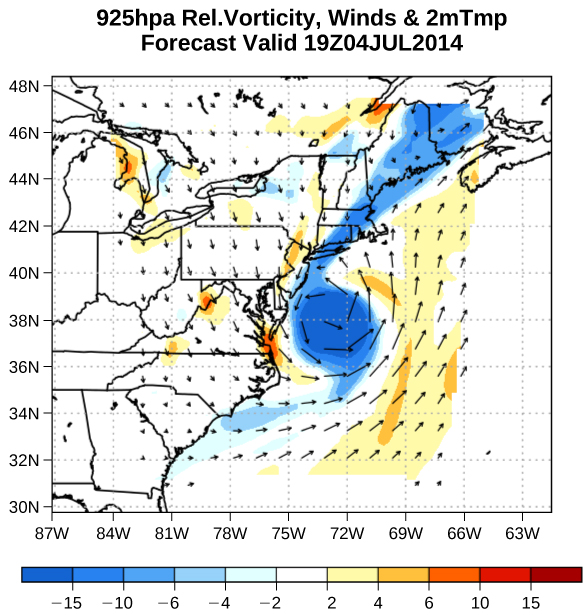
(credit: modification of work by Joseph Trout, Stockton University) OpenStax University Physics Volume 1, CC BY 4.0. · CC BY 4.0 · Source出典

Figure 14.24図 14.24
The velocity vectors show the flow of wind in Hurricane Arthur. Notice the circulation of the wind around the eye of the hurricane. Wind speeds are highest near the eye. The colors represent the relative vorticity, a measure of turning or spinning of the air. (credit: modification of work by Joseph Trout, Stockton University)
英語のヒント
速度ベクトルは、ハリケーン・アーサーの風の流れを示す。目の周囲を巡る風に注目しよう。風速は目の近くで最大となる。色は相対渦度を示し、空気の回転の程度を表す。(クレジット:Joseph Trout、Stockton Universityの作品を改変)
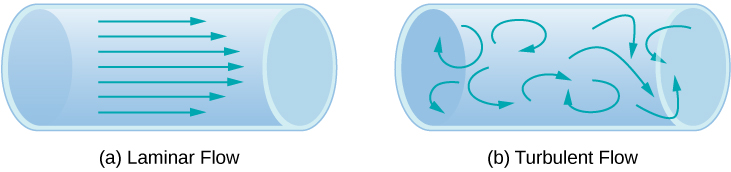
Another method for representing fluid motion is a streamline. A streamline represents the path of a small volume of fluid as it flows. The velocity is always tangential to the streamline. The diagrams in Figure 14.25 use streamlines to illustrate two examples of fluids moving through a pipe. The first fluid exhibits a laminar flow (sometimes described as a steady flow), represented by smooth, parallel streamlines. Note that in the example shown in part (a), the velocity of the fluid is greatest in the center and decreases near the walls of the pipe due to the viscosity of the fluid and friction between the pipe walls and the fluid. This is a special case of laminar flow, where the friction between the pipe and the fluid is high, known as no slip boundary conditions. The second diagram represents turbulent flow, in which streamlines are irregular and change over time. In turbulent flow, the paths of the fluid flow are irregular as different parts of the fluid mix together or form small circular regions that resemble whirlpools. This can occur when the speed of the fluid reaches a certain critical speed.
英語のヒント
流体の運動を表すもう一つの方法が流線である。流線は、小さな体積の流体が流れる経路を表す。速度は常に流線の接線方向を向く。図14.25は、管内を動く流体の二例を流線で示す。最初は層流(定常流と表現されることもある)で、滑らかで平行な流線を持つ。(a)では、流体の速度は中央で最大となり、流体の粘性と管壁との摩擦により、壁に近づくほど小さくなることに注意しよう。これは管と流体の摩擦が大きい層流の特別な場合で、滑りなし境界条件として知られる。二つ目は乱流で、流線は不規則になり、時間とともに変わる。乱流では、流体の異なる部分が混ざったり、渦に似た小さな円形の領域を作ったりするため、流れの経路が不規則になる。流体の速さがある臨界速度へ達すると、このような流れが起こることがある。
OpenStax / Rice University, University Physics Volume 1, CC BY 4.0. Source-book artwork retained. · CC BY 4.0 · Source出典

Figure 14.25図 14.25
(a) Laminar flow can be thought of as layers of fluid moving in parallel, regular paths. (b) In turbulent flow, regions of fluid move in irregular, colliding paths, resulting in mixing and swirling.
英語のヒント
(a) 層流は、流体の層が平行で規則的な経路を動くものと考えられる。(b) 乱流では、流体の各部分が不規則で衝突する経路を動き、混合や渦巻きを生じる。
Flow Rate and its Relation to Velocity流量と速度の関係
The volume of fluid passing by a given location through an area during a period of time is called flow rate Q, or more precisely, volume flow rate. In symbols, this is written as
英語のヒント
ある時間に、ある場所の面を通過する流体の体積を、流量Q、より正確には体積流量という。記号では次のように表す。
where V is the volume and t is the elapsed time. In Figure 14.26, the volume of the cylinder is Ax, so the flow rate is
英語のヒント
ここで、Vは体積、tは経過時間である。図14.26の円柱の体積はAxなので、流量は次のようになる。
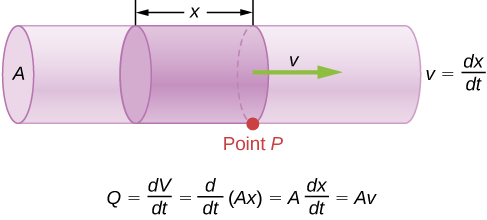
OpenStax / Rice University, University Physics Volume 1, CC BY 4.0. Source-book artwork retained. · CC BY 4.0 · Source出典

Figure 14.26図 14.26
Flow rate is the volume of fluid flowing past a point through the area A per unit time. Here, the shaded cylinder of fluid flows past point P in a uniform pipe in time t.
英語のヒント
流量は、単位時間に面積Aを通って、ある点を通過する流体の体積である。ここでは、一定断面の管を流れる、薄色の円柱状の流体が、時間tで点Pを通過する。
The SI unit for flow rate is but several other units for Q are in common use, such as liters per minute (L/min). Note that a liter (L) is 1/1000 of a cubic meter or 1000 cubic centimeters
英語のヒント
流量のSI単位はだが、Qには1分あたりのリットル(L/min)など、ほかの単位も広く使われる。1リットル(L)は1立方メートルの1000分の1、すなわち1000立方センチメートルであり、である。
Flow rate and velocity are related, but quite different, physical quantities. To make the distinction clear, consider the flow rate of a river. The greater the velocity of the water, the greater the flow rate of the river. But flow rate also depends on the size and shape of the river. A rapid mountain stream carries far less water than the Amazon River in Brazil, for example. Figure 14.26 illustrates the volume flow rate. The volume flow rate is where is the cross-sectional area of the pipe and v is the magnitude of the velocity.
英語のヒント
流量と速度は関係するが、かなり異なる物理量である。違いを明確にするため、川の流量を考えよう。水の速度が大きいほど、川の流量は大きい。しかし、流量は川の大きさや形にも依存する。例えば、流れの速い山の小川が運ぶ水の量は、ブラジルのアマゾン川よりはるかに少ない。図14.26は体積流量を示す。体積流量はであり、は管の断面積、vは速度の大きさである。
The precise relationship between flow rate Q and average speed v is
英語のヒント
流量Qと平均の速さvの正確な関係は、次のとおりである。
where A is the cross-sectional area and is the average speed. The relationship tells us that flow rate is directly proportional to both the average speed of the fluid and the cross-sectional area of a river, pipe, or other conduit. The larger the conduit, the greater its cross-sectional area. Figure 14.26 illustrates how this relationship is obtained. The shaded cylinder has a volume , which flows past the point P in a time t. Dividing both sides of this relationship by t gives
英語のヒント
ここでAは断面積、は平均の速さである。この関係から、流量は流体の平均の速さと、川・管などの流路の断面積の両方に正比例することが分かる。流路が大きいほど、その断面積も大きい。図14.26は、この関係の求め方を示す。薄色の円柱の体積はであり、時間tで点Pを通過する。この関係の両辺をtで割ると、次のようになる。
We note that and the average speed is . Thus the equation becomes .
英語のヒント
であり、平均の速さはである。したがって、式はとなる。
Figure 14.27 shows an incompressible fluid flowing along a pipe of decreasing radius. Because the fluid is incompressible, the same amount of fluid must flow past any point in the tube in a given time to ensure continuity of flow. The flow is continuous because they are no sources or sinks that add or remove mass, so the mass flowing into the pipe must be equal the mass flowing out of the pipe. In this case, because the cross-sectional area of the pipe decreases, the velocity must necessarily increase. This logic can be extended to say that the flow rate must be the same at all points along the pipe. In particular, for arbitrary points 1 and 2,
英語のヒント
図14.27は、半径が小さくなる管を流れる非圧縮性流体を示す。流体は圧縮できないため、流れの連続性を保つには、同じ時間に、管内のどの点でも同じ量の流体が通過しなければならない。質量を加えたり取り除いたりする湧き出しや吸い込みがないので流れは連続し、管へ入る質量は出る質量に等しい。この場合、管の断面積が減るので、速度は増えなければならない。この考え方を広げると、管に沿ったすべての点で流量は同じである。特に、任意の点1と2について、次が成り立つ。
This is called the equation of continuity and is valid for any incompressible fluid (with constant density). The consequences of the equation of continuity can be observed when water flows from a hose into a narrow spray nozzle: It emerges with a large speed—that is the purpose of the nozzle. Conversely, when a river empties into one end of a reservoir, the water slows considerably, perhaps picking up speed again when it leaves the other end of the reservoir. In other words, speed increases when cross-sectional area decreases, and speed decreases when cross-sectional area increases.
英語のヒント
これを連続の式といい、密度が一定のあらゆる非圧縮性流体で成り立つ。その結果は、ホースから細い散水ノズルへ水が流れるときに観察できる。水は大きな速さで出てきて、それがノズルの目的である。逆に、川が貯水池の一端へ流れ込むと、水は大きく減速する。反対側から流れ出るときには、再び速くなることもある。つまり、断面積が小さくなると速さは増し、断面積が大きくなると速さは減る。
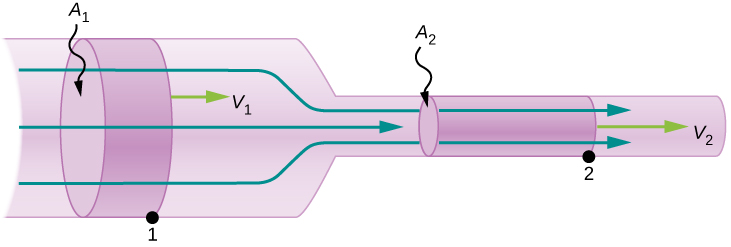
OpenStax / Rice University, University Physics Volume 1, CC BY 4.0. Source-book artwork retained. · CC BY 4.0 · Source出典

Figure 14.27図 14.27
When a tube narrows, the same volume occupies a greater length. For the same volume to pass points 1 and 2 in a given time, the speed must be greater at point 2. The process is exactly reversible. If the fluid flows in the opposite direction, its speed decreases when the tube widens. (Note that the relative volumes of the two cylinders and the corresponding velocity vector arrows are not drawn to scale.)
英語のヒント
管が狭くなると、同じ体積がより長い区間を占める。同じ体積が同じ時間に点1と点2を通過するには、点2での速さのほうが大きくなければならない。この過程は、逆向きでもまったく同様に成り立つ。逆向きに流れるなら、管が広がると速さは小さくなる。(二つの円柱の体積と、それぞれの速度ベクトルの矢印は、縮尺どおりには描いていない。)
Since liquids are essentially incompressible, the equation of continuity is valid for all liquids. However, gases are compressible, so the equation must be applied with caution to gases if they are subjected to compression or expansion.
英語のヒント
液体は実質的に非圧縮性なので、連続の式はすべての液体に成り立つ。しかし気体は圧縮できるため、圧縮や膨張を受ける気体へ適用する場合には注意が必要である。
Example 14.5例題 14.5
Calculating Fluid Speed through a Nozzleノズルを通る流体の速さの計算
A nozzle with a diameter of 0.500 cm is attached to a garden hose with a radius of 0.900 cm. The flow rate through hose and nozzle is 0.500 L/s. Calculate the speed of the water (a) in the hose and (b) in the nozzle.
英語のヒント
半径0.900 cmの散水用ホースへ、直径0.500 cmのノズルを取り付ける。ホースとノズルを通る流量は0.500 L/sである。水の速さを、(a) ホース内、(b) ノズル内でそれぞれ求めよ。
Strategy方針
We can use the relationship between flow rate and speed to find both speeds. We use the subscript 1 for the hose and 2 for the nozzle.
英語のヒント
流量と速さの関係を使い、両方の速さを求める。添字1をホース、2をノズルに用いる。
Solution解答
- We solve the flow rate equation for speed and use for the cross-sectional area of the hose, obtaining
英語のヒント
流量の式を速さについて解き、ホースの断面積にを用いると、次のようになる。Substituting values and using appropriate unit conversions yields英語のヒント
値を代入し、単位を適切に換算すると、次のようになる。 - We could repeat this calculation to find the speed in the nozzle , but we use the equation of continuity to give a somewhat different insight. The equation states
英語のヒント
同じ計算を繰り返せばノズル内の速さを求められるが、少し違う見方を得るため、連続の式を使う。この式は、次のとおりである。Solving for and substituting for the cross-sectional area yields英語のヒント
について解き、断面積にを代入すると、次のようになる。Substituting known values,英語のヒント
既知の値を代入すると、
Significance考察
A speed of 1.96 m/s is about right for water emerging from a hose with no nozzle. The nozzle produces a considerably faster stream merely by constricting the flow to a narrower tube.
英語のヒント
1.96 m/sという速さは、ノズルのないホースから出る水として妥当である。ノズルは、流れをより細い管へ絞るだけで、ずっと速い水流を作る。
The solution to the last part of the example shows that speed is inversely proportional to the square of the radius of the tube, making for large effects when radius varies. We can blow out a candle at quite a distance, for example, by pursing our lips, whereas blowing on a candle with our mouth wide open is quite ineffective.
英語のヒント
例題の後半の解から、速さは管の半径の2乗に反比例することが分かる。したがって、半径が変わると大きな効果が生じる。例えば、唇をすぼめれば、かなり離れたろうそくも吹き消せるが、口を大きく開けて吹いても、あまり効果がない。