第14章流体力学
Pressure in a static fluid in a uniform gravitational field一様な重力場内の静止流体の圧力
A static fluid is a fluid that is not in motion. At any point within a static fluid, the pressure on all sides must be equal—otherwise, the fluid at that point would react to a net force and accelerate.
英語のヒント
静止流体とは、動いていない流体である。静止流体内のどの点でも、すべての方向の圧力は等しくなければならない。そうでなければ、その点の流体には合力が働き、加速するはずである。
The pressure at any point in a static fluid depends only on the depth at that point. As discussed, pressure in a fluid near Earth varies with depth due to the weight of fluid above a particular level. In the above examples, we assumed density to be constant and the average density of the fluid to be a good representation of the density. This is a reasonable approximation for liquids like water, where large forces are required to compress the liquid or change the volume. In a swimming pool, for example, the density is approximately constant, and the water at the bottom is compressed very little by the weight of the water on top. Traveling up in the atmosphere is quite a different situation, however. The density of the air begins to change significantly just a short distance above Earth’s surface.
英語のヒント
静止流体内のある点の圧力は、その点の深さだけに依存する。これまで述べたように、地球付近の流体の圧力は、その高さより上にある流体の重さによって、深さとともに変わる。これまでの例では密度を一定とし、平均密度が流体の密度をよく表すと仮定した。水のように、圧縮や体積の変化に大きな力を必要とする液体では、これは妥当な近似である。例えばプールでは、密度はほぼ一定で、底の水は上にある水の重さによってわずかしか圧縮されない。しかし、大気中を上昇する場合は、状況が大きく異なる。地表から少し上がるだけで、空気の密度は大きく変わり始める。
To derive a formula for the variation of pressure with depth in a tank containing a fluid of density ρ on the surface of Earth, we must start with the assumption that the density of the fluid is not constant. Fluid located at deeper levels is subjected to more force than fluid nearer to the surface due to the weight of the fluid above it. Therefore, the pressure calculated at a given depth is different than the pressure calculated using a constant density.
英語のヒント
地表で、密度ρの流体を入れたタンクの深さと圧力の関係を導くには、流体の密度が一定でないという仮定から出発しなければならない。深い場所の流体は、上の流体の重さのために、表面近くより大きな力を受ける。したがって、ある深さで計算した圧力は、密度を一定として計算した圧力とは異なる。
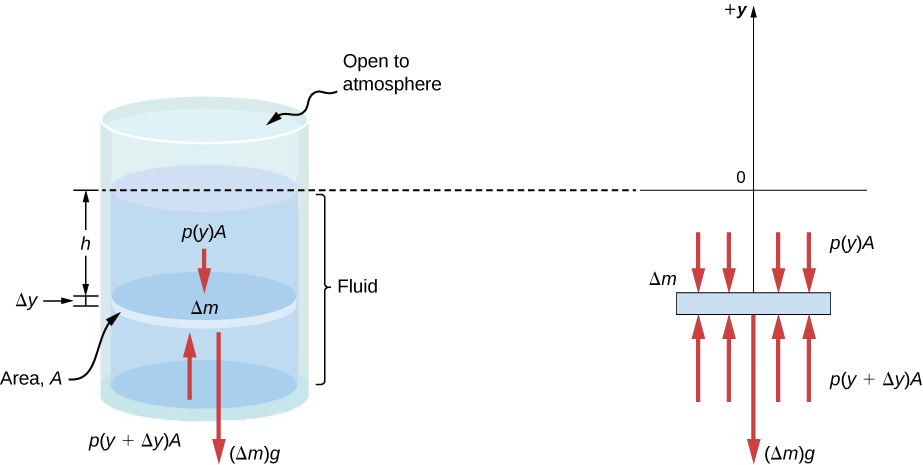
Imagine a thin element of fluid at a depth h, as shown in Figure 14.8. Let the element have a cross-sectional area A and height . The forces acting upon the element are due to the pressures p(y) above and below it. The weight of the element itself is also shown in the free-body diagram.
英語のヒント
図14.8のように、深さhにある薄い流体要素を考えよう。断面積をA、高さをとする。要素には、上側の圧力p(y)と下側の圧力による力が働く。自由物体図には、要素自体の重さも示してある。
OpenStax / Rice University, University Physics Volume 1, CC BY 4.0. Source-book artwork retained. · CC BY 4.0 · Source出典

Figure 14.8図 14.8
Forces on a mass element inside a fluid. The weight of the element itself is shown in the free-body diagram.
英語のヒント
流体内の質量要素に働く力。自由物体図には、要素自身の重さも示してある。
Since the element of fluid between y and is not accelerating, the forces are balanced. Using a Cartesian y-axis oriented up, we find the following equation for the y-component:
英語のヒント
yとの間の流体要素は加速していないので、力はつり合っている。直交座標のy軸を上向きに取ると、y成分について次の式が得られる。
(14.6)
Note that if the element had a non-zero y-component of acceleration, the right-hand side would not be zero but would instead be the mass times the y-acceleration. The mass of the element can be written in terms of the density of the fluid and the volume of the elements:
英語のヒント
もし要素の加速度のy成分がゼロでなければ、右辺はゼロではなく、質量とy方向の加速度の積になることに注意しよう。要素の質量は、流体の密度と要素の体積を使って、次のように表せる。
Putting this expression for into Equation 14.6 and then dividing both sides by , we find
英語のヒント
このの式を式14.6へ代入し、両辺をで割ると、次のようになる。
(14.7)
Taking the limit of the infinitesimally thin element , we obtain the following differential equation, which gives the variation of pressure in a fluid:
英語のヒント
要素を無限に薄くする極限を取ると、流体内の圧力の変化を表す次の微分方程式が得られる。
This equation tells us that the rate of change of pressure in a fluid is proportional to the density of the fluid. The solution of this equation depends upon whether the density ρ is constant or changes with depth; that is, the function ρ(y).
英語のヒント
この式は、流体内での圧力の変化率が密度に比例することを示す。解は、密度ρが一定か、深さとともに変わるか、すなわち関数ρ(y)によって決まる。
If the range of the depth being analyzed is not too great, we can assume the density to be constant. But if the range of depth is large enough for the density to vary appreciably, such as in the case of the atmosphere, there is significant change in density with depth. In that case, we cannot use the approximation of a constant density.
英語のヒント
調べる深さの範囲があまり大きくなければ、密度を一定と仮定できる。しかし大気のように、密度がはっきり変わるほど深さの範囲が大きい場合には、密度は深さとともに大きく変化する。この場合、密度一定の近似は使えない。
Pressure in a fluid with a constant density密度一定の流体の圧力
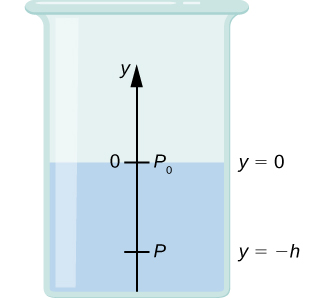
Let’s use Equation 14.9 to work out a formula for the pressure at a depth h from the surface in a tank of a liquid such as water, where the density of the liquid can be taken to be constant.
英語のヒント
式14.9を使い、水のように密度を一定とみなせる液体を入れたタンクについて、表面から深さhでの圧力の式を求めよう。
OpenStax / Rice University, University Physics Volume 1, CC BY 4.0. Source-book artwork retained. · CC BY 4.0 · Source出典

We need to integrate Equation 14.9 from where the pressure is atmospheric pressure to the y-coordinate of the depth:
英語のヒント
式14.9を、圧力が大気圧であるから、深さのy座標まで積分する。
(14.9)
Hence, pressure at a depth of fluid on the surface of Earth is equal to the atmospheric pressure plus ρgh if the density of the fluid is constant over the height, as we found previously.
英語のヒント
したがって、地表付近の流体の密度が高さによらず一定なら、ある深さの圧力は、大気圧にρghを加えたものに等しい。これは先ほど求めた結果と同じである。
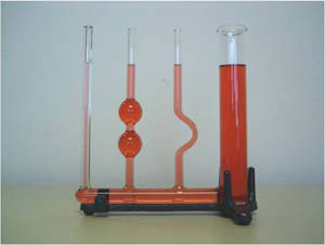
Note that the pressure in a fluid depends only on the depth from the surface and not on the shape of the container. Thus, in a container where a fluid can freely move in various parts, the liquid stays at the same level in every part, regardless of the shape, as shown in Figure 14.9.
英語のヒント
流体の圧力は表面からの深さだけに依存し、容器の形には依存しないことに注意しよう。したがって、容器の各部分の間を流体が自由に移動できれば、図14.9のように、形が違っても、液面はどの部分でも同じ高さになる。
OpenStax / Rice University, University Physics Volume 1, CC BY 4.0. Source-book artwork retained. · CC BY 4.0 · Source出典

Figure 14.9図 14.9
If a fluid can flow freely between parts of a container, it rises to the same height in each part. In the container pictured, the pressure at the bottom of each column is the same; if it were not the same, the fluid would flow until the pressures became equal.
英語のヒント
流体が容器の各部分の間を自由に流れられるなら、各部で同じ高さまで上がる。この容器では、各液柱の底の圧力は等しい。等しくなければ、等しくなるまで流体が流れるはずである。