第14章流体力学
Pressure圧力
You have no doubt heard the word ‘pressure’ used in relation to blood (high or low blood pressure) and in relation to weather (high- and low-pressure weather systems). These are only two of many examples of pressure in fluids. (Recall that we introduced the idea of pressure in Static Equilibrium and Elasticity, in the context of bulk stress and strain.)
英語のヒント
「圧力」という言葉を、血液については高血圧や低血圧、天候については高気圧や低気圧という形で耳にしたことがあるだろう。これらは、流体の圧力に関する多くの例のうちの二つにすぎない。(「静的平衡と弾性」では、体積応力と体積ひずみの関連で、圧力という考えを導入したことを思い出そう。)
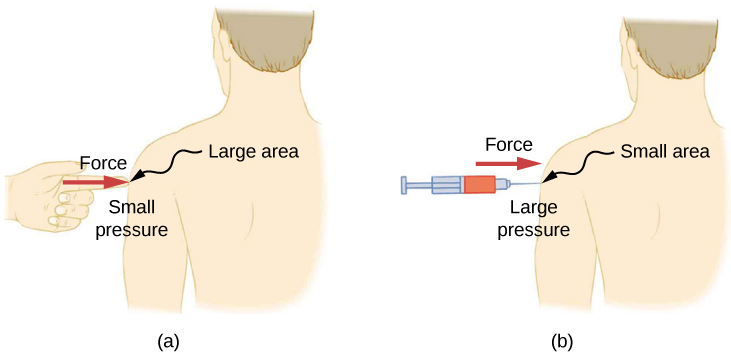
A given force can have a significantly different effect, depending on the area over which the force is exerted. For instance, a force applied to an area of has a pressure that is 100 times as great as the same force applied to an area of That is why a sharp needle is able to poke through skin when a small force is exerted, but applying the same force with a finger does not puncture the skin (Figure 14.5).
英語のヒント
同じ力でも、加わる面積によって、その効果は大きく異なる。例えば、面積に加えた力の圧力は、同じ力を面積に加えた場合の100倍になる。このため、鋭い針は小さな力でも皮膚を突き破れるが、指で同じ力を加えても皮膚に穴は開かない(図14.5)。
OpenStax / Rice University, University Physics Volume 1, CC BY 4.0. Source-book artwork retained. · CC BY 4.0 · Source出典

Figure 14.5図 14.5
(a) A person being poked with a finger might be irritated, but the force has little lasting effect. (b) In contrast, the same force applied to an area the size of the sharp end of a needle is enough to break the skin.
英語のヒント
(a) 指でつつかれると不快かもしれないが、その力の影響はほとんど残らない。(b) 対照的に、同じ力でも、針の鋭い先端ほどの面積へ加われば、皮膚を破るのに十分である。
Note that although force is a vector, pressure is a scalar. Pressure is a scalar quantity because it is defined to be proportional to the magnitude of the force acting perpendicular to the surface area. The SI unit for pressure is the pascal (Pa), named after the French mathematician and physicist Blaise Pascal (1623–1662), where
英語のヒント
力はベクトルだが、圧力はスカラーであることに注意しよう。圧力は、面に垂直に働く力の大きさに比例する量として定義されるため、スカラー量である。圧力のSI単位はパスカル(Pa)で、フランスの数学者・物理学者ブレーズ・パスカル(1623–1662)にちなんで名付けられた。次の関係が成り立つ。
Several other units are used for pressure, which we discuss later in the chapter.
英語のヒント
圧力には、ほかにもいくつかの単位が使われる。この章の後で扱う。
Variation of pressure with depth in a fluid of constant density密度が一定の流体における深さと圧力の変化
Pressure is defined for all states of matter, but it is particularly important when discussing fluids. An important characteristic of fluids is that there is no significant resistance to the component of a force applied parallel to the surface of a fluid. The molecules of the fluid simply flow to accommodate the horizontal force. A force applied perpendicular to the surface compresses or expands the fluid. If you try to compress a fluid, you find that a reaction force develops at each point inside the fluid in the outward direction, balancing the force applied on the molecules at the boundary.
英語のヒント
圧力は物質のどの状態についても定義されるが、流体を扱う際には特に重要である。流体の重要な特徴は、その表面に平行に加えられた力の成分に、ほとんど抵抗しないことだ。流体の分子は水平方向の力に応じて流れる。表面に垂直な力は、流体を圧縮したり膨張させたりする。流体を圧縮しようとすると、その内部の各点に外向きの反力が生じ、境界の分子に加えた力とつり合うことが分かる。
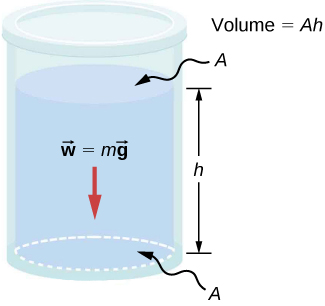
Consider a fluid of constant density as shown in Figure 14.6. The pressure at the bottom of the container is due to the pressure of the atmosphere plus the pressure due to the weight of the fluid. The pressure due to the fluid is equal to the weight of the fluid divided by the area. The weight of the fluid is equal to its mass times the acceleration due to gravity.
英語のヒント
図14.6のように、密度が一定の流体を考えよう。容器の底の圧力は、大気の圧力と、流体の重さによる圧力の和である。流体による圧力は、流体の重さを面積で割ったものに等しい。流体の重さは、質量と重力加速度の積に等しい。
OpenStax / Rice University, University Physics Volume 1, CC BY 4.0. Source-book artwork retained. · CC BY 4.0 · Source出典

Figure 14.6図 14.6
The bottom of this container supports the entire weight of the fluid in it. The vertical sides cannot exert an upward force on the fluid (since it cannot withstand a shearing force), so the bottom must support it all.
英語のヒント
この容器の底は、中の流体の重さ全体を支える。流体はせん断力に抵抗できないため、垂直な側壁は流体へ上向きの力を及ぼせない。したがって、底がすべてを支える必要がある。
Since the density is constant, the weight can be calculated using the density:
英語のヒント
密度は一定なので、重さは密度を用いて次のように計算できる。
The pressure at the bottom of the container is therefore equal to atmospheric pressure added to the weight of the fluid divided by the area:
英語のヒント
したがって、容器の底の圧力は、大気圧に、流体の重さを面積で割ったものを加えた値に等しい。
This equation is only good for pressure at a depth for a fluid of constant density.
英語のヒント
この式は、密度が一定の流体中の、ある深さでの圧力についてのみ成り立つ。
Image omitted because its reuse rights could not be verified.権利の確認ができないため画像を割愛。
Figure 14.7図 14.7
The Three Gorges Dam, erected on the Yangtze River in central China in 2008, created a massive reservoir that displaced more than one million people. (credit: modification of work by “Le Grand Portage”/Flickr)
英語のヒント
2008年に中国中部の長江に建設された三峡ダムは、巨大な貯水池を作り、100万人を超える人々が移転した。(クレジット:“Le Grand Portage”/Flickrの作品を改変)
Example 14.1例題 14.1
What Force Must a Dam Withstand?ダムはどれほどの力に耐えなければならないか
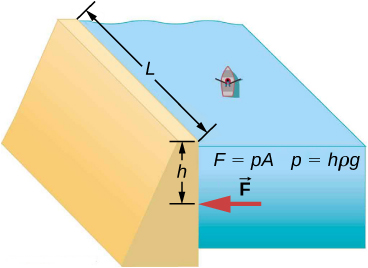
Consider the pressure and force acting on the dam retaining a reservoir of water (Figure 14.7). Suppose the dam is 500-m wide and the water is 80.0-m deep at the dam, as illustrated below. (a) What is the average pressure on the dam due to the water? (b) Calculate the force exerted against the dam.
英語のヒント
貯水池の水をせき止めるダムに働く圧力と力を考えよう(図14.7)。下の図のように、ダムの幅は500 m、ダムの位置での水深は80.0 mとする。(a) 水によってダムにかかる平均圧力はいくらか。(b) ダムに加わる力を計算せよ。
OpenStax / Rice University, University Physics Volume 1, CC BY 4.0. Source-book artwork retained. · CC BY 4.0 · Source出典

The average pressure p due to the weight of the water is the pressure at the average depth h of 40.0 m, since pressure increases linearly with depth. The force exerted on the dam by the water is the average pressure times the area of contact,
英語のヒント
圧力は深さに比例して増えるため、水の重さによる平均圧力pは、平均の深さh=40.0 mでの圧力に等しい。水がダムに及ぼす力は、平均圧力と接触面積の積である。
solution解答
- The average pressure due to the weight of a fluid is
英語のヒント
流体の重さによる平均圧力は、次のようになる。(14.5)Entering the density of water from Table 14.2 and taking h to be the average depth of 40.0 m, we obtain英語のヒント
表14.2の水の密度を代入し、hを平均の深さ40.0 mとすると、次のようになる。 - We have already found the value for p. The area of the dam is
英語のヒント
pの値はすでに求めた。ダムの面積は、次のようになる。so that英語のヒント
したがって、
Significance考察
Although this force seems large, it is small compared with the weight of the water in the reservoir. In fact, it is only 0.0800% of the weight.
英語のヒント
この力は大きく見えるが、貯水池の水の重さに比べれば小さい。実際、その重さのわずか0.0800%である。