第14章流体力学
14.2 Measuring Pressure14.2 圧力の測定
Learning Objectives学習目標
Learning Objectives学習目標
By the end of this section, you will be able to:
英語のヒント
この節を終えると、次のことができるようになる。
- Define gauge pressure and absolute pressure
英語のヒント
ゲージ圧と絶対圧を定義する。 - Explain various methods for measuring pressure
英語のヒント
圧力を測定するさまざまな方法を説明する。 - Understand the working of open-tube barometers
英語のヒント
開管式気圧計の仕組みを理解する。 - Describe in detail how manometers and barometers operate
英語のヒント
液柱圧力計と気圧計の動作を詳しく説明する。
In the preceding section, we derived a formula for calculating the variation in pressure for a fluid in hydrostatic equilibrium. As it turns out, this is a very useful calculation. Measurements of pressure are important in daily life as well as in science and engineering applications. In this section, we discuss different ways that pressure can be reported and measured.
英語のヒント
前節では、流体静力学的平衡にある流体について、圧力の変化を計算する式を導いた。この計算は、実際には非常に役立つ。圧力の測定は、科学や工学の応用だけでなく、日常生活でも重要である。この節では、圧力のさまざまな表し方と測り方を扱う。
Gauge Pressure vs. Absolute Pressureゲージ圧と絶対圧
Suppose the pressure gauge on a full scuba tank reads 3000 psi, which is approximately 207 atmospheres. When the valve is opened, air begins to escape because the pressure inside the tank is greater than the atmospheric pressure outside the tank. Air continues to escape from the tank until the pressure inside the tank equals the pressure of the atmosphere outside the tank. At this point, the pressure gauge on the tank reads zero, even though the pressure inside the tank is actually 1 atmosphere—the same as the air pressure outside the tank.
英語のヒント
満タンの潜水用タンクの圧力計が3000 psi、約207気圧を示しているとする。バルブを開くと、タンク内の圧力は外の大気圧より高いので、空気が流れ出す。内部の圧力が外の大気圧に等しくなるまで、空気は流れ出し続ける。この時点で、タンクの圧力計はゼロを示す。しかし、内部の圧力は実際には1気圧で、外の空気の圧力と同じである。
Most pressure gauges, like the one on the scuba tank, are calibrated to read zero at atmospheric pressure. Pressure readings from such gauges are called gauge pressure, which is the pressure relative to the atmospheric pressure. When the pressure inside the tank is greater than atmospheric pressure, the gauge reports a positive value.
英語のヒント
潜水用タンクのものを含め、大半の圧力計は、大気圧でゼロを示すように校正されている。このような計器の読みをゲージ圧といい、大気圧に対する相対的な圧力である。内部の圧力が大気圧より大きいとき、計器は正の値を示す。
Some gauges are designed to measure negative pressure. For example, many physics experiments must take place in a vacuum chamber, a rigid chamber from which some of the air is pumped out. The pressure inside the vacuum chamber is less than atmospheric pressure, so the pressure gauge on the chamber reads a negative value.
英語のヒント
負の圧力を測るよう設計された計器もある。例えば、多くの物理実験は真空容器で行う必要がある。これは、空気の一部をポンプで排出した硬い容器である。内部の圧力は大気圧より低いので、その容器の圧力計は負の値を示す。
Unlike gauge pressure, absolute pressure accounts for atmospheric pressure, which in effect adds to the pressure in any fluid not enclosed in a rigid container.
英語のヒント
ゲージ圧と違って、絶対圧は大気圧を含む。大気圧は、硬い容器に閉じ込められていない流体の圧力に、実際に加わる。
For example, if a tire gauge reads 34 psi, then the absolute pressure is 34 psi plus 14.7 psi ( in psi), or 48.7 psi (equivalent to 336 kPa).
英語のヒント
例えば、タイヤの圧力計が34 psiを示すなら、絶対圧は34 psiに14.7 psi(をpsiで表した値)を加えた48.7 psi、すなわち336 kPaである。
In most cases, the absolute pressure in fluids cannot be negative. Fluids push rather than pull, so the smallest absolute pressure in a fluid is zero (a negative absolute pressure is a pull). Thus, the smallest possible gauge pressure is (which makes zero). There is no theoretical limit to how large a gauge pressure can be.
英語のヒント
大半の場合、流体の絶対圧は負にならない。流体は引くのではなく押すので、流体の最小の絶対圧はゼロである(負の絶対圧は引く力に当たる)。したがって、ゲージ圧の最小値はで、このときはゼロになる。ゲージ圧がどれだけ大きくなれるかには、理論上の上限はない。
Measuring Pressure圧力の測定
A host of devices are used for measuring pressure, ranging from tire gauges to blood pressure monitors. Many other types of pressure gauges are commonly used to test the pressure of fluids, such as mechanical pressure gauges. We will explore some of these in this section.
英語のヒント
圧力の測定には、タイヤの圧力計から血圧計まで、多種多様な装置が使われる。機械式圧力計など、流体の圧力を調べるために広く使われる形式はほかにも多い。この節では、そのいくつかを調べる。
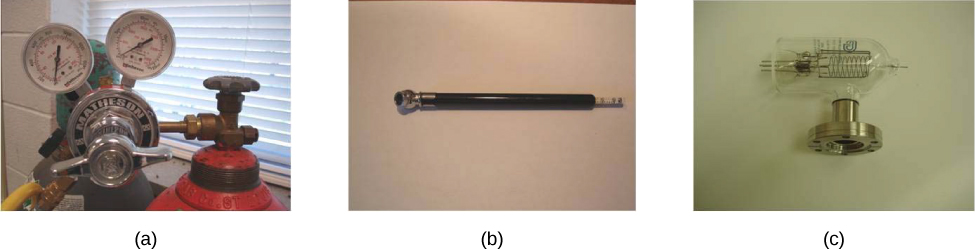
Any property that changes with pressure in a known way can be used to construct a pressure gauge. Some of the most common types include strain gauges, which use the change in the shape of a material with pressure; capacitance pressure gauges, which use the change in electric capacitance due to shape change with pressure; piezoelectric pressure gauges, which generate a voltage difference across a piezoelectric material under a pressure difference between the two sides; and ion gauges, which measure pressure by ionizing molecules in highly evacuated chambers. Different pressure gauges are useful in different pressure ranges and under different physical situations. Some examples are shown in Figure 14.11.
英語のヒント
圧力との関係が分かっている性質なら、圧力計を作るために利用できる。よく使われるものには、圧力による材料の変形を使うひずみゲージ、圧力で形が変わることによる電気容量の変化を使う静電容量式圧力計、両側の圧力差によって圧電材料の両端に電圧差を生む圧電式圧力計、空気を十分に抜いた容器内の分子を電離させて圧力を測る電離真空計などがある。異なる圧力計は、それぞれ異なる圧力範囲や物理的条件で役立つ。図14.11にいくつかの例を示す。
OpenStax / Rice University, University Physics Volume 1, CC BY 4.0. Source-book artwork retained. · CC BY 4.0 · Source出典

Figure 14.11図 14.11
(a) Gauges are used to measure and monitor pressure in gas cylinders. Compressed gases are used in many industrial as well as medical applications. (b) Tire pressure gauges come in many different models, but all are meant for the same purpose: to measure the internal pressure of the tire. This enables the driver to keep the tires inflated at optimal pressure for load weight and driving conditions. (c) An ionization gauge is a high-sensitivity device used to monitor the pressure of gases in an enclosed system. Neutral gas molecules are ionized by the release of electrons, and the current is translated into a pressure reading. Ionization gauges are commonly used in industrial applications that rely on vacuum systems.
英語のヒント
(a) ガスボンベの圧力は、計器で測定・監視する。圧縮気体は、工業だけでなく医療にも広く使われる。(b) タイヤ圧力計にはさまざまな形式があるが、目的はいずれもタイヤの内部圧力を測ることである。これにより、運転者は積載重量や走行条件に合った最適な圧力に、タイヤの空気を保てる。(c) 電離真空計は、閉じた系内の気体の圧力を監視する高感度の装置である。中性の気体分子を放出した電子で電離し、その電流を圧力の指示値へ換算する。電離真空計は、真空装置を利用する工業用途で広く使われている。