第14章流体力学
Density and Archimedes’ Principle密度とアルキメデスの原理
If you drop a lump of clay in water, it will sink. But if you mold the same lump of clay into the shape of a boat, it will float. Because of its shape, the clay boat displaces more water than the lump and experiences a greater buoyant force, even though its mass is the same. The same is true of steel ships.
英語のヒント
粘土の塊を水へ落とすと沈む。しかし同じ塊を船の形へ変えると浮く。形のために粘土の船は塊より多くの水を押しのけるので、質量は同じでも、より大きな浮力を受ける。鋼鉄の船にも同じことが当てはまる。
The average density of an object is what ultimately determines whether it floats. If an object’s average density is less than that of the surrounding fluid, it will float. The reason is that the fluid, having a higher density, contains more mass and hence more weight in the same volume. The buoyant force, which equals the weight of the fluid displaced, is thus greater than the weight of the object. Likewise, an object denser than the fluid will sink.
英語のヒント
物体が浮くかどうかを最終的に決めるのは、平均密度である。物体の平均密度が周囲の流体より小さければ、浮く。密度の高い流体は、同じ体積でより多くの質量、したがってより大きな重さを持つためである。押しのけた流体の重さに等しい浮力は、この場合、物体の重さより大きくなる。同様に、流体より密度の高い物体は沈む。
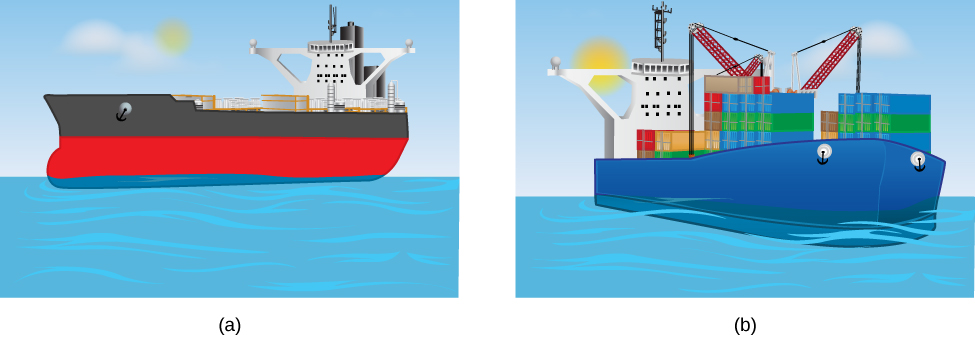
The extent to which a floating object is submerged depends on how the object’s density compares to the density of the fluid. In Figure 14.22, for example, the unloaded ship has a lower density and less of it is submerged compared with the same ship when loaded. We can derive a quantitative expression for the fraction submerged by considering density. The fraction submerged is the ratio of the volume submerged to the volume of the object, or
英語のヒント
浮いている物体がどれだけ沈むかは、物体の密度と流体の密度の関係で決まる。例えば図14.22では、荷物を積んでいない船は密度が小さく、同じ船が積荷を載せたときより沈む部分が少ない。密度を考えると、沈む割合の定量的な式を導ける。沈む割合は、沈んでいる体積と物体全体の体積の比である。すなわち、
The volume submerged equals the volume of fluid displaced, which we call . Now we can obtain the relationship between the densities by substituting into the expression. This gives
英語のヒント
沈んだ体積は、押しのけた流体の体積に等しく、これをと呼ぶ。ここへを代入すれば、密度どうしの関係が得られる。すると、
where is the average density of the object and is the density of the fluid. Since the object floats, its mass and that of the displaced fluid are equal, so they cancel from the equation, leaving
英語のヒント
ここで、は物体の平均密度、は流体の密度である。物体は浮いているので、その質量と押しのけた流体の質量は等しい。したがって、式の中で相殺され、次の式が残る。
We can use this relationship to measure densities.
英語のヒント
この関係を使って、密度を測定できる。
OpenStax / Rice University, University Physics Volume 1, CC BY 4.0. Source-book artwork retained. · CC BY 4.0 · Source出典

Figure 14.22図 14.22
An unloaded ship (a) floats higher in the water than a loaded ship (b).
英語のヒント
荷物を積んでいない船(a)は、積んだ船(b)より高く浮く。
Example 14.4例題 14.4
Calculating Average Density平均密度の計算
Suppose a 60.0-kg woman floats in fresh water with 97.0% of her volume submerged when her lungs are full of air. What is her average density?
英語のヒント
質量60.0 kgの女性が、肺を空気で満たすと、体積の97.0%を水中に沈めて淡水に浮くとする。平均密度はいくらか。
Strategy方針
We can find the woman’s density by solving the equation
英語のヒント
次の式を物体の密度について解けば、女性の密度を求められる。
for the density of the object. This yields
英語のヒント
物体の密度を求める形にすると、次のようになる。
We know both the fraction submerged and the density of water, so we can calculate the woman’s density.
英語のヒント
沈む割合と水の密度はどちらも分かっているので、女性の密度を計算できる。
Solution解答
Entering the known values into the expression for her density, we obtain
英語のヒント
密度の式へ既知の値を代入すると、次のようになる。
Significance考察
The woman’s density is less than the fluid density. We expect this because she floats.
英語のヒント
女性の密度は流体の密度より小さい。浮いているので、これは予想どおりである。
Numerous lower-density objects or substances float in higher-density fluids: oil on water, a hot-air balloon in the atmosphere, a bit of cork in wine, an iceberg in salt water, and hot wax in a “lava lamp,” to name a few. A less obvious example is mountain ranges floating on the higher-density crust and mantle beneath them. Even seemingly solid Earth has fluid characteristics.
英語のヒント
密度の低い物体や物質が、より高密度の流体に浮く例は多い。水に浮く油、大気中の熱気球、ワインに浮くコルク片、海水中の氷山、「溶岩ランプ」内の熱いろうなどは、その一部である。あまり明白でない例として、山脈が、その下のより高密度な地殻やマントルに浮いていることも挙げられる。一見固い地球でさえ、流体としての性質を持つ。
Measuring Density密度の測定
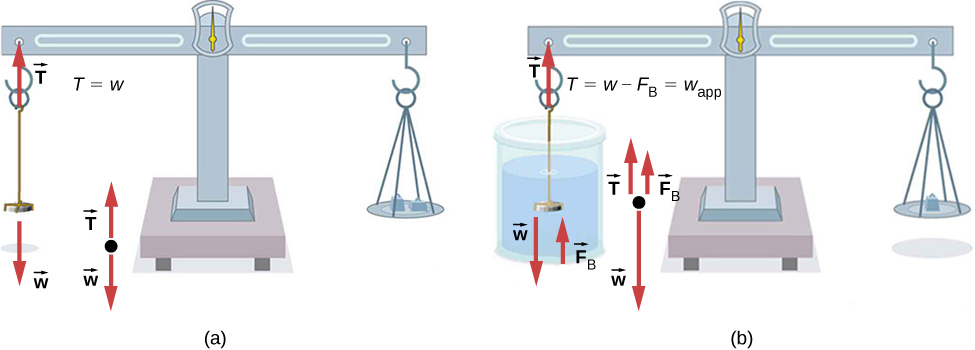
One of the most common techniques for determining density is shown in Figure 14.23.
英語のヒント
密度を求める、特によく使われる方法の一つを図14.23に示す。
OpenStax / Rice University, University Physics Volume 1, CC BY 4.0. Source-book artwork retained. · CC BY 4.0 · Source出典

Figure 14.23図 14.23
(a) A coin is weighed in air. (b) The apparent weight of the coin is determined while it is completely submerged in a fluid of known density. These two measurements are used to calculate the density of the coin.
英語のヒント
(a) 硬貨の重さを空気中で測る。(b) 密度が分かっている流体へ完全に沈め、見かけの重さを測る。この二つの測定値を使い、硬貨の密度を計算する。
An object, here a coin, is weighed in air and then weighed again while submerged in a liquid. The density of the coin, an indication of its authenticity, can be calculated if the fluid density is known. We can use this same technique to determine the density of the fluid if the density of the coin is known.
英語のヒント
物体、この例では硬貨を空気中で量り、次に液体へ沈めて再び量る。流体の密度が分かれば、硬貨が本物かどうかの手がかりとなる密度を計算できる。同じ方法で、硬貨の密度が分かっていれば、流体の密度を求めることもできる。
All of these calculations are based on Archimedes’ principle, which states that the buoyant force on the object equals the weight of the fluid displaced. This, in turn, means that the object appears to weigh less when submerged; we call this measurement the object’s apparent weight. The object suffers an apparent weight loss equal to the weight of the fluid displaced. Alternatively, on balances that measure mass, the object suffers an apparent mass loss equal to the mass of fluid displaced. That is, apparent weight loss equals weight of fluid displaced, or apparent mass loss equals mass of fluid displaced.
英語のヒント
これらの計算はすべて、物体に働く浮力が、押しのけた流体の重さに等しいというアルキメデスの原理に基づく。そこから、沈めた物体は軽くなったように見えることが分かる。この測定値を、物体の見かけの重さという。物体の見かけの重さは、押しのけた流体の重さと同じだけ減る。質量を測るはかりなら、見かけの質量が、押しのけた流体の質量と同じだけ減る。つまり、見かけの重さの減少は押しのけた流体の重さに、見かけの質量の減少は押しのけた流体の質量に、それぞれ等しい。