第14章流体力学
Analyzing Bernoulli’s Equationベルヌーイの式を調べる
According to Bernoulli’s equation, if we follow a small volume of fluid along its path, various quantities in the sum may change, but the total remains constant. Bernoulli’s equation is, in fact, just a convenient statement of conservation of energy for an incompressible fluid in the absence of friction.
英語のヒント
ベルヌーイの式によれば、小さな体積の流体をその経路に沿って追うと、和に含まれる各量は変わり得るが、合計は一定に保たれる。この式は、実際には、摩擦のない非圧縮性流体のエネルギー保存を便利に表したものにすぎない。
The general form of Bernoulli’s equation has three terms in it, and it is broadly applicable. To understand it better, let us consider some specific situations that simplify and illustrate its use and meaning.
英語のヒント
ベルヌーイの式の一般形には三つの項があり、広い範囲へ適用できる。理解を深めるため、使い方や意味を簡単に示す、いくつかの具体的な状況を考えよう。
Bernoulli’s equation for static fluids静止流体のベルヌーイの式
First consider the very simple situation where the fluid is static—that is, Bernoulli’s equation in that case is
英語のヒント
まず、流体が静止している、すなわちという非常に単純な場合を考える。このとき、ベルヌーイの式は次のようになる。
We can further simplify the equation by setting (Any height can be chosen for a reference height of zero, as is often done for other situations involving gravitational force, making all other heights relative.) In this case, we get
英語のヒント
とおけば、式をさらに簡単にできる。(重力が関わるほかの問題と同様に、どの高さを基準のゼロとして選んでもよく、ほかの高さはその基準に対して定まる。)この場合、次の式を得る。
This equation tells us that, in static fluids, pressure increases with depth. As we go from point 1 to point 2 in the fluid, the depth increases by , and consequently, is greater than by an amount . In the very simplest case, is zero at the top of the fluid, and we get the familiar relationship . and Thus, Bernoulli’s equation confirms the fact that the pressure change due to the weight of a fluid is . Although we introduce Bernoulli’s equation for fluid motion, it includes much of what we studied for static fluids earlier.
英語のヒント
この式は、静止流体では深さとともに圧力が増すことを示す。流体内で点1から点2へ移ると、深さはだけ増す。そのためはよりだけ大きい。最も単純な場合、流体の上面でがゼロなら、よく知っている関係を得る。、およびを思い出そう。このように、ベルヌーイの式は、流体の重さによる圧力変化がであることを確かめる。流体運動のために導入した式だが、以前に学んだ静止流体の内容も多く含んでいる。
Bernoulli’s principleベルヌーイの原理
Suppose a fluid is moving but its depth is constant—that is, . Under this condition, Bernoulli’s equation becomes
英語のヒント
流体が動いていても深さは一定、すなわちとする。この条件では、ベルヌーイの式は次の形になる。
Situations in which fluid flows at a constant depth are so common that this equation is often also called Bernoulli’s principle, which is simply Bernoulli’s equation for fluids at constant depth. (Note again that this applies to a small volume of fluid as we follow it along its path.) Bernoulli’s principle reinforces the fact that pressure drops as speed increases in a moving fluid: If is greater than in the equation, then must be less than for the equality to hold.
英語のヒント
流体が一定の深さで流れる状況は非常に多いため、この式はベルヌーイの原理とも呼ばれる。これは、深さ一定の流体についてのベルヌーイの式にすぎない。(これも、小さな体積の流体を経路に沿って追うときに成り立つことを、もう一度確認しよう。)ベルヌーイの原理は、動く流体では速さが増すと圧力が下がることを示す。式の中でがより大きいなら、等式が成り立つには、がより小さくなければならない。
Example 14.6例題 14.6
Calculating Pressure圧力の計算
In Example 14.5, we found that the speed of water in a hose increased from 1.96 m/s to 25.5 m/s going from the hose to the nozzle. Calculate the pressure in the hose, given that the absolute pressure in the nozzle is (atmospheric, as it must be) and assuming level, frictionless flow.
英語のヒント
例14.5では、水がホースからノズルへ移ると速さが1.96 m/sから25.5 m/sへ増すことを求めた。ノズル内の絶対圧を(当然、大気圧に等しい)とし、高さが一定で摩擦のない流れと仮定して、ホース内の圧力を計算せよ。
Strategy方針
Level flow means constant depth, so Bernoulli’s principle applies. We use the subscript 1 for values in the hose and 2 for those in the nozzle. We are thus asked to find .
英語のヒント
水平な流れでは深さが一定なので、ベルヌーイの原理を使える。ホースの値に添字1、ノズルの値に添字2を用いる。求めるのはである。
Solution解答
Solving Bernoulli’s principle for yields
英語のヒント
ベルヌーイの原理の式をについて解くと、次のようになる。
Substituting known values,
英語のヒント
既知の値を代入すると、
Significance考察
This absolute pressure in the hose is greater than in the nozzle, as expected, since v is greater in the nozzle. The pressure in the nozzle must be atmospheric, because the water emerges into the atmosphere without other changes in conditions.
英語のヒント
予想どおり、ホース内の絶対圧はノズル内より高い。ノズルではvが大きいからである。水はほかの条件を変えずに大気中へ出るため、ノズル内の圧力は大気圧でなければならない。
Applications of Bernoulli’s Principleベルヌーイの原理の応用
Many devices and situations occur in which fluid flows at a constant height and thus can be analyzed with Bernoulli’s principle.
英語のヒント
多くの装置や状況では、流体が一定の高さで流れるため、ベルヌーイの原理で解析できる。
Entrainment巻き込み
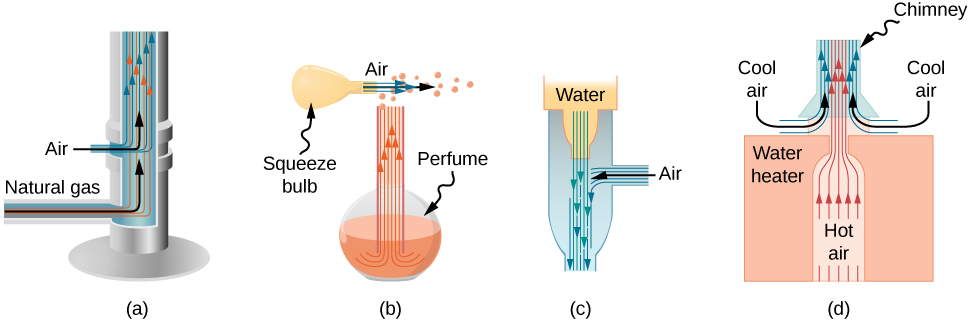
People have long put the Bernoulli principle to work by using reduced pressure in high-velocity fluids to move things about. With a higher pressure on the outside, the high-velocity fluid forces other fluids into the stream. This process is called entrainment. Entrainment devices have been in use since ancient times as pumps to raise water to small heights, as is necessary for draining swamps, fields, or other low-lying areas. Some other devices that use the concept of entrainment are shown in Figure 14.31.
英語のヒント
人々は昔から、高速の流体で圧力が下がることを利用して物を動かし、ベルヌーイの原理を役立ててきた。外側の圧力のほうが高いため、高速流体の流れには、ほかの流体が押し込まれる。この過程を巻き込みという。巻き込みを使う装置は古代から、沼地や田畑などの低地を排水する際に必要な、小さな高さまで水を上げるポンプとして使われてきた。図14.31に、巻き込みを利用するほかの装置を示す。
OpenStax / Rice University, University Physics Volume 1, CC BY 4.0. Source-book artwork retained. · CC BY 4.0 · Source出典

Figure 14.31図 14.31
Entrainment devices use increased fluid speed to create low pressures, which then entrain one fluid into another. (a) A Bunsen burner uses an adjustable gas nozzle, entraining air for proper combustion. (b) An atomizer uses a squeeze bulb to create a jet of air that entrains drops of perfume. Paint sprayers and carburetors use very similar techniques to move their respective liquids. (c) A common aspirator uses a high-speed stream of water to create a region of lower pressure. Aspirators may be used as suction pumps in dental and surgical situations or for draining a flooded basement or producing a reduced pressure in a vessel. (d) The chimney of a water heater is designed to entrain air into the pipe leading through the ceiling.
英語のヒント
巻き込み装置は、流速を増して低圧部を作り、一つの流体を別の流体へ引き込む。(a) ブンゼンバーナーは、調節できるガスノズルを使い、適切な燃焼のために空気を巻き込む。(b) 噴霧器はゴム球で空気噴流を作り、香水の液滴を巻き込む。塗料噴霧器やキャブレターも、よく似た方法でそれぞれの液体を動かす。(c) 一般的なアスピレーターは、高速の水流で低圧部を作る。歯科や外科の吸引ポンプ、浸水した地下室の排水、容器内の減圧などに使える。(d) 給湯器の煙突は、天井を通る管へ空気を巻き込むように設計されている。