第14章流体力学
Variation of atmospheric pressure with height高度による大気圧の変化
The change in atmospheric pressure with height is of particular interest. Assuming the temperature of air to be constant, and that the ideal gas law of thermodynamics describes the atmosphere to a good approximation, we can find the variation of atmospheric pressure with height, when the temperature is constant. (We discuss the ideal gas law in a later chapter, but we assume you have some familiarity with it from high school and chemistry.) Let p(y) be the atmospheric pressure at height y. The density at y, the temperature T in the Kelvin scale (K), and the mass m of a molecule of air are related to the absolute pressure by the ideal gas law, in the form
英語のヒント
高度による大気圧の変化は、特に興味深い。空気の温度が一定で、熱力学の理想気体の状態方程式が大気をよく近似すると仮定すれば、温度一定のもとで、高度による大気圧の変化を求められる。(理想気体の状態方程式は後の章で扱うが、高校の学習や化学である程度なじみがあるものとする。)高さyでの大気圧をp(y)とする。その高さの密度、ケルビン尺度(K)で表す温度T、空気分子1個の質量mは、理想気体の状態方程式によって、絶対圧力と次の形で関係する。
where is Boltzmann’s constant, which has a value of .
英語のヒント
ここではボルツマン定数で、その値はである。
You may have encountered the ideal gas law in the form , where n is the number of moles and R is the gas constant. Here, the same law has been written in a different form, using the density instead of volume V. Therefore, if pressure p changes with height, so does the density Using density from the ideal gas law, the rate of variation of pressure with height is given as
英語のヒント
理想気体の状態方程式には、という形で出会ったことがあるかもしれない。nはモル数、Rは気体定数である。ここでは同じ法則を、体積Vの代わりに密度を使った別の形で書いた。したがって、圧力pが高さとともに変われば、密度も変わる。理想気体の状態方程式から求めた密度を使うと、高さに対する圧力の変化率は次のようになる。
where constant quantities have been collected inside the parentheses. Replacing these constants with a single symbol the equation looks much simpler:
英語のヒント
ここでは定数を括弧内にまとめた。これらを一つの記号へ置き換えると、式はずっと簡単になる。
This gives the solution
英語のヒント
この方程式の解は、次のようになる。
Thus, atmospheric pressure drops exponentially with height, since the y-axis is pointed up from the ground and y has positive values in the atmosphere above sea level. The pressure drops by a factor of when the height is which gives us a physical interpretation for : The constant is a length scale that characterizes how pressure varies with height and is often referred to as the pressure scale height.
英語のヒント
このように、大気圧は高さとともに指数関数的に低下する。y軸は地面から上向きなので、海面より上の大気中でyは正となるためである。高さがになると、圧力は倍になる。このことから、の物理的な意味が分かる。定数は、圧力が高さとともにどう変わるかを特徴付ける長さの尺度であり、圧力スケールハイトと呼ばれることが多い。
We can obtain an approximate value of by using the mass of a nitrogen molecule as a proxy for an air molecule. At temperature or 300 K, we find
英語のヒント
空気分子の代わりに窒素分子の質量を使えば、の近似値を求められる。温度、すなわち300 Kでは、次のようになる。
Therefore, for every 8800 meters, the air pressure drops by a factor 1/e, or approximately one-third of its value. This gives us only a rough estimate of the actual situation, since we have assumed both a constant temperature and a constant g over such great distances from Earth, neither of which is correct in reality.
英語のヒント
したがって、8800 m上がるごとに、気圧は1/e倍、すなわち約3分の1になる。これは実際の状況の大まかな推定にすぎない。地球からこれほど離れても温度とgがともに一定だと仮定したが、実際にはどちらも正しくないためである。
Direction of pressure in a fluid流体中の圧力の方向
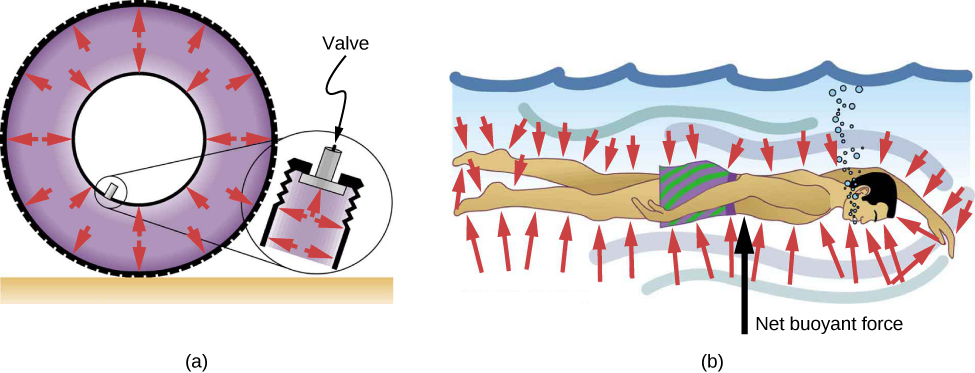
Fluid pressure has no direction, being a scalar quantity, whereas the forces due to pressure have well-defined directions: They are always exerted perpendicular to any surface. The reason is that fluids cannot withstand or exert shearing forces. Thus, in a static fluid enclosed in a tank, the force exerted on the walls of the tank is exerted perpendicular to the inside surface. Likewise, pressure is exerted perpendicular to the surfaces of any object within the fluid. Figure 14.10 illustrates the pressure exerted by air on the walls of a tire and by water on the body of a swimmer.
英語のヒント
流体の圧力はスカラー量なので方向を持たないが、圧力による力には明確な方向がある。力は、どの面に対しても常に垂直に加わる。流体はせん断力に耐えることも、それを及ぼすこともできないためである。したがって、タンクに閉じ込められた静止流体が壁へ加える力は、内面に垂直である。同様に、流体内にある物体の表面にも垂直に圧力が加わる。図14.10は、タイヤの壁に空気が加える圧力と、水泳者の体に水が加える圧力を示す。
OpenStax / Rice University, University Physics Volume 1, CC BY 4.0. Source-book artwork retained. · CC BY 4.0 · Source出典

Figure 14.10図 14.10
(a) Pressure inside this tire exerts forces perpendicular to all surfaces it contacts. The arrows represent directions and magnitudes of the forces exerted at various points. (b) Pressure is exerted perpendicular to all sides of this swimmer, since the water would flow into the space he occupies if he were not there. The arrows represent the directions and magnitudes of the forces exerted at various points on the swimmer. Note that the forces are larger underneath, due to greater depth, giving a net upward or buoyant force. The net vertical force on the swimmer is equal to the sum of the buoyant force and the weight of the swimmer.
英語のヒント
(a) タイヤ内部の圧力は、接するすべての面へ垂直に力を及ぼす。矢印は、各点に働く力の向きと大きさを表す。(b) 水泳者のすべての面へ垂直に圧力が加わる。水泳者がいなければ、その占めている空間へ水が流れ込むためである。矢印は、水泳者の各点に働く力の向きと大きさを示す。下側は深いので力が大きく、差し引きで上向きの力、すなわち浮力が生じることに注意しよう。水泳者に働く鉛直方向の合力は、浮力と重さの和に等しい。
Summaryまとめ
- A fluid is a state of matter that yields to sideways or shearing forces. Liquids and gases are both fluids. Fluid statics is the physics of stationary fluids.
英語のヒント
流体は、横向きの力やせん断力に応じて変形する物質の状態である。液体と気体は、ともに流体である。流体静力学は、静止した流体を扱う物理学である。 - Density is the mass per unit volume of a substance or object, defined as The SI unit of density is
英語のヒント
密度は、物質や物体の単位体積あたりの質量であり、と定義される。SI単位はである。 - Pressure is the force per unit perpendicular area over which the force is applied, The SI unit of pressure is the pascal: .
英語のヒント
圧力は、力に垂直な単位面積あたりに加わる力で、である。SI単位はパスカルで、となる。 - Pressure due to the weight of a liquid of constant density is given by , where p is the pressure, h is the depth of the liquid, is the density of the liquid, and g is the acceleration due to gravity.
英語のヒント
密度が一定の液体の重さによる圧力は、で与えられる。pは圧力、hは液体の深さ、は液体の密度、gは重力加速度である。