第14章流体力学
14.1 Fluids, Density, and Pressure14.1 流体、密度、圧力
Learning Objectives学習目標
Learning Objectives学習目標
By the end of this section, you will be able to:
英語のヒント
この節を終えると、次のことができるようになる。
- State the different phases of matter
英語のヒント
物質の異なる相を挙げる。 - Describe the characteristics of the phases of matter at the molecular or atomic level
英語のヒント
物質の各相の特徴を、分子や原子の段階で説明する。 - Distinguish between compressible and incompressible materials
英語のヒント
圧縮できる物質と圧縮できない物質を区別する。 - Define density and its related SI units
英語のヒント
密度と、そのSI単位を定義する。 - Compare and contrast the densities of various substances
英語のヒント
さまざまな物質の密度を比較し、共通点と相違点を説明する。 - Define pressure and its related SI units
英語のヒント
圧力と、そのSI単位を定義する。 - Explain the relationship between pressure and force
英語のヒント
圧力と力の関係を説明する。 - Calculate force given pressure and area
英語のヒント
圧力と面積から力を計算する。
Matter most commonly exists as a solid, liquid, or gas; these states are known as the three common phases of matter. We will look at each of these phases in detail in this section.
英語のヒント
物質は通常、固体、液体、気体のいずれかとして存在する。これらの状態は、物質の一般的な三つの相として知られる。この節では、それぞれの相を詳しく見ていく。
Characteristics of Solids固体の特徴
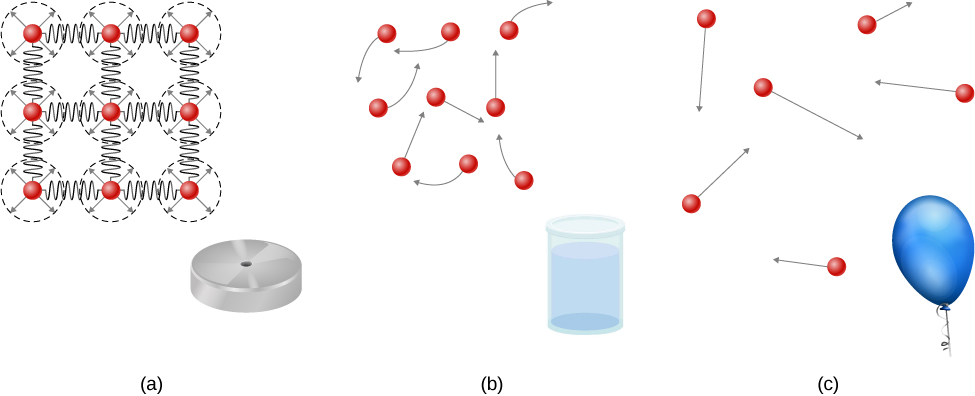
Solids are rigid and have specific shapes and definite volumes. The atoms or molecules in a solid are in close proximity to each other, and there is a significant force between these molecules. Solids will take a form determined by the nature of these forces between the molecules. Although true solids are not incompressible, it nevertheless requires a large force to change the shape of a solid. In some cases, the force between molecules can cause the molecules to organize into a lattice as shown in Figure 14.2. The structure of this three-dimensional lattice is represented as molecules connected by rigid bonds (modeled as stiff springs), which allow limited freedom for movement. Even a large force produces only small displacements in the atoms or molecules of the lattice, and the solid maintains its shape. Solids also resist shearing forces. (Shearing forces are forces applied tangentially to a surface, as described in Static Equilibrium and Elasticity.)
英語のヒント
Characteristics of Fluids流体の特徴
Liquids and gases are considered to be fluids because they yield to shearing forces, whereas solids resist them. Like solids, the molecules in a liquid are bonded to neighboring molecules, but possess many fewer of these bonds. The molecules in a liquid are not locked in place and can move with respect to each other. The distance between molecules is similar to the distances in a solid, and so liquids have definite volumes, but the shape of a liquid changes, depending on the shape of its container. Gases are not bonded to neighboring atoms and can have large separations between molecules. Gases have neither specific shapes nor definite volumes, since their molecules move to fill the container in which they are held (Figure 14.2).
英語のヒント
液体と気体はせん断力に応じて変形するため、流体とみなされる。固体はこの力に抵抗する。液体の分子は固体と同様に隣接する分子と結合しているが、結合の数はずっと少ない。液体の分子は位置に固定されず、互いに相対的に動ける。分子間の距離は固体と同程度なので、液体には一定の体積があるが、形は容器の形に応じて変わる。気体の原子は隣り合う原子と結合しておらず、分子間が大きく離れることもある。気体は一定の形も一定の体積も持たない。分子が動き、入れられた容器を満たすためである(図14.2)。
OpenStax / Rice University, University Physics Volume 1, CC BY 4.0. Source-book artwork retained. · CC BY 4.0 · Source出典

Figure 14.2図 14.2
(a) Atoms in a solid are always in close contact with neighboring atoms, held in place by forces represented here by springs. (b) Atoms in a liquid are also in close contact but can slide over one another. Forces between the atoms strongly resist attempts to compress the atoms. (c) Atoms in a gas move about freely and are separated by large distances. A gas must be held in a closed container to prevent it from expanding freely and escaping.
英語のヒント
(a) 固体の原子は、常に隣の原子と密接している。ここではばねで表した力によって、位置が保たれる。(b) 液体の原子も密接しているが、互いの間を滑って動ける。原子間の力は、原子を押し縮めようとすることに強く抵抗する。(c) 気体の原子は自由に動き回り、大きく離れている。気体が自由に膨張して逃げ出さないようにするには、密閉した容器に入れる必要がある。
Liquids deform easily when stressed and do not spring back to their original shape once a force is removed. This occurs because the atoms or molecules in a liquid are free to slide about and change neighbors. That is, liquids flow (so they are a type of fluid), with the molecules held together by mutual attraction. When a liquid is placed in a container with no lid, it remains in the container. Because the atoms are closely packed, liquids, like solids, resist compression; an extremely large force is necessary to change the volume of a liquid.
英語のヒント
液体は応力を受けると簡単に変形し、力を取り除いても元の形へ戻らない。液体の原子や分子は自由に滑って動き、隣り合う相手を変えられるためである。つまり、分子どうしは互いの引力でまとまっているが、液体は流れる。したがって液体は流体の一種である。ふたのない容器へ入れても、液体は容器内にとどまる。原子が密に詰まっているため、液体は固体と同じく圧縮に抵抗する。液体の体積を変えるには、極めて大きな力が必要になる。
In contrast, atoms in gases are separated by large distances, and the forces between atoms in a gas are therefore very weak, except when the atoms collide with one another. This makes gases relatively easy to compress and allows them to flow (which makes them fluids). When placed in an open container, gases, unlike liquids, will escape.
英語のヒント
対照的に、気体の原子は大きく離れているため、互いに衝突するときを除けば、原子間の力は非常に弱い。このため、気体は比較的簡単に圧縮でき、流れることもできるので、流体である。開いた容器に入れると、気体は液体と違って逃げ出す。
In this chapter, we generally refer to both gases and liquids simply as fluids, making a distinction between them only when they behave differently. There exists one other phase of matter, plasma, which exists at very high temperatures. At high temperatures, molecules may disassociate into atoms, and atoms disassociate into electrons (with negative charges) and protons (with positive charges), forming a plasma. Plasma will not be discussed in depth in this chapter because plasma has very different properties from the three other common phases of matter, discussed in this chapter, due to the strong electrical forces between the charges.
英語のヒント
この章では一般に、気体と液体をまとめて流体と呼び、振る舞いが異なる場合にだけ区別する。物質には、非常に高い温度で存在するプラズマという、もう一つの相もある。高温では、分子が原子へ分かれ、さらに原子が、負の電荷を持つ電子と正の電荷を持つ陽子へ分かれて、プラズマを形成することがある。プラズマでは電荷間に強い電気力が働くため、この章で扱う通常の三つの相とは性質が大きく異なる。そのため、この章では詳しく扱わない。