第14章流体力学
Mass Conservation質量保存
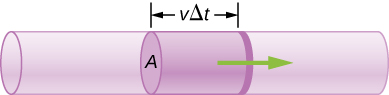
The rate of flow of a fluid can also be described by the mass flow rate or mass rate of flow. This is the rate at which a mass of the fluid moves past a point. Refer once again to Figure 14.26, but this time consider the mass in the shaded volume. The mass can be determined from the density and the volume:
英語のヒント
流体の流れの量は、質量流量でも表せる。これは、ある点を単位時間あたりに通過する流体の質量である。図14.26をもう一度見よう。ただし今度は、薄色の体積の中にある質量を考える。質量は、密度と体積から次のように求められる。
The mass flow rate is then
英語のヒント
したがって、質量流量は次のようになる。
where is the density, A is the cross-sectional area, and v is the magnitude of the velocity. The mass flow rate is an important quantity in fluid dynamics and can be used to solve many problems. Consider Figure 14.27. The pipe in the figure starts at the inlet with a cross sectional area of and constricts to an outlet with a smaller cross sectional area of . The mass of fluid entering the pipe has to be equal to the mass of fluid leaving the pipe. For this reason the velocity at the outlet is greater than the velocity of the inlet . Using the fact that the mass of fluid entering the pipe must be equal to the mass of fluid exiting the pipe, we can find a relationship between the velocity and the cross-sectional area by taking the rate of change of the mass in and the mass out:
英語のヒント
ここでは密度、Aは断面積、vは速度の大きさである。質量流量は流体動力学の重要な量で、多くの問題に利用できる。図14.27を考えよう。管は断面積の入口から始まり、より小さい断面積の出口へ向かって狭くなる。管へ入る流体の質量は、出る質量と等しくなければならない。このため、出口の速度は入口の速度より大きい。流入質量と流出質量が等しいことを使い、それぞれの時間変化率を取ると、速度と断面積の関係が得られる。
Equation 14.15 is also known as the continuity equation in general form. If the density of the fluid remains constant through the constriction—that is, the fluid is incompressible—then the density cancels from the continuity equation,
英語のヒント
この質量流量の関係は、一般形の連続の式とも呼ばれる。狭くなる部分を通っても流体の密度が一定、すなわち非圧縮性なら、連続の式から密度を消去できる。
The equation reduces to show that the volume flow rate into the pipe equals the volume flow rate out of the pipe.
英語のヒント
式は、管へ入る体積流量と、管から出る体積流量が等しいことを示す形になる。
OpenStax / Rice University, University Physics Volume 1, CC BY 4.0. Source-book artwork retained. · CC BY 4.0 · Source出典

Figure 14.28図 14.28
Geometry for deriving the equation of continuity. The amount of liquid entering the cross-sectional (shaded) area must equal the amount of liquid leaving the cross-sectional area if the liquid is incompressible.
英語のヒント
連続の式を導くための幾何学的な関係。液体が非圧縮性なら、薄色の断面へ入る液体の量は、断面から出る量と等しくなければならない。
Summaryまとめ
- Flow rate Q is defined as the volume V flowing past a point in time t, or where V is volume and t is time. The SI unit of flow rate is but other rates can be used, such as L/min.
英語のヒント
流量Qは、時間tの間にある点を通過する体積Vを使い、と定義される。Vは体積、tは時間である。SI単位はだが、L/minなどの単位も使える。 - Flow rate and velocity are related by where A is the cross-sectional area of the flow and v is its average velocity.
英語のヒント
流量と速度はで関係付けられる。Aは流れの断面積、vは平均速度である。 - The equation of continuity states that for an incompressible fluid, the mass flowing into a pipe must equal the mass flowing out of the pipe.
英語のヒント
連続の式は、非圧縮性流体について、管へ流入する質量が、流出する質量に等しくなければならないことを述べる。
Conceptual Questions概念に関する問題
Exercises 55練習問題 55
Exercise 55問題 55
Many figures in the text show streamlines. Explain why fluid velocity is greatest where streamlines are closest together. (Hint: Consider the relationship between fluid velocity and the cross-sectional area through which the fluid flows.)
英語のヒント
本文の多くの図には流線が描かれている。流線が最も密な場所で流体の速度が最大になる理由を説明せよ。(ヒント:流速と、流体が通る断面積の関係を考える。)
Solution解き方
Consider two different pipes connected to a single pipe of a smaller diameter, with fluid flowing from the two pipes into the smaller pipe. Since the fluid is forced through a smaller cross-sectional area, it must move faster as the flow lines become closer together. Likewise, if a pipe with a large radius feeds into a pipe with a small radius, the stream lines will become closer together and the fluid will move faster.
英語のヒント
二つの異なる管が、より小径の1本の管へつながり、流体が二つの管から細い管へ流れ込む場合を考えよう。流体は小さな断面積を通されるため、流線が密になると、より速く動かなければならない。同様に、半径の大きな管から小さな管へ流れ込むと、流線は密になり、流体は速くなる。
Problems問題
Exercises 56–63練習問題 56–63
Exercise 56問題 56
What is the average flow rate in of gasoline to the engine of a car traveling at 100 km/h if it averages 10.0 km/L?
英語のヒント
燃費10.0 km/Lの車が100 km/hで走るとき、エンジンへ流れるガソリンの平均流量は、の単位でいくらか。
Solution解き方
2.78
Exercise 57問題 57
The heart of a resting adult pumps blood at a rate of 5.00 L/min. (a) Convert this to . (b) What is this rate in ?
英語のヒント
安静時の成人の心臓は、5.00 L/minで血液を送り出す。(a) これをに換算せよ。(b) ではいくらか。
Exercise 58問題 58
The Huka Falls on the Waikato River is one of New Zealand’s most visited natural tourist attractions. On average, the river has a flow rate of about 300,000 L/s. At the gorge, the river narrows to 20-m wide and averages 20-m deep. (a) What is the average speed of the river in the gorge? (b) What is the average speed of the water in the river downstream of the falls when it widens to 60 m and its depth increases to an average of 40 m?
英語のヒント
ワイカト川のフカ滝は、ニュージーランドで特に多くの観光客が訪れる自然の名所である。川の平均流量は約300,000 L/sである。峡谷では川幅が20 mに狭まり、平均の深さは20 mとなる。(a) 峡谷内の平均流速はいくらか。(b) 滝の下流で幅60 m、平均の深さ40 mになると、平均流速はいくらか。
Solution解き方
a. 0.75 m/s; b. 0.13 m/s
(a) 0.75 m/s。(b) 0.13 m/s。
Exercise 59問題 59
(a) Estimate the time it would take to fill a private swimming pool with a capacity of 80,000 L using a garden hose delivering 60 L/min. (b) How long would it take if you could divert a moderate size river, flowing at into the pool?
英語のヒント
(a) 毎分60 L出る庭用ホースで、容量80,000 Lの家庭用プールを満たす時間を見積もれ。(b) で流れる中規模の川をプールへ引き込めるなら、どれだけかかるか。
Exercise 60問題 60
What is the fluid speed in a fire hose with a 9.00-cm diameter carrying 80.0 L of water per second? (b) What is the flow rate in cubic meters per second? (c) Would your answers be different if salt water replaced the fresh water in the fire hose?
英語のヒント
毎秒80.0 Lの水を運ぶ、直径9.00 cmの消火ホース内の速さはいくらか。(b) 流量は毎秒何立方メートルか。(c) ホース内の淡水を塩水に替えると、答えは変わるか。
Solution解き方
a. 12.6 m/s; b. ; c. No, the flow rate and the velocity are independent of the density of the fluid.
英語のヒント
(a) 12.6 m/s。(b) 。(c) 変わらない。流量と速度は、流体の密度に依存しない。
Exercise 61問題 61
Water is moving at a velocity of 2.00 m/s through a hose with an internal diameter of 1.60 cm. (a) What is the flow rate in liters per second? (b) The fluid velocity in this hose’s nozzle is 15.0 m/s. What is the nozzle’s inside diameter?
英語のヒント
内径1.60 cmのホースを、水が2.00 m/sで流れている。(a) 流量は毎秒何Lか。(b) ノズル内の流速が15.0 m/sなら、ノズルの内径はいくらか。
Exercise 62問題 62
Prove that the speed of an incompressible fluid through a constriction, such as in a Venturi tube, increases by a factor equal to the square of the factor by which the diameter decreases. (The converse applies for flow out of a constriction into a larger-diameter region.)
英語のヒント
ベンチュリ管などの狭い部分を通る非圧縮性流体の速さは、直径が縮小する倍率の2乗の倍率で増すことを証明せよ。(狭い部分から大径の部分へ流れる場合には、逆の関係が成り立つ。)
Solution解き方
If the fluid is incompressible, the flow rate through both sides will be equal:
英語のヒント
流体が非圧縮性なら、両側の流量は等しい。
or
、すなわち。
Exercise 63問題 63
Water emerges straight down from a faucet with a 1.80-cm diameter at a speed of 0.500 m/s. (Because of the construction of the faucet, there is no variation in speed across the stream.) (a) What is the flow rate in ? (b) What is the diameter of the stream 0.200 m below the faucet? Neglect any effects due to surface tension.
英語のヒント
直径1.80 cmの蛇口から、水が0.500 m/sで真下へ流れ出す。(蛇口の構造により、流れの断面内では速さに違いがない。)(a) 流量はでいくらか。(b) 蛇口から0.200 m下での水流の直径はいくらか。表面張力の効果は無視する。
flow rate
流量
abbreviated Q, it is the volume V that flows past a particular point during a time t, or
英語のヒント
記号Qで表す。時間tの間に、特定の点を通過する体積Vを用いて、で与えられる量。
ideal fluid
理想流体
fluid with negligible viscosity
英語のヒント
粘性を無視できる流体。
laminar flow
層流
type of fluid flow in which layers do not mix
英語のヒント
層どうしが混ざらない流れ。
turbulent flow
乱流
type of fluid flow in which layers mix together via eddies and swirls
英語のヒント
渦や渦巻きによって層どうしが混ざる流れ。
viscosity
粘性
measure of the internal friction in a fluid
英語のヒント
流体内部の摩擦の尺度。